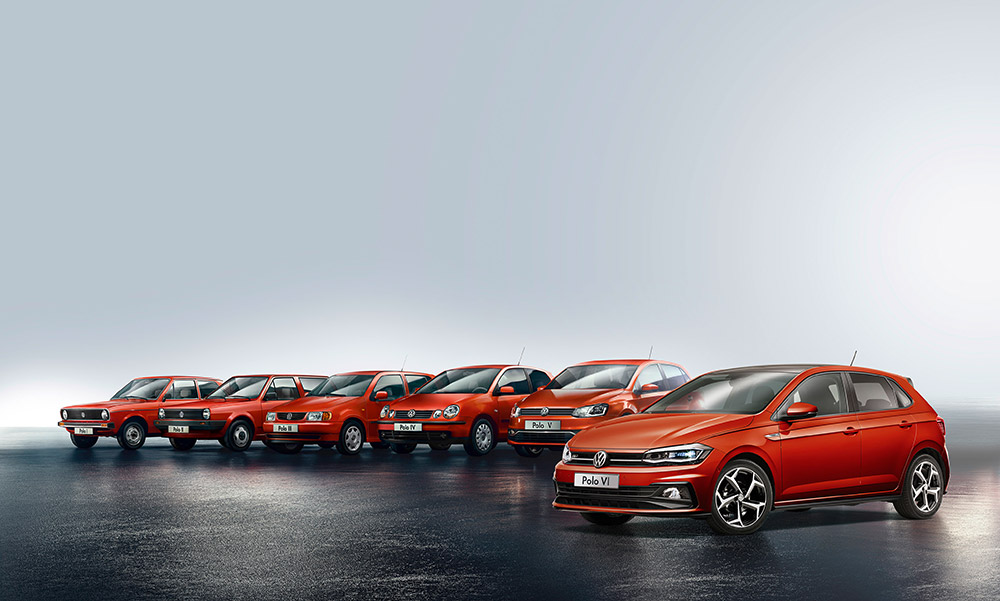
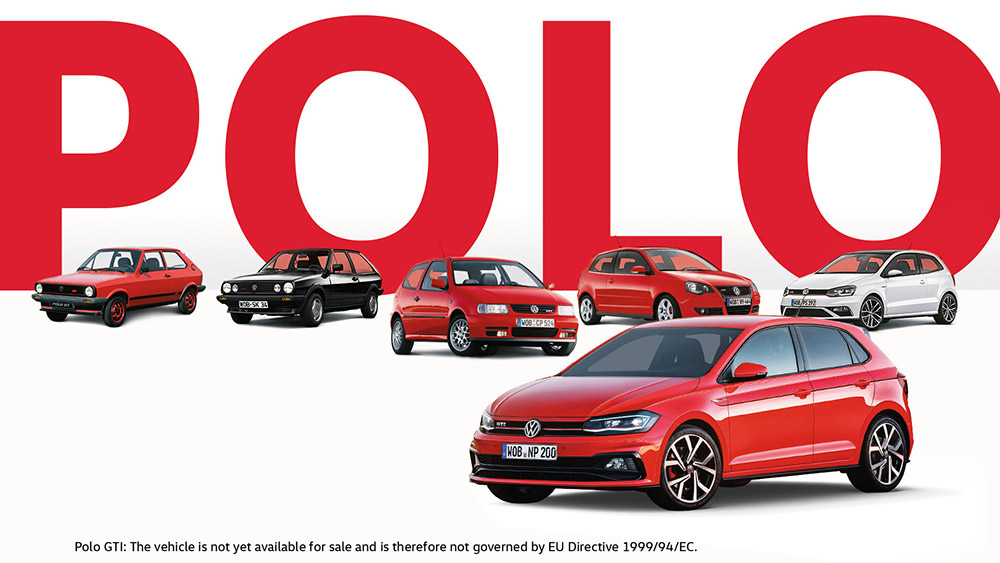
Since 1975, the Volkswagen Polo has delighted generations of people, and as a pioneer in its class, it has always stood for affordable mobility, timeless design, and pioneering technology. With more than 20 million units sold in six generations, the Polo has established itself as one of the most successful models in its class. Locally, the small hatch has gone from stand-in model to the mainstay of the company.
When the Beetle was due to be replaced in the 70s, Volkswagen had several models up its sleeve: the Passat came onto the market in 1973, followed a year later by the Golf, while the Polo debuted in March 1975 – exactly 50 years ago.
Positioned a class below the Golf, the Polo perfectly rounded off the then new front-wheel drive model family. Now, five decades later and in its sixth generation, the Polo has proven how a small car can assert itself confidently in a likeable way. More than 20 million units sold speak for themselves.
Perhaps the fact that the original small hatch, with a length of less than four metres, was initially an Audi (the Audi 50, introduced in 1974) contributed to its initial success. With Audi moving upmarket, Polo went into series production in Wolfsburg in slightly modified form,. Its clean design and high functionality,provided a breath of fresh air in the small car segment.
Efficient, practical and affordable, the lightweight vehicle caught the spirit of the times. It was characterised by agility, good handling characteristics, and economical engines, which are core virtues that have continued the success story ever since. Besides technical innovations and state-of-the-art technology, the Polo also stands for affordable mobility for everyone, with a fair price-performance ratio.
This philosophy inspired extensions to the range: the special edition Polo Jeans, following in the footsteps of the famous Beetle, appeared in 1976. The Derby notchback sedan arrived in 1977, the sporty Polo GT was launched in 1979, and the fuel-saving Polo Formel E in 1981.

A SMALL CAR MAKES THE BIG TIME
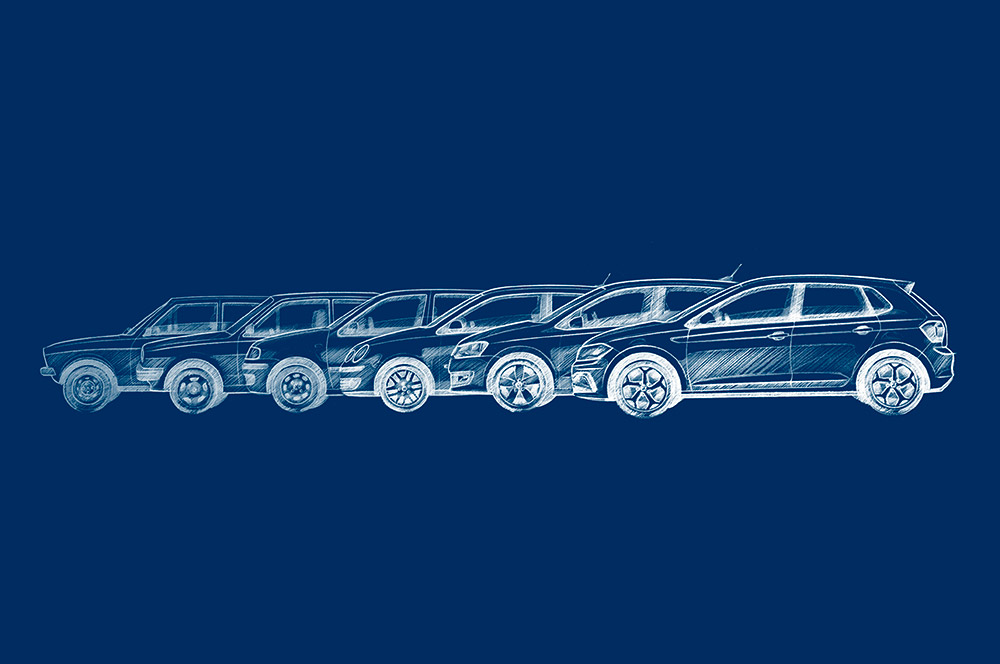
With each generation, the small Polo was developed further. The second-generation Polo brought a host of improvements, including more space and comfort as well as modernised engines. A fastback Coupé was added
to the range in 1982, the entry-level Fox followed in 1984, and in 1985 the Derby became the Polo notchback.
In 1983 the Polo Cup racing series was established in Germany, and in 1985 a special supercharged Polo G40 set a world speed record in a 24-hour record-breaking drive with an average speed of 208.13 km/h. This led to the launch of the limited-edition Polo Coupé GT G40 with scroll-type supercharger in 1987. In 1990, the Polo II received an extensive model update and in 1992 the special edition Polo Genesis was launched. This model generation was in production for 13 years.
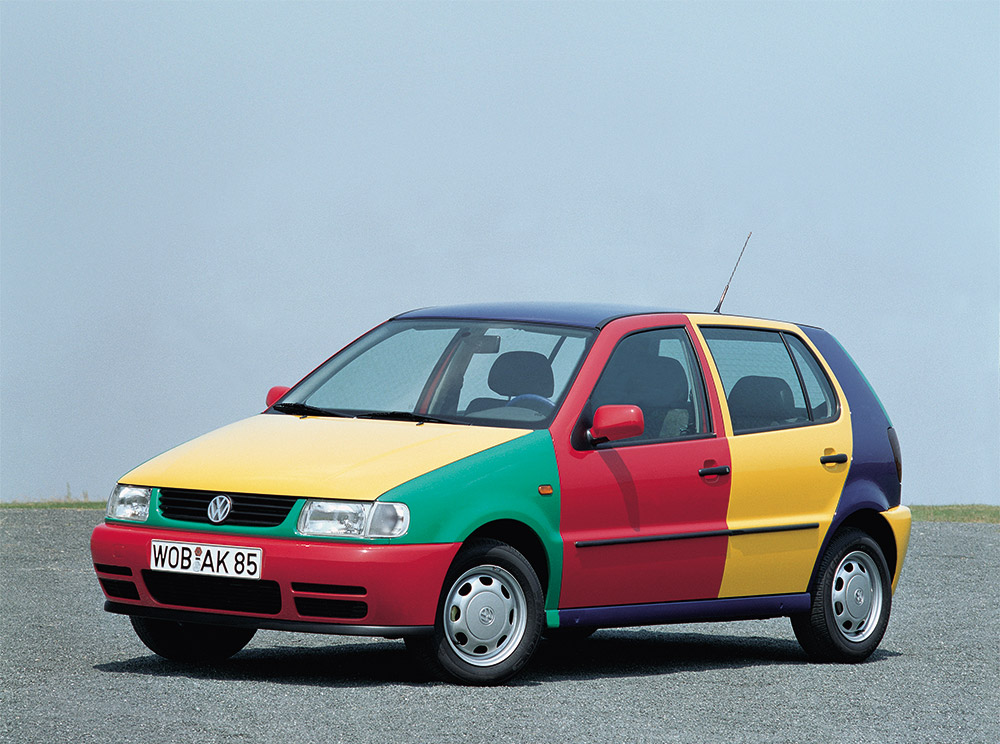
Another leap forward followed with the Polo III from 1994, also in terms of technology as it was one of the first vehicles in its class with safety features such as airbags. Besides the Open Air special edition and the Variant station-wagon in 1997, this generation Polo will be remembered for the multi-coloured Harlequin model, and in 1998, the Polo also became available as a GTI for the first time for the first time.
The fourth generation Polo saw a significant increase in size and offered a new level of comfort and safety from 2002, with front and side airbags, power steering and ABS as standard. This model range also spawned the CrossPolo, which was produced in 2007.
The Polo V saw the introduction of a host of digital innovations (infotainment and driving assistance systems) from 2009, and this Polo also impressed in motorsport. With the Polo R WRC, Volkswagen won the World Rally Championship title four times in a row from 2013, and it was also used for one-make track championships.
The sixth-generation Polo used modular transverse matrix (MQB) architecture and, in 2017, set new standards in terms of connectivity, safety, and driving dynamics. With the last product upgrade in 2021, the compact Polo became even more digital and innovative, with assistance and comfort systems previously seen only in higher vehicle classes.

SOUTH AFRICAN LEGACY
With the popularity of the Jetta and Golf in South Africa in the 1970s and 1980s, Volkswagen did not deem the introduction of the Polo necessary but instead opted to continue with the Golf Mk I, the venerable CitiGolf. However, with the CitiGolf reaching the end of its long lifecycle and Jetta sales starting to decline, Volkswagen needed a stand-in model to slot in under the Golf.
When Spanish company SEAT became wholly owned by the Volkswagen Group in 1990, it was decided that the first Polo introduced to South Africa would be the Polo Classic—essentially a SEAT Cordoba with some local tweaks—instead of the Euro-spec Polo III, as tooling up was less costly for the SEAT-based model.
Production in the Kariega (then Uitenhage) plant started in 1996. The Classic was followed in 1998 by the Polo Playa hatchback – a SEAT Ibiza based local creation with the front end of the Polo Classic paired with the body shell of the Ibiza. Volkswagen South Africa (VWSA) introduced the Polo Cup racing series in 1998 to promote this exclusively South African Polo range. This one-make series was for Polo Classic cars with 2.0-litre engines running on locally produced slick racing tyres. This series proved highly popular and is still in existence.
The first local Polo range soon established itself as a major contender in the market (although it still played second fiddle to the Golf). Besides spawning a race car, VWSA followed the example of the European mothership with the Polo III Harlekin by building a couple of Polo Classic Harlequins. Over a six-year lifespan, 95,385 examples of this generation were sold.
In 2002, VWSA started producing the fourth-generation European-spec Polo (the second locally), which was also the first model to be exported to overseas markets. This generation Polo was built in Kariega for eight years before the third local generation, and the fifth internationally, was introduced in 2010.
Even so, this generation enjoyed an extended life as the Polo Vivo, which effectively replaced the long-serving Citi Golf. It remained in production for sixteen years until 2018. With this model, VWSA enjoyed incredible motorsport success, as the marque won six National Rally championships in a row from 2005 to 2010 with the locally developed Polo S2000 rally car.
With Kariega now becoming the home base for Polo, the Polo V model range accelerated export numbers, and in total 692,469 units were built until 2018, when the current Polo was locally introduced. The Polo IV now served as base for the Polo Vivo, and this model spawned special editions such as the Eclipse, Street, Storm and Citi Vivo.
Since 2018, the latest Polo range has so far amassed a local production number of 556,957, including the two-millionth Polo built in Kariega in December 2022, with more than half (1,065,718 units at the time) exported to other countries. With the Polo Vivo now based on Polo V underpinnings, it was briefly offered as the Polo Vivo Maxx, a similar package to the discontinued Cross Polo. In 2019 it also spawned a locally developed concept car, the Polo Vivo Dune, as well as the Sound edition, the Xpress, Mswenko and Black Style package.

POLO VIVO EDITION 15
The 100,000th unit of the current Polo Vivo range was built in January 2022, and last year, the Global New Car Assessment Programme (Global NCAP) awarded it a four-star safety rating. This year, to commemorate the 15th anniversary of Polo Vivo production, Volkswagen will introduce the Edition 15, with only 1,500 units to be produced.
The Edition 15 is available in Deep Black Pearl and the new Crystal Ice Blue body colour, with an Edition 15 logo on the leading edge of the bonnet, machined and black painted 15″ Vivo wheels, interior step sill scuff plates with Edition 15 branding, side decals with Edition 15 branding and VW silhouettes, a rear window decal, gloss black roof, pillars and mirror caps.
While the future of the Polo remains uncertain, since development of a next-generation model can be unfeasible given upcoming pollution laws in Europe, Volkswagen South Africa is lobbying for a new small Polo-based SUV to be produced locally.
Even so, Polo has proven proven over 50 years that small can also be big. The highly adaptable model range has contributed to individual and affordable mobility over generations. Whether for first driving lessons, sporty driving pleasure, or as a family car, the Polo has created memories and will continue to be a versatile companion in the future.
Report by FERDI DE VOS | Images © VOLKSWAGEN AG/GROUP AFRICA