With the iconic Toyota Hilux commemorating its 55th anniversary in South Africa and the venerable, locally developed Ratel IFV turning 50, we embarked on a 1,400 km journey from Cape Town to the Eastern Free State in the Legend 55 to celebrate the legacy of these two local heroes.
The heritage of Hilux in South Africa stretches back to 1969, when the first bakkie was imported from Toyota Japan. Local Hilux production started in 1970, the same year a user requirement for the erstwhile South African Defence Force (SADF) was finalised to develop a new Infantry Fighting Vehicle (IFV) under Project “Pampoen” (Pumpkin), as it would later be known.
By 1972, the Hilux was the best-selling bakkie in the country, and in the same year, the company Springfield Büssing presented a 6×6 APC built by MAN as replacement for the old Saracen APC to the SADF for trials. It was named Buffel, and out of five contenders, this vehicle was found to be the most suitable as developmental platform for what would become the Ratel (honey badger).
The first prototype, the Ratel SS, was built from mild steel to enable quick modifications, and although it resembled the Buffel, it was a completely new design. The Ratel SS was tested during 1974, and in 1975, the first production Ratels – the first wheeled IFV in the world – were put through their paces.
With the Hilux then celebrating five years in the country, three as the top-selling bakkie, the first batch of 13 Ratels Mk1s was delivered to the SADF, and series production started. Much like the Hilux, the Ratel was significantly improved over the years, following extensive operational experience.
The Ratel Mk2, incorporating many functional modifications primarily to optimise the vehicle for Southern African conditions and to improve its reliability, was introduced in 1979. Earlier Mk1 vehicles were subsequently upgraded to Mk2 standard during refits.
By now, the Hilux was already in its third generation, with the iconic fourth generation, which included the first double-cab 4×4 models, introduced in 1984 – a year ahead of the final upgrade of the Ratel vehicle family. The Mk3 included over 135 modifications, including an improved cooling system, additional fuel filters, a digital acceleration meter, and more robust bush protection.

DIFFERENT VERSIONS
Over decades of popularity, the Hilux family has grown from a single cab derivative to a range of variants (extra cab, double cab, 4×2, 4×4, raised-body Raider). In much the same way, the Ratel’s battlefield success led to numerous derivatives.
In 1979, the base model Ratel 20 was supplemented by a 12.7 Command version and the Ratel 90, with an Eland 90 turret fitted to a strengthened Ratel 20 hull, was introduced in the same year. The Ratel 60 was conceived in 1980, and the Ratel 81, with an open turret fitted with an 81mm mortar tube, was delivered in 1985.
The need for an anti-tank missile capability led to the introduction of the Ratel ZT-3 in 1986, and another notable version was the Ratel EAOS (Enhanced Artillery Observation System) used for artillery support. Variants developed but not introduced include the eight-wheel Ratel Logistics vehicle (only two built) and the Ratel 120 (a 120 mm mortar platform, one prototype built).
LEGACY CELEBRATION
Somewhere in the late 1980s or early 1990s, Toyota South Africa produced a television commercial starring the fourth-generation Hilux (this range introduced the first diesel 4×4 pickup in South Africa) in an off-road encounter against a turretless Ratel IFV. Obviously, the Toyota won, depicting the toughness and durability of the Hilux range.
This inspired us to take the latest Hilux Legend 55 on a legacy trip from Cape Town to the Eastern Free State for the inaugural Maluti Military Fair at Sandstone Estates near Ficksburg, to meet its old “adversary” and celebrate 50 years of service in the Defence Force.
Available in extra-cab and double-cab guise, the Legend 55 is distinguished from its single-cab stablemates by exclusive insignia, a bush bar, lockable load-bay roll cover, and, on double-cab models, puddle lamps projecting the Legend 55 logo, a shark-fin antenna, a rubberised load bay, and a removable towbar.
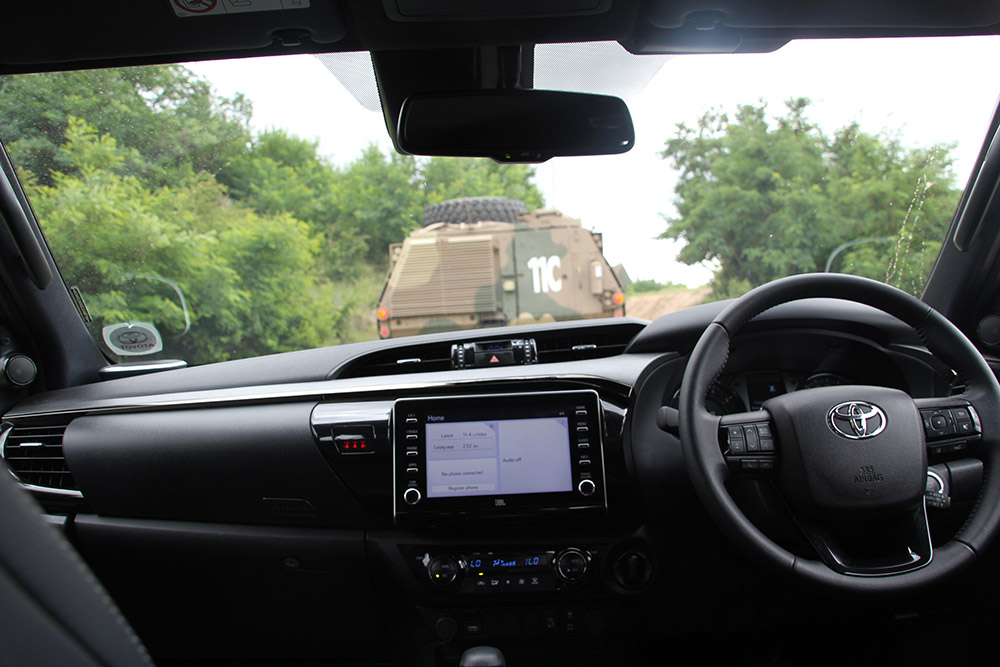
Inside, it is set apart by heavy-duty floormats, chrome scuff plates, sports seats with embraided Legend 55 insignia, an 8” touchscreen for the infotainment system with Apple CarPlay and Android Auto compatibility, as well as a nine-speaker JBL sound system.
The quality, trim and quietness of the Hilux’s interior again impressed on the long road from the Mother City to Colesberg, skirting Bethulie and Smithfield and snaking past Ladybrand. With 150 kW and 500 Nm available from its reliable turbodiesel mill and smooth shifts from the six-speed auto ’box (no manual is available), the Legend 55 swiftly devoured the kilometres.
On relatively good tar surfaces, the ride quality was adequate for a bakkie, and the torquey engine made passing slower traffic a breeze, while we maintained an average diesel consumption of between 9.8 and 10.2 l/100 km – a snip compared to the 50 l/100 km of a fully laden Ratel 20 on tar.
MALUTI MILITARY FAIR
Arriving at Sandstone Estates in the early evening, final preparations for the Maluti Military Fair were in full swing, with some fine examples of military hardware from the Sandstone Collection, including a Ratel 90 in yellow desert garb, manoeuvring out towards the display area.
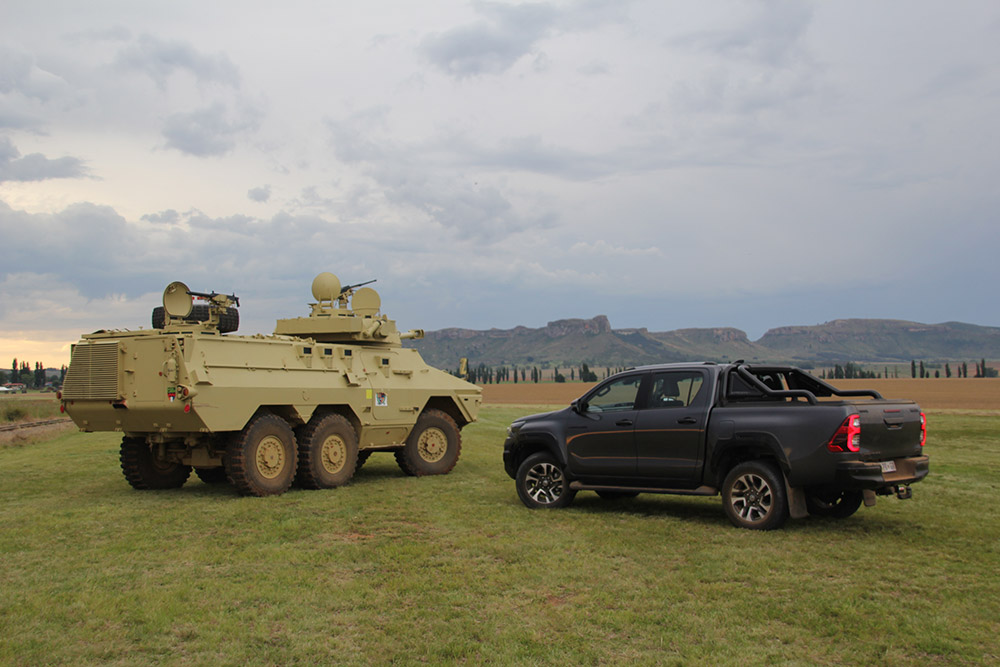
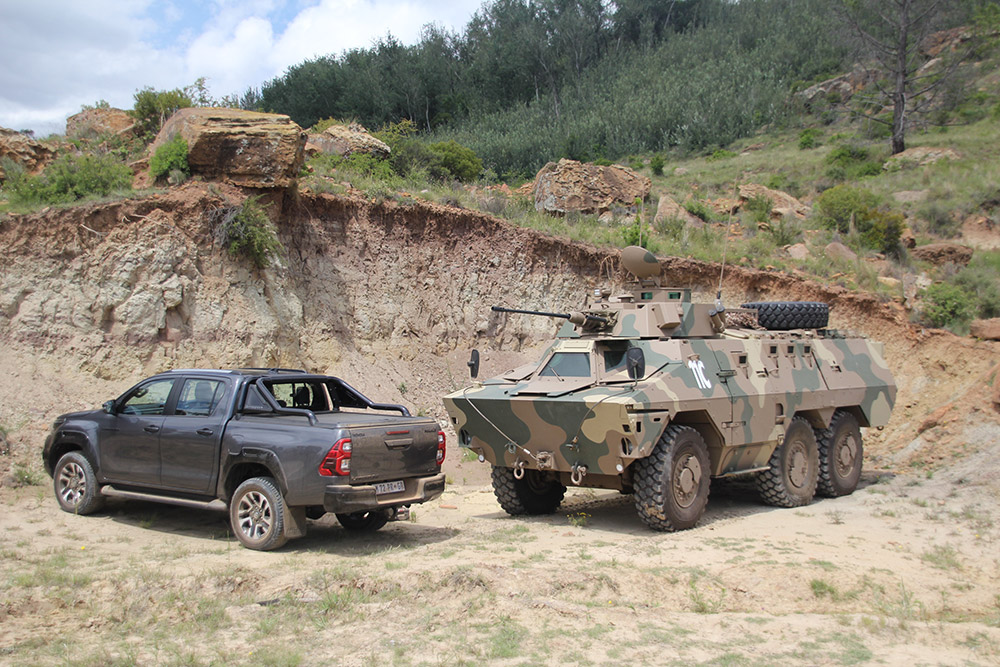
The next morning, we parked the Legend 55 next to the 18-tonne monster, the unmistakable drone of the Ratel’s 12-litre Bussing six-cylinder direct-injection turbocharged diesel engine (210 kW and over 900 Nm of torque) occasionally drowned out by old military training aircraft buzzing overhead.
The session ended with an impromptu “drag” race – the heavy Ratel gamely loped along, its turbo whining as the fully automatic transmission with torque converter shifted through the gears. Adjacent, on a smoother track, the Hilux idled along, never breaking a sweat and easily “winning” the contest (again).
Unbeknownst to us, though, the organisers had a surprise in store. But first some context…
Over the years, numerous projects to upgrade the Ratel included the Krokodil (Crocodile) IFV prototype, the so-called Ratel Mk4, and the iKlwa, all with mid-mounted engines and a rear access door.
Nothing came from them, but OTT Solutions is still forging ahead with its Ratel Service Life Extension Programme (SLEP) programme. Initiated in 2022, the Ratel SLEP has been offered to the SANDF and to foreign Ratel users (yes, Ratels have been exported to Ghana, Morocco, Rwanda, Cameroon, and Jordan).
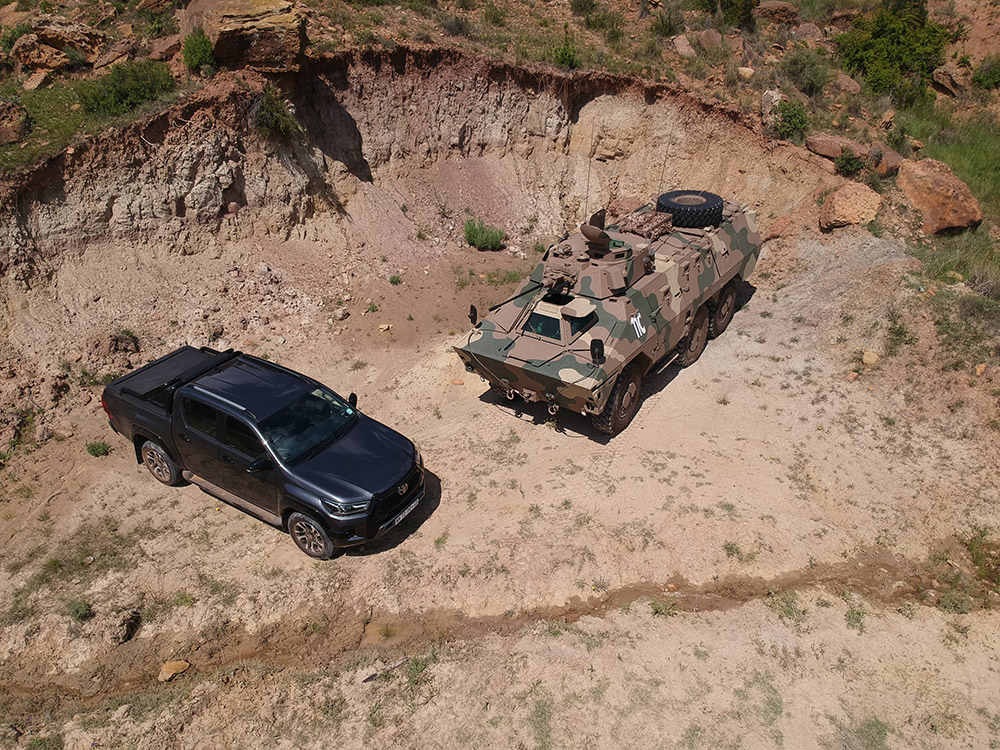
Like the Legend 55, the Ratel SLEP represents the “latest variant” in the Ratel legacy, and OTT Solutions made its demonstrator available to the show organisers, allowing us to feature the Hilux with this prototype, looking proper with its 20 mm turret and camouflaged metal jacket.
Improvements implemented in the Ratel SLEP include a new Cummins engine, weighing less than half (586 kg) of the original Büssing (1,230 kg) while developing 270 kW (compared to 210 kW). It also features a lighter, smaller Allison six-speed automatic transmission and a Katsa transfer case.
With the smaller, lighter drivetrain, extra armour was added, making the Ratel SLEP more resistant to small-arms fire. Performance is the same or better than the original Ratel (60% incline and 60 cm step capability, 110 km/h top speed). Additionally, the upgraded Ratel can utilise the latest sighting, navigation, and command-and-control systems.
Both the Hilux and the Ratel have attained legendary status during their respective timelines, and this reunion again highlighted the qualities that made them icons. Even at the end of its lifecycle (the new model is expected this year), the eighth-generation Hilux remains the country’s top-selling vehicle.
And given the current state of the SANDF, the Ratel (either in Mk3 guise or hopefully in upgraded SLEP format in future) will most likely be around for many more years as South Africa’s mechanised infantry stalwart. Honed and refined over decades, the two local legends live on.
*Our gratitude to Jandré du Plessis and Herman Labuschagne of G5 Events, Chris Gildenhuys of OTT Solutions, Sandstone Estates, and Toyota South Africa for making this feature possible.
Report by FERDI DE VOS | Images: © NATHANEAL SLABBERT (youtube.com/@HighPingHero)