



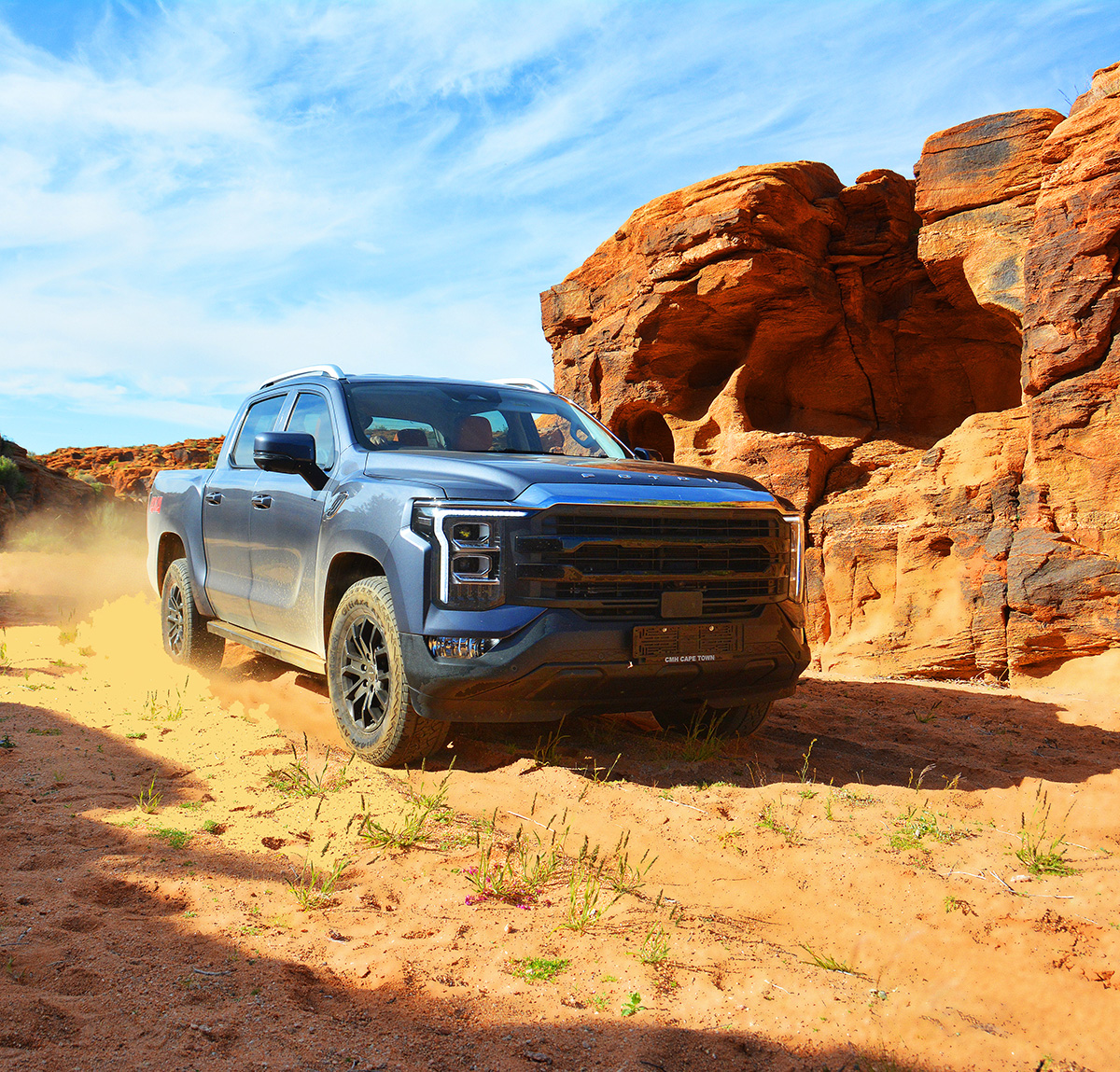
Focused on durability and tough work assignments, Foton’s Tunland V7 is well-suited to carrying heavy loads and taking on demanding terrain. Known as the Mars 7 in China, we took the huge double-cab bakkie into the harsh Northern Cape hinterland to a place colloquially known as “Mars”.
Having recently added the big and bold Tunland V-Series bakkies to its range, Foton – an affiliate of the BAIC Group – is the first Chinese manufacturer to assemble bakkies locally (its Tunland G7 range in the BAIC-plant in Gqeberha) as part of its Lighthouse Plan, which positions South Africa as a strategic manufacturing and growth hub for the African market.
Expanding its bakkie portfolio, the full-size V-Series range is built to suit a wide range of South African lifestyles, with the flagship Tunland V9 (which we featured recently) prioritising comfort and refinement, while the even bolder V7 with its leaf-sprung rear suspension and reinforced cargo box is more of a refined workhorse, ready for demanding daily use.
The V-Series is known as Mars in China, so we decided to take the big V7 double-cab bakkie on an extended road trip to the harsh Northern Cape hinterland near the Gariep River and the border with Namibia. The reason? Well, due to the stark, austere landscape, the area around Klein Pella – also home to the largest date farm in the Southern Hemisphere – is colloquially known as “Mars”.
Originally, our mission to Mars was planned for February, but as a Tunland V7 was not available at the time, we moved it to April. This had some unforeseen consequences, as the normally arid region received some uncommonly heavy rainfall during this period – turning the Martian landscape (as we were to discover) into an unfamiliar kaleidoscope of green.
HYBRID POWER, HYBRID LANDSCAPE
Described as a full-size pickup truck, the V7 is now the biggest pickup available in the highly contested one-ton double-cab bakkie market. Bigger than the BYD Shark, the sizeable LDV Terron (standing 5,500 mm long, 1,997 mm wide, 1,874 mm high, with a 3,300 mm wheelbase), and the newly arrived JMC Vigus (5,335 mm long, 1,882 mm wide and 1,834 mm high).
The Tunland 7 dwarfs the Ford Ranger, Toyota Hilux and Isuzu D-Max, and its grille is even bigger and more prominent than that of the V9. Its conspicuous front with double-deck headlights and inverted L-shaped driving lights is a primary focal point of the V7, and at a glance, it can easily be mistaken for an American-built Ford F-150 or GMC Sierra.
Having left Cape Town on our way to Pofadder via the N7, we were inundated at every stop by people admiring the V7’s looks, commenting on its size, its in-your-face design, the cabin’s roominess, and the attractiveness of the interior, and requesting more information about the vehicle.
Big it is, with lots of interior space that easily accommodates five adults. Although not as thoroughly equipped as the V9, the V7 has a 14.6” infotainment touchscreen, a customisable digital instrument screen, synthetic leather steering wheel with controls, dual-zone climate control, wireless charging, and ample storage spaces – including a handy cooled centre bin.
Our test unit featured an eye-catching beige interior, comfortable synthetic leather seats with electric adjustment, a wide range of ambient lighting colours, but no sunroof. Although perhaps too audacious for some, the interior colour blended in nicely with the Martian theme.
Powered by Foton’s 2.0-litre AUCAN Mild Hybrid turbodiesel engine, co-developed with Cummins, coupled with a 48V belt-integrated starter generator, the V7’s peak output is 120 kW at 2,600 r/min and 450 Nm of torque from 1,500 rpm to 2,600 rpm.
Having experienced the V9 before, we knew that despite its somewhat modest power figures and 2.2-tonne bulk, the Tunland was not underpowered. Mated to a smooth eight-speed ZF auto transmission (with low-range 4×4 transfer case), the engine ticked over nicely at highway speed. However, it required gentle throttle inputs to keep it from hunting through the gears on any modest incline.
The laidback character of the engine, with its typical soft Cummins clatter, means the V7 is no speed machine. Still, the 48V system gave the bulky V7 a nice shove from the get-go, giving it respectable acceleration (zero to 100 km/h in under 12 seconds), although one does need to plan overtaking manoeuvres timeously.
By now, we were close to Springbok, having traversed the Knersvlakte and the Namakwaland towns of Nuwerus, Garies and Kamieskroon. Never have I seen this region so green and colourful before, and if it weren’t for the lack of larger trees, one would have thought you were driving through the Bushveld in summer.
DATE FORESTS AND OFF-ROAD PROWESS
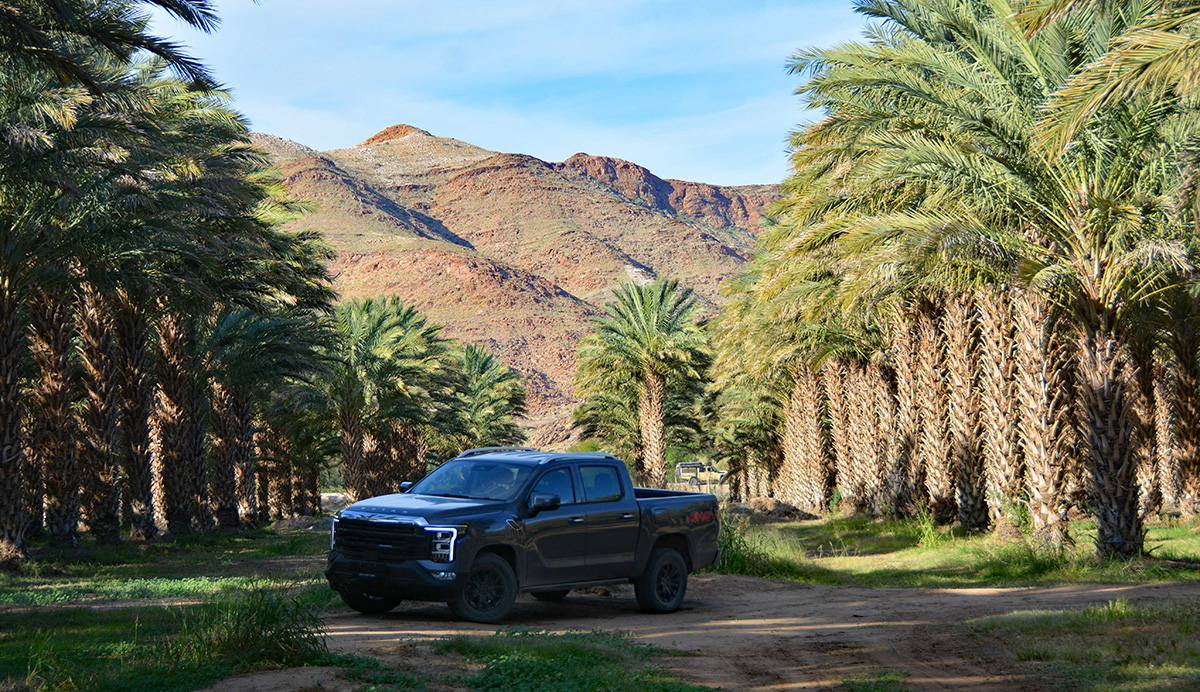
From Springbok, we headed for Pofadder and shod with 19″ all-terrain tyres, the ride quality of the V7 on the long, straight tar road past Aggeneys was slightly harder than that of the V9 but still comfortable enough. We turned off onto the gravel road towards Klein Pella and soon enough traversed the multiple date forests, with 14,000 trees covering 100 ha of the huge 18,000-ha farm.
However, the normally harsh brown environment was green beyond description, with bluegrass waving on the usually dusty plains and shrubs covering the typically bare red outcrops… So much for our pictures depicting a Martian landscape.
Even so, research suggests Mars has plenty of water, it’s just locked away as vast ice sheets at the polar caps, trapped inside rocks and soil, or located in deep underground liquid reservoirs. We stayed over in Pofadder and the next day tackled the Namaqua 4×4 off-road track winding past the town of Pella, close to the Gariep River, to look for a final Mars-type location.
The trail was littered with loose rocks and gravel from all the rain, but with four-wheel drive engaged, the Tunland V7 made short work of any hindrance, the diesel mill ticking over unperturbed as it propelled the big vehicle through ruts and over boulders. Due to its size, one had to be careful navigating the tight, tricky twists in the riverbed, but overall, the Foton left us highly impressed with its cross-country prowess.

LAST WORD
The scenery around us was just as imposing, and the spot we had in mind for our final images – normally covered in red sand and surrounded by black volcanic ridges – was now blanketed in tall, waving grass, with green shrubs dotting the kopjes.
Ah, well, it still was beautiful, and our mission was still successful in proving the capabilities of the biggest bakkie now available locally. The only drawback? Its size means it doesn’t easily fit into a normal garage or small parking spaces, and it has a large turning circle (13.5 m), making it less agile in confined spaces.
Even so, over the full distance of 1,500 km, the big V7’s average diesel consumption was an acceptable 10.8 litres/100 km. The Tunland, with a five-star C-NCAP safety rating, impressed us with its comfort and willingness on and off the road…and its price of R765,900 (in 4×4 VLX trim) is highly competitive in an oversubscribed market segment.
Report by FERDI DE VOS | Images © JIM FREEMAN

