CHEQUERED CHERY TRANSFORMED
Chery Q
From stirring up controversy in an intellectual property dispute with General Motors, being described as the cheapest production car in the world and a “legend in the history of the Chinese automobile”, to having the dubious honour of scoring a zero-star safety rating in South Africa, the Chery QQ, or QQ3 as later known. has a long and interesting history.
First introduced in 2003, the original QQ (an imitation of the Daewoo Matiz and Chevrolet Spark) was introduced in South Africa five years later but was discontinued in 2017 after the local version of the QQ3 (with no airbags and no ABS) received zero stars for adult occupants and zero stars for infants from Global NCAP 1.0.
Now in its third generation, the QQ3 (as it is still badged in China) has been completely transformed from a small city car to a subcompact all-electric hatchback, and its ongoing popularity on home soil was proven when the newcomer accumulated 56,879 orders within two hours (including pre-orders) after its Chinese domestic launch earlier this year.
Known as the Q in export markets, the new Chery is now available in South Africa, with prices ranging from R350,000 to R400,000, and we got a sneak preview of Wuhu’s latest model range – aimed squarely at the Geely E2 and the BYD Dolphin Surf – before its official launch later this month.
According to Chery, the Q, built on Chery’s dedicated T12 EV platform, was developed to make electric mobility accessible and a realistic option for a broader range of car buyers by combining compact dimensions with a spacious cabin, useful storage capacity, and a claimed driving range suited to everyday commuting.
RED DOT-RECOGNISED DESIGN
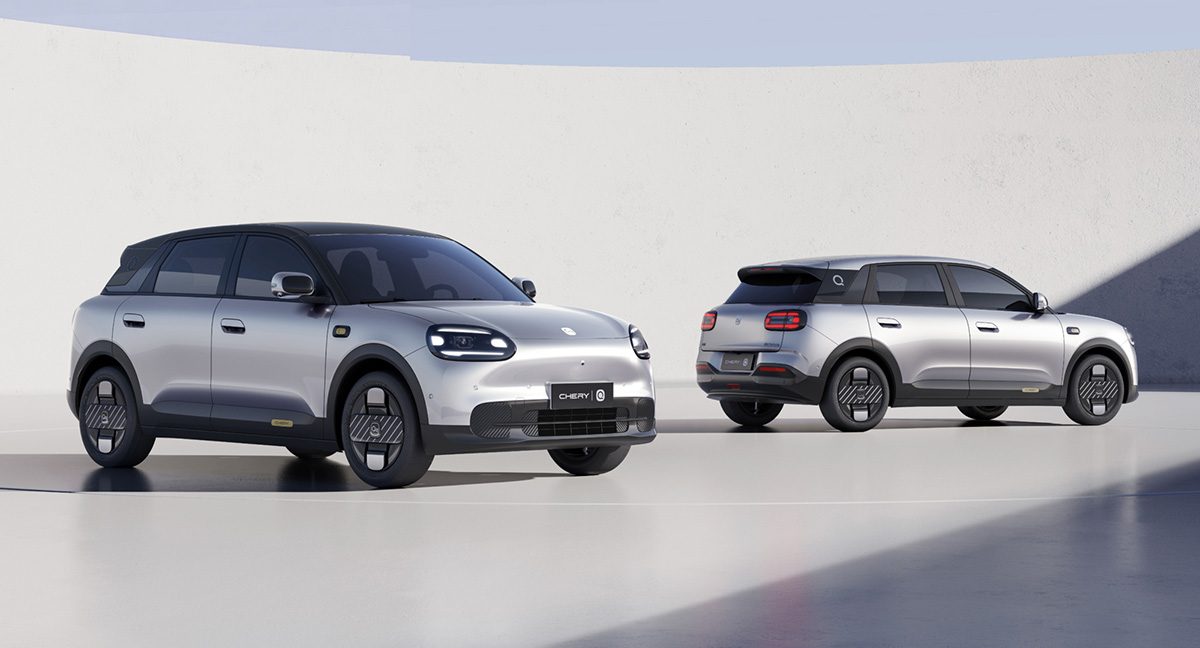
In stark contrast to the copied lines of its predecessors, the new Q’s exterior design combines squared-off proportions with softer, rounded details, borrowing traits from competitors like GWM’s Ora 5 and the Geely E2. However, it is less angular than the smaller BYD Dolphin Surf.
Chery calls this approach “Square-Round Harmony” to give the vehicle a distinctive but approachable look, and the design earned international recognition with a Red Dot Product Design Award for Chery’s focus on creating a visually distinctive compact EV without relying on excessive detailing.
Its four-wheels-at-the-corners layout and short front and rear overhangs give the Q a planted stance, and at the front, Q-shaped LED headlights provide the most recognisable design feature. Each square headlight chamber incorporates a curved lighting element to give the vehicle a friendly expression, while the closed-off grille reflects the Q’s electric powertrain. Semi-flush door handles, two-tone exterior mirrors and a floating C-pillar add detail to the Q’s profile.
Measuring 4,195 mm long, 1,811 mm wide and 1,570 mm high, the Chery Q is marginally bigger than the Geely E2, and its 2,700 mm wheelbase allows for a comparatively spacious cabin with a boot capacity of 375 litres that can be expanded to 1,450 litres. A 70-litre frunk provides extra storage, and several smaller compartments are spread throughout the cabin.
TWO DERIVATIVES, ONE POWERTRAIN
Two derivatives will be available initially: the entry-level Comfort with 16″ wheels and the Elite riding on 17″ wheels with a distinctive design. Inside, both derivatives have a dual-tone dashboard, contrast-colour air vents and a flat-bottom steering wheel.
A column-mounted gear selector removes the need for a conventional shifter on the centre console, freeing up storage space below. In the Elite (the model we drove during our preview), an 8.8″ digital instrument display is paired with a 15.6″ 2.5K central touchscreen, powered by a Qualcomm Snapdragon 8155 processor that supports a customisable home screen and gesture controls.
Interestingly, the Q is rear-wheel driven, with a single rear-mounted motor producing 90 kW and 115 Nm of torque, paired with a 42.7 kWh lithium-ion phosphate battery for a claimed range of around 400 km (NEDC cycle) – although it will most likely be closer to 300 km in real-world conditions. And with DC fast charging, the battery can be charged to 80% in around 15 minutes.
On our short drive, the linear power delivery felt more than adequate in a quiet, unobtrusive way…easily keeping up with traffic (and scooting away from it at traffic lights), making it ideal for city driving. However, the Q’s roomy cabin, with more than ample space for passengers and luggage, is the real clincher, together with its compact footprint and tight turning circle.
The big windscreen with a 16.8-degree upper field of vision improves outward visibility, and in the Elite derivative, intelligent driver-assistance and automatic parking systems help with congestion and parking in tight spaces. Chery has also introduced a pre-order package for the Q that includes a seven-year/150,000 km vehicle warranty, a home-charging wallbox and portable charging equipment.
Customers can also choose between a charging card of equivalent value to their holding deposit, or a deduction from the vehicle’s purchase price, and a complimentary electric tailgate upgrade forms part of the offer. Further information on the range, specifications and final pricing will be announced at launch this month.

VW’S HALF-TONNER REVEALED
Volkswagen Tukan
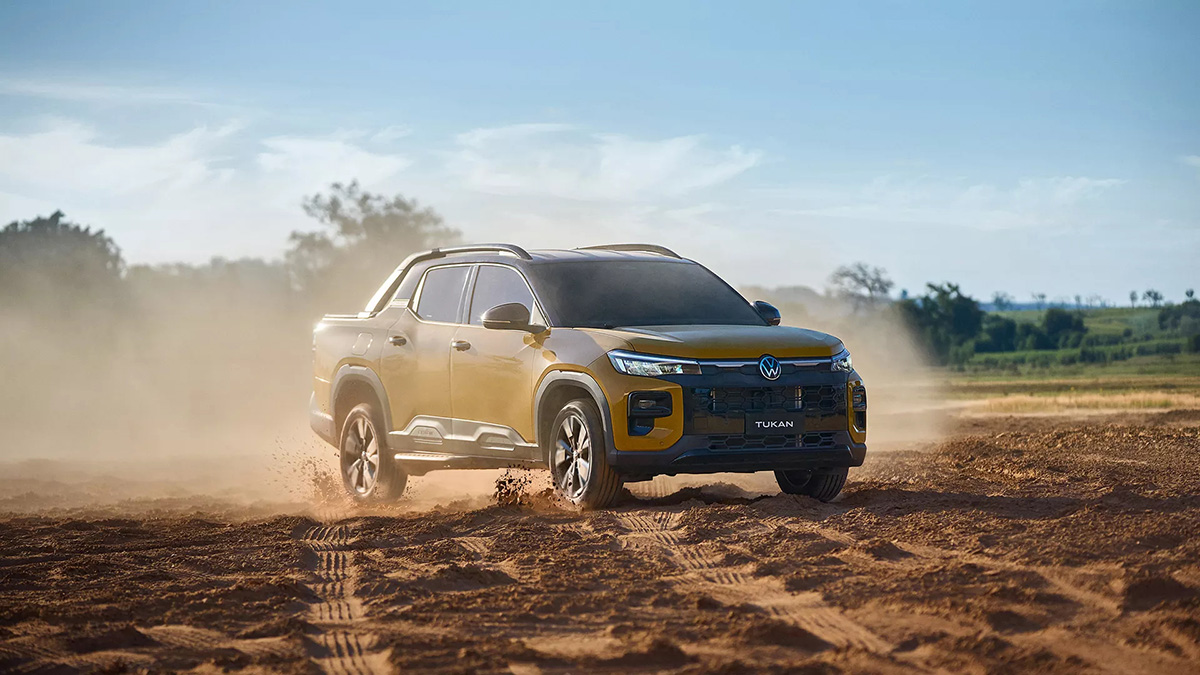
The Volkswagen Tukan, long-awaited replacement for the ageing Saveiro half-ton bakkie, has now been revealed – a full eight years after the Tarok Concept pickup was shown at the São Paulo Motor Show in 2018 – and it is very likely that this small bakkie, displayed in double cab and single cab form, will make its way to South Africa.
Expected to only enter production next year at the São José dos Pinhais plant in Brazil, the flagship Extreme double cab variant and the base workhorse-oriented Robust derivative were exhibited in São Paolo late last month. Both derivatives incorporate styling reminiscent of the Tera that will be assembled in South Africa and go on sale as the Tengo from next year.
The Tukan will most likely be based on the MOB A0 platform that also underpins the locally built Volkswagen Polo and the imported Taigo, as well as the forthcoming Tengo. However, it may ride on a leaf-sprung suspension, though this has not been confirmed.
Like the Saveiro, the new Tukan will rival the best-selling Fiat Strada, the Fiat Toro, Ram Rampage, Ford Maverick, Chevrolet Montana (locally known as the Chevrolet Corsa) and the upcoming Renault Niagara in the Brazilian market but will have no direct competition if introduced here.
Although no details of the interior or powertrain were supplied, the Tukan is expected to be powered by a normally aspirated 1.6-litre petrol engine from the Saveiro, a flex-fuel version of the 1.0 TSI engine used in the Tera, and a 1.5 eTSI engine with a 48-volt mild-hybrid system. However, being based on the same platform as the Polo, many other powertrain options are also available.
With the Polo and Polo Vivo assembled in Kariega, and local production of the Tengo imminent, adding a bakkie version as a third locally assembled variant makes sense, and the viability of such an undertaking is currently under investigation.