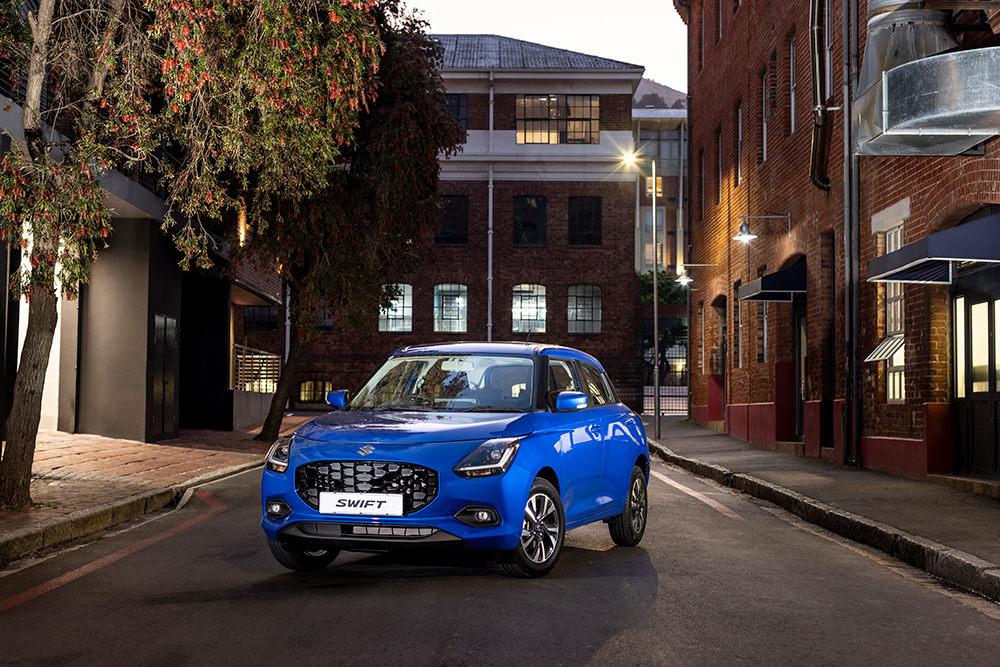
Since its launch in September last year, the new fourth-generation Suzuki Swift’s rapid ascension up the South African vehicle sales charts have culminated in the compact hatch reaching the top spot in January this year, knocking off the venerable Toyota Hilux and Volkswagen Polo Vivo from their traditional top perches.
Following chart-ascending performances in November and December last year, an incredible 2,628 Swift units were sold in January, making the Indian-sourced hatch the country’s highest-ranked imported vehicle. The Swift achieved this once before, in April 2022 when 1,621 units were sold, but this was when Toyota production was curtailed due to flooding in their plant.
So, what attributes of the latest Japanese and Indian developed range contributed to this (swift) ascendancy? Well, the new model builds on the strengths of its predecessors with evolutionary exterior styling, a revamped interior, advanced digitisation, upgraded safety features, and a new and even more frugal engine.
Celebrating its 40th anniversary, over nine million Swift units have been sold globally since 2005, and following its introduction in 2008, with the second-generation derivative launched in 2011, quickly became Suzuki’s best-selling model locally.
The hatchback’s energetic exterior styling has contributed to its overall appeal (in my view, the first-generation Swift is still the best-looking). Thus, the Suzuki designers kept the recognisable shape of Gen 2 and 3 Swift models for Gen 4, so much so that you need to look closely to pick up the differences.
EVOLUTIONARY STYLING
Key revisions include restyled headlight clusters with L-shaped headlamps, a slightly different oval radiator grille with a piano black finish and a new bumper design with a more pronounced lower intake. The Swift now has a clamshell bonnet and retains the blacked-out pillars, but the hidden rear door handles of the outgoing model have been superseded by conventional units (which are most likely to save cost).
Available locally in GL, GL +, and GLX guise, we recently test-drove both the GLX CVT and the GL+ five-speed manual models. In addition to the difference in transmission, the flagship GLX is distinguished from its mid-tier sibling by auto LED projector headlamps with a guide-me-home function, L-shaped LED daytime running lights, LED front fog lamps, folding side mirrors, and 15” diamond-cut wheels.
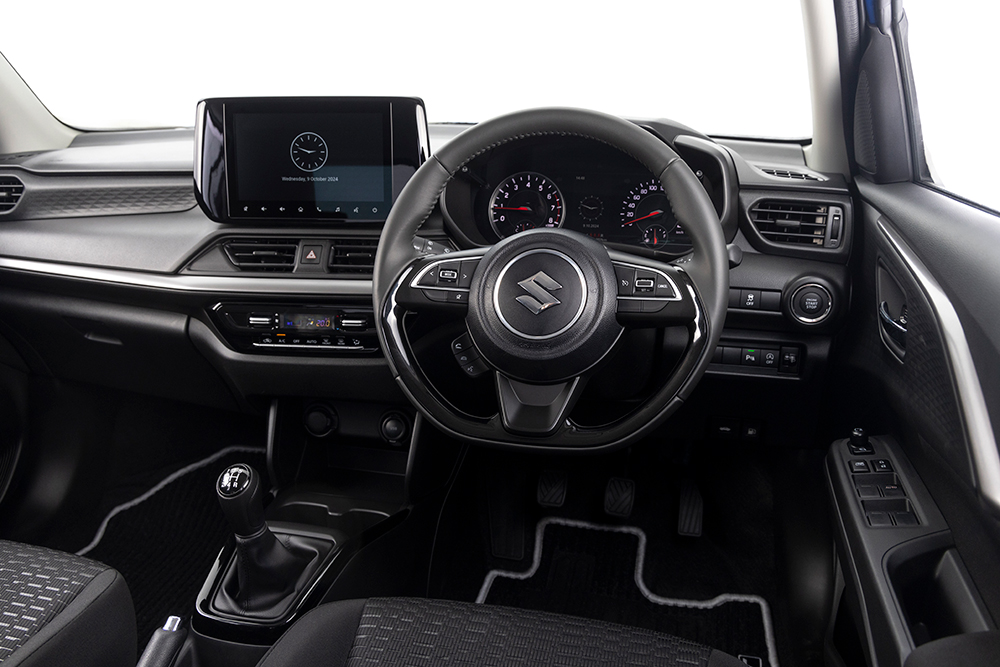
Other extras include a 9” touchscreen for the infotainment system, keyless entry with push-button start, cruise control, automatic climate control, a leather multifunction steering wheel with paddle shifters and a pair of front tweeters for the audio system.
Conversely, the GL+ comes with 15” alloy wheels, a 7” touchscreen infotainment system with four speakers compatible with Apple CarPlay and Android Auto, and a multifunction steering wheel. Standard safety systems on both grades include six airbags, ABS with EBD, Brake Assist, ESPro and rear Isofix anchors. However, boot space (265 litres) is limited but can be expanded to 580 litres.
Another important attribute of the latest Swift is its new Z12E 1.2-litre three-cylinder petrol engine. Delivering 60 kW at 5,700 rpm and 112 Nm at 4,300 rpm, it does not surpass the outgoing K12M four-cylinder engine (61 kW/112 Nm) in terms of power and torque, yet it is lighter and more compact.
NOT SO SWIFT(LY)
Despite the lighter powerplant, the new Swift is 25 kg heavier than its predecessor. Although the new mill feels perky and delivers a sporty thrum when pushed, it is down on performance compared to the four-cylinder. Suzuki may claim a 10% improvement in zero to 100 km/h performance, but the newcomer is much slower getting out of the starting blocks.
Yes, the three-cylinder packs slightly more mid-range punch, which improves its overall driveability. Even so, the new Swift manual takes a leisurely 13.7 seconds to reach 100 km/h from a standstill, nearly a second longer than its predecessor. The GLX CVT is even slower.
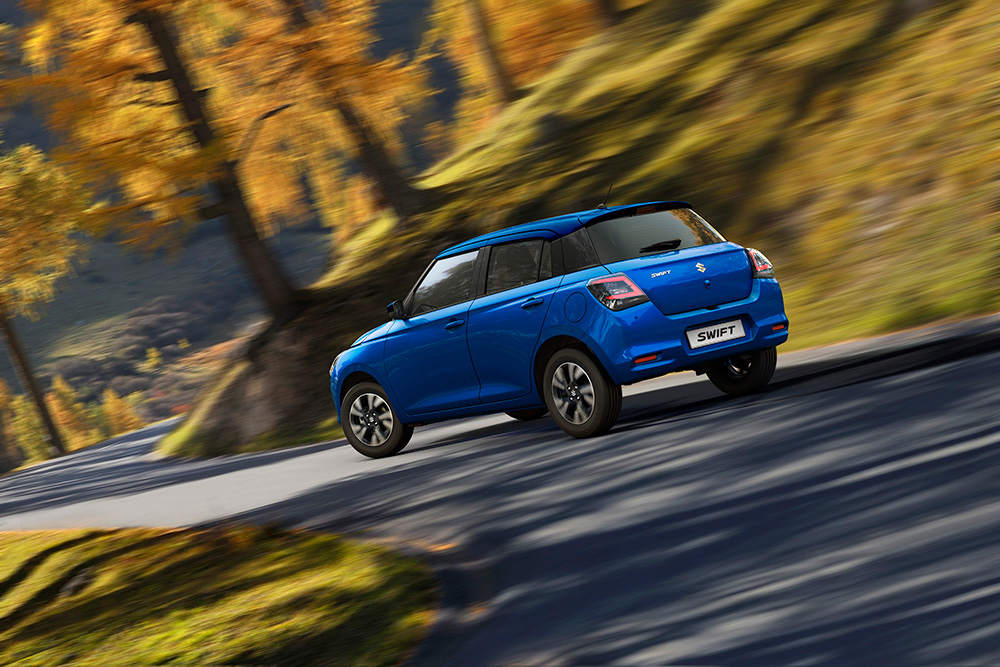
Compared to the older model, the newcomer does feel less sprightly, but thanks to the latest Heartect platform, which is both light and extremely rigid, the Swift has not lost any of its dynamic verve or feel-good driving pleasure. This is bolstered by a recalibrated suspension setup with optimised geometry.
Suzuki also says the smaller, multipoint fuel-injected mill is efficient, returning a combined fuel consumption figure that is 11% higher than its predecessor. During our test period, the manual Swift model returned a figure of 5.1 l/100 km, while the CVT model was slightly less thrifty.
LAST WORD
The latest Suzuki Swift may not be as, well, swift as before, yet it retains all the qualities that has assured the popularity of its best-selling predecessors and improve on some of these traits with advanced digitisation and upgraded safety features…and three dual-tone paint options, recently introduced, further adds to its allure.
Testament to its ongoing popularity are accolades such as the coveted 2025 Automotive Researchers’ and Journalists’ Conference of Japan (RJC) Car of the Year award, being picked as a Top 10 finalist in the 2025 World Car of the Year, a Top Five finalist in the 2025 World Urban Car (vehicles no longer than 4.25 metres) presented by the World Car Awards, and a finalist in the 2025 Old Mutual Insure South African Car of the Year (COTY) competition.
Add to this its competitive pricing, which includes a two-year/30,000 km service plan and five-year/200,000 km promotional warranty, and there is no reason why the new, fourth-generation Swift won’t continue its ascendancy on the local sales chart and, in the future, may entrench itself in the number one position.
Report by FERDI DE VOS | Images SUZUKI AUTO SOUTH AFRICA