



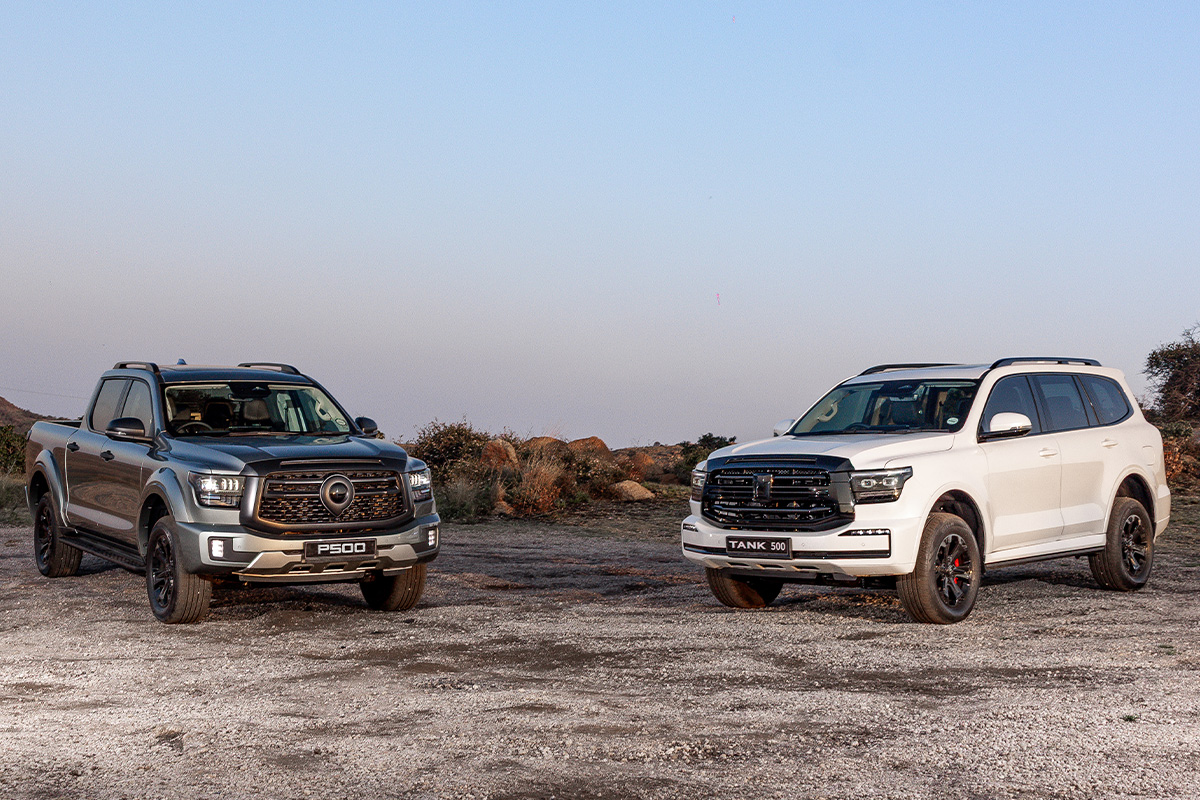
Despite all the talk of electrification, a sizeable part of the South African market still has very specific requirements for a large SUV or double-cab bakkie. It wants torque, towing ability, long-distance range and the confidence to go off-road whenever and wherever. GWM clearly believes its latest turbodiesel powertrain on its flagship SUV and bakkie has all the right ingredients.
Last month, GWM introduced a new 3.0-litre turbodiesel engine for both the P500 double-cab and Tank 500 SUV, giving the two models a substantial boost in diesel performance while maintaining the increasingly sophisticated levels of comfort and technology GWM has become known for.
Perhaps the biggest surprise, however, is the pricing. The P500 3.0T starts at R724,900, with the 4×4 Ultra Luxury coming in at R799,900. The Tank 500 3.0T, meanwhile, ranges from R849,900 to R999,900. Given the size, specification and performance on offer, those are remarkably competitive prices in a segment where similarly specified diesel bakkies and SUVs can comfortably push beyond the R1-million mark.
The new engine is a four-cylinder unit displacing 2,993 cc that produces 170 kW and 620 Nm, with the latter available between 1,400 and 2,400 rpm. More unusually, GWM says 385 Nm is available from just 1,000 rpm, giving the engine a strong low-speed response. It is paired exclusively with a nine-speed automatic transmission.
That makes the new engine 35 kW and 140 Nm more powerful than the outgoing 2.4-litre diesel, and puts its torque output ahead of several larger diesel engines in the segment. The P500 retains a towing capacity of up to 3,500 kg, while the Tank 500’s combination of ladder-frame construction, four-wheel drive and substantial torque makes the diesel particularly suited to long-distance touring and off-road use.
A DIFFERENT KIND OF DIESEL
On paper, the numbers suggest a fairly serious engine. On the road, however, the 3.0T takes a rather more understated approach.
Early driving impressions from the South African launch have highlighted how smooth and quiet the engine is. There is none of the pronounced diesel clatter you might expect from a large four-cylinder oil-burner, thanks to six specific noise and vibration-reduction measures. The company’s own testing includes more than a million kilometres of bench testing, along with full-vehicle validation.
Interestingly, that refinement also means the engine does not necessarily feel as muscular as the 620 Nm figure might suggest. Rather than delivering a sudden wallop of torque, it builds its power in a smooth, linear fashion. That’s likely to be welcome in normal driving, particularly when the P500 is used as a daily vehicle rather than permanently hauling a heavy trailer.
There is plenty of pulling power when required, though, and the nine-speed automatic makes good use of the broad torque band. For a vehicle that could spend its life alternating between urban traffic, highway cruising, towing and gravel roads, that flexibility is arguably more important than an entertaining burst of acceleration.
Fuel economy is another interesting aspect. GWM quotes figures in the region of 7.1 to 7.3 l/100 km, depending on the application, which sounds remarkably optimistic for vehicles of this size and weight. During our launch drive, we saw figures averaging closer to 8.7 l/100 km in the Tank 500.
That’s encouraging, although proper long-term testing will tell us considerably more than a launch drive can.
P500 GETS SERIOUS
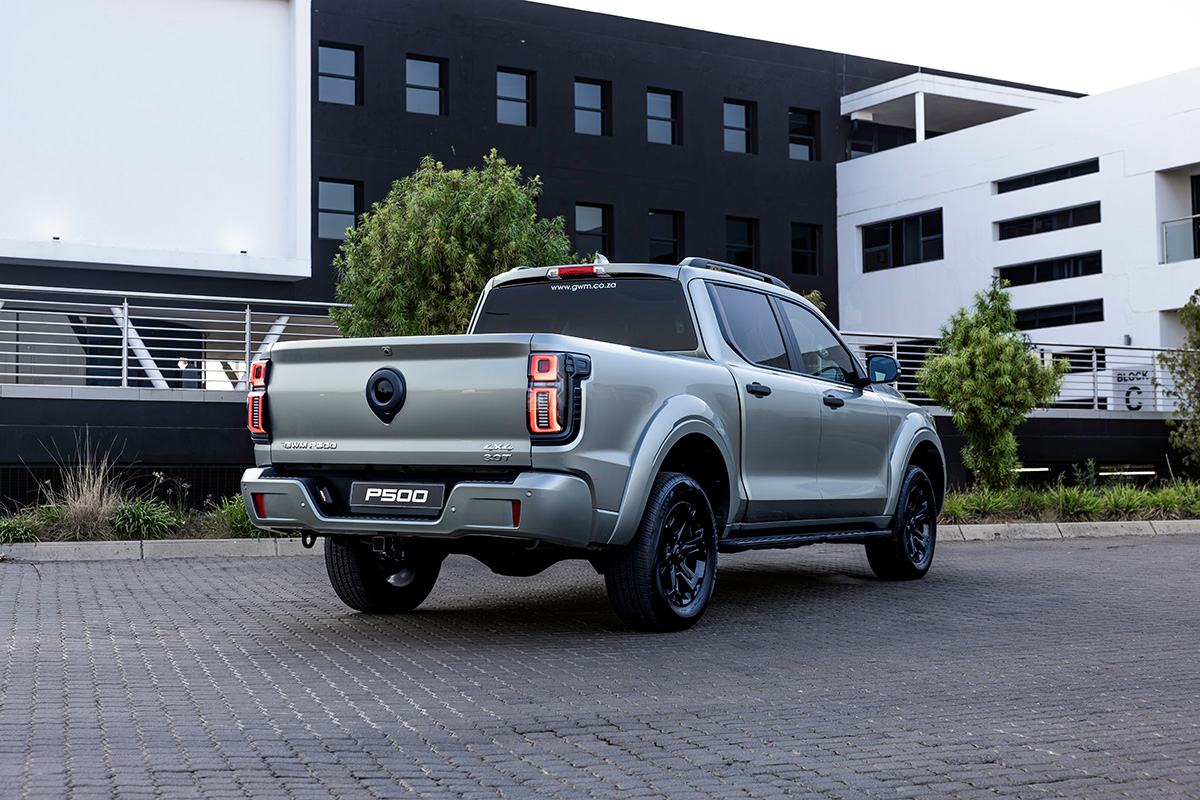
For the P500, the 3.0T represents a significant increase in diesel capability. Two derivatives are offered: the P500 3.0T Super Luxury 4×2, and the P500 3.0T Ultra Luxury 4×4. Both use the nine-speed automatic, with the latter adding four-wheel drive and low range. GWM backs the models with a seven-year/200,000 km warranty and a seven-year/75,000 km service plan.
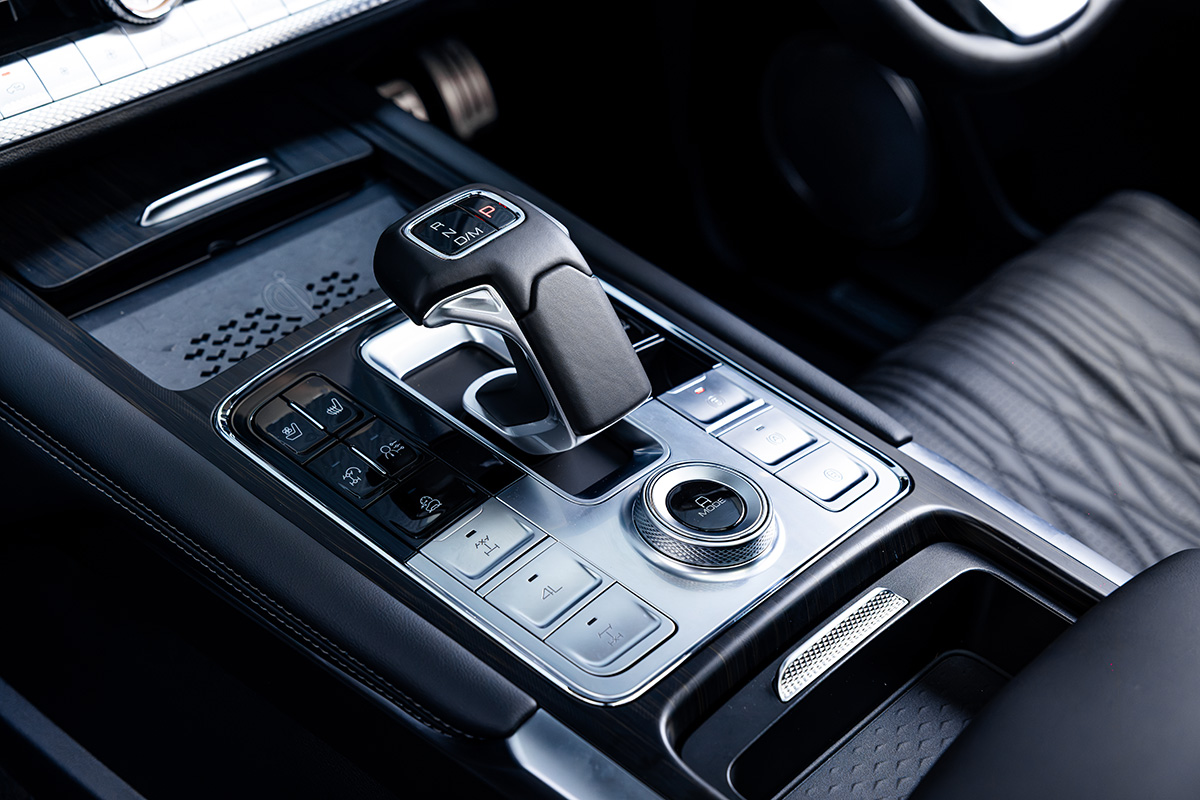
The P500 remains an interesting interpretation of the modern premium bakkie. Its cabin is packed with technology, including a 14.6″ central touchscreen, 12.3″ digital instrument display and head-up display, and front seats with heating, ventilation, massage, electric adjustment, and memory functions.
However, one dynamic caveat is worth noting. Unladen, the P500’s rear suspension is stiffer than you’d think, particularly over rougher surfaces. Hit some corrugation and the rear might even become a little loose. That’s not great news for a bakkie that will presumably spend most of its time ferrying passengers and the occasional load, and it will be interesting to see how the suspension behaves over a longer test, particularly when loaded.
TANK GETS LONG-RANGE TREATMENT
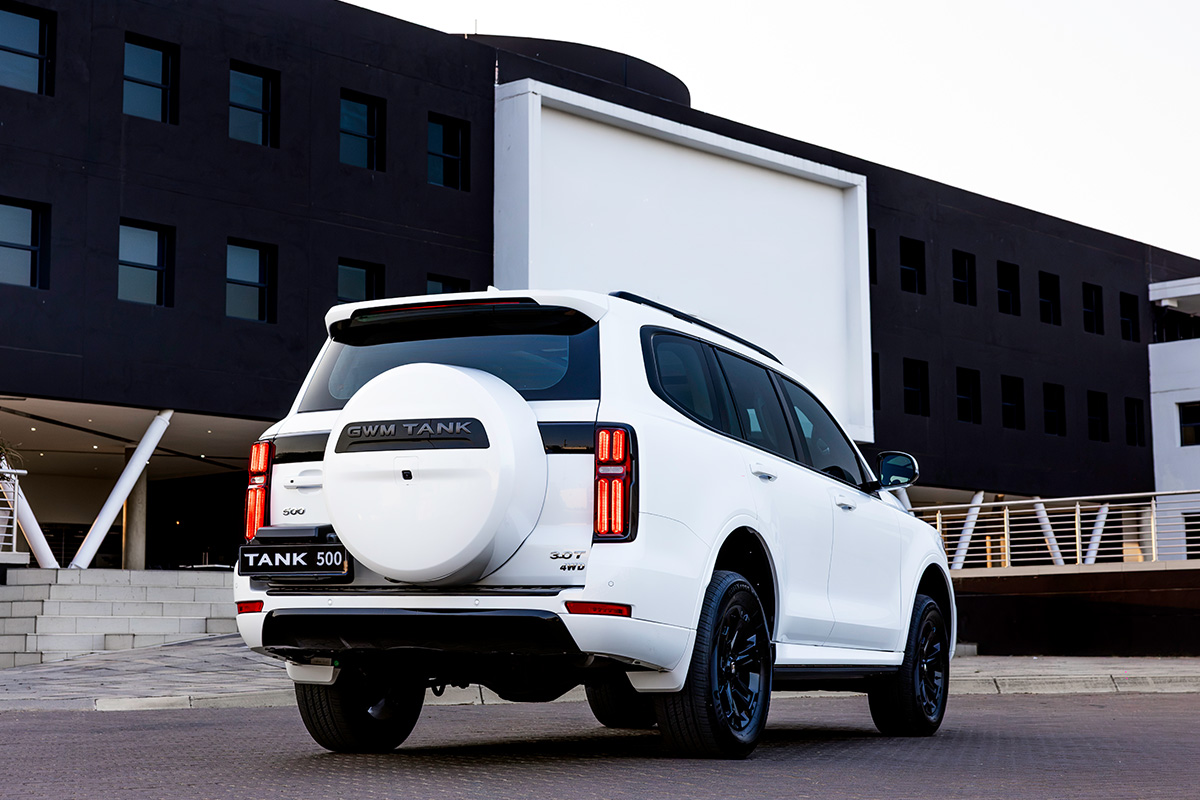
The Tank 500 is perhaps the more natural home for the new engine. The flagship SUV is available in three diesel derivatives – 3.0T Super Luxury 4×2, Ultra Luxury 4×4, and Overland 4×4. All have a 78-litre fuel tank, while the Overland can be equipped with an additional 53-litre auxiliary tank.
That last feature says a great deal about where GWM sees the diesel Tank 500 fitting into the market. With seven seats, four-wheel drive, low-range capability and substantial torque, the Overland is clearly aimed at owners who regard a 1,000 km-plus touring day as perfectly normal.
The diesel also changes the Tank’s character. Rather than relying on the instant response and outright power of a petrol-electric hybrid system, the 3.0T brings a more traditional touring philosophy of low-speed torque, a conventional automatic transmission, and the ability to tow up to 3.5 tonnes.
The result is a powertrain that makes considerable sense for the South African environment. Plenty of places still have limited charging infrastructure, trailers are heavy, and the nearest filling station can be several hundred kilometres away.
LAST WORD
GWM’s new 3.0-litre turbodiesel arrives at an interesting time. The industry is moving rapidly towards electrification, yet the requirements of a large bakkie or seven-seat adventure SUV have not changed quite as quickly.
With 170 kW and 620 Nm, the new engine gives both the P500 and Tank 500 the sort of low-speed pulling power their size suggests they should have. More importantly, it does so with impressive refinement.
Report by BERNIE HELLBERG JR | Images © GWM SOUTH AFRICA

