



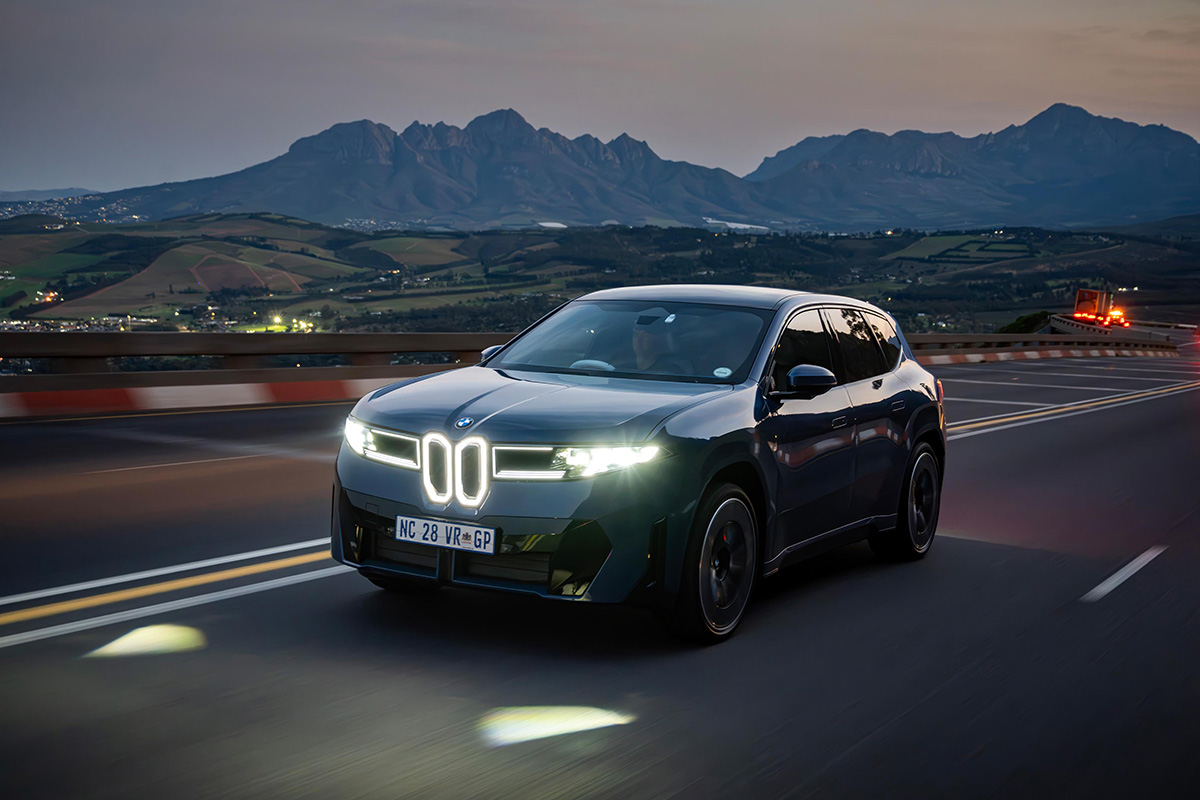
The new BMW iX3 is much more than the replacement for BMW’s first electric X3. As the first series-production Neue Klasse model, it introduces a new design language, new battery and drivetrain technology, and perhaps the most significant change to the BMW user experience in decades.
There is a moment with some new cars when you realise that what you are looking at is more important than the model itself. The new BMW iX3 is one of those cars.
Officially, it is the first series-production BMW born from the Neue Klasse programme, a name that carries considerable historical significance for the company. The original Neue Klasse cars of the 1960s effectively reset BMW’s trajectory. This time around, the objective is similarly ambitious, with the technologies and design principles introduced by the iX3 scheduled to filter through around 40 new or updated BMW models by 2027.
So, while the badge says iX3, this is really BMW’s opening statement for the next generation of its cars. And having driven it in the Western Cape, I can confirm that it feels like it.
A NEW BMW
Let’s get the obvious out of the way first. Regardless of what you may have seen in photographs, the new iX3 looks considerably more imposing in the metal. Dare I say it, even sexy.
The photographs don’t quite convey the car’s presence. Its proportions are clean and purposeful, with much less visual clutter than some recent BMW designs. The kidney grille remains, of course, but the days when BMW’s ever-expanding nostrils were the subject of endless memes appear to be over.
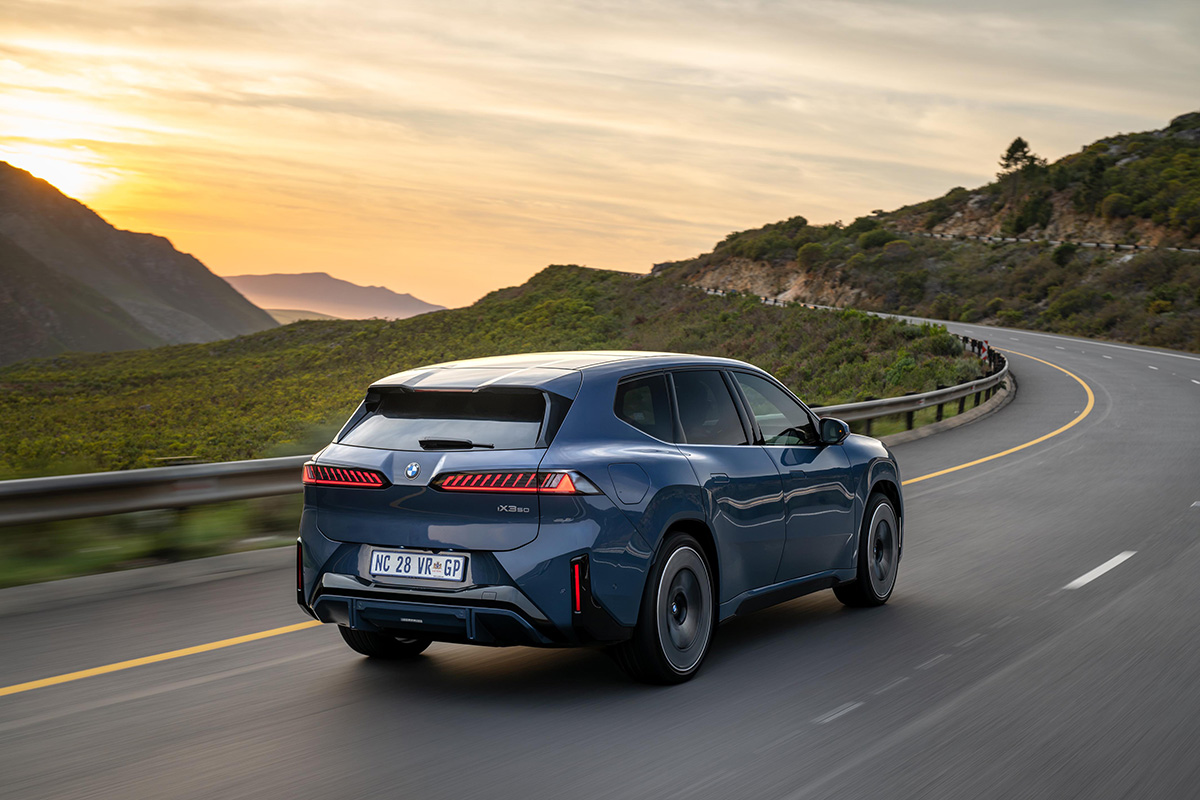
At 4,782 mm long and 1,895 mm wide, the new iX3 is slightly longer but narrower than the current X3, while its wheelbase is 32 mm longer. The result is a car that looks substantial without appearing unnecessarily bulky. Aerodynamic efficiency has also played a major role in the design, with a claimed drag coefficient of just 0.24.
The design includes subtle references to BMW’s past, but the overall impression is decidedly forward-looking. The Hofmeister kink remains, the proportions still immediately identify it as a BMW, and yet almost every surface has been reconsidered.
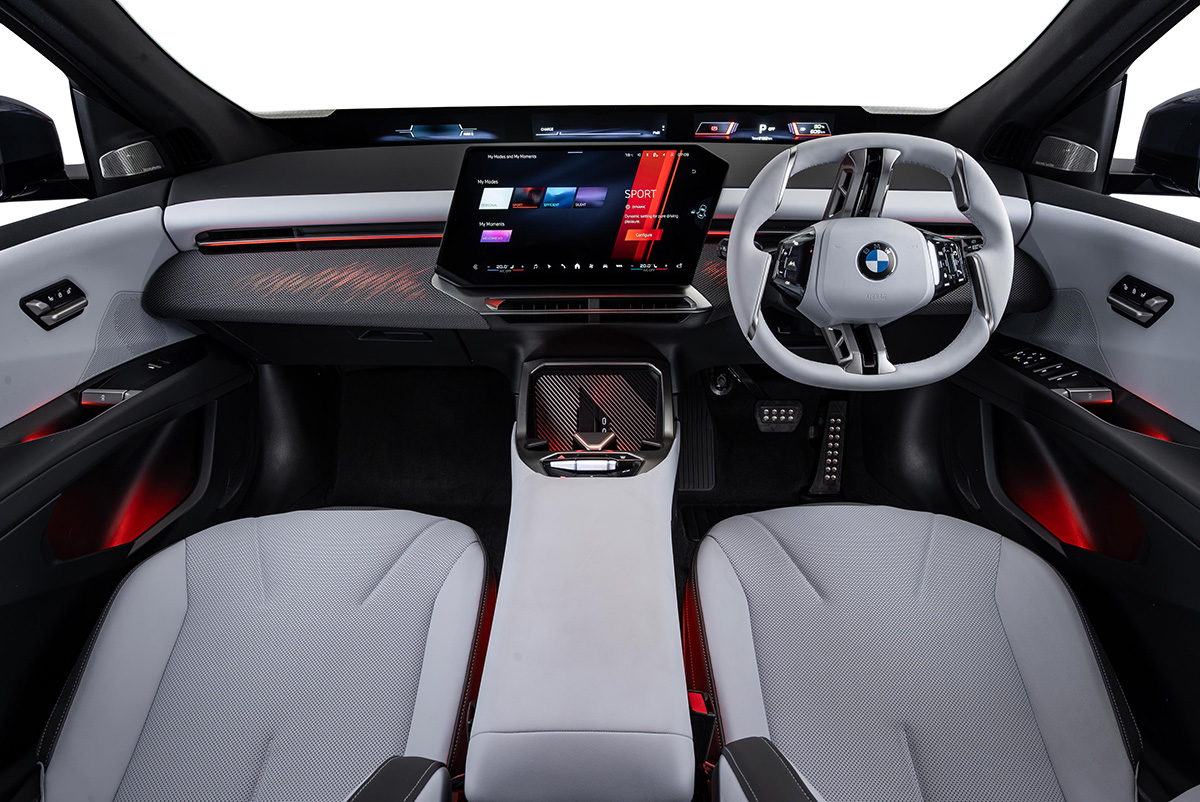
The changes become even more significant once you open the door. The interior is cleaner, more minimalist and, initially, slightly unfamiliar. There is no conventional instrument binnacle and no traditional rotary iDrive controller. Instead, the driver’s information is presented through BMW’s new Panoramic iDrive concept, supported by a central 17.9″ display and BMW Operating System X.
PANORAMIC iDRIVE CHANGES THE GAME
BMW Panoramic iDrive is plainly spectacular. The most obvious element is the Panoramic Vision display, positioned immediately below the windscreen and stretching across the dashboard. It puts information at precisely the height where you naturally want to see it, without requiring you to look down at a conventional instrument cluster.
The content is configurable, letting the driver choose what to display, while the central touchscreen handles the more conventional infotainment functions. A new head-up display is also available, while the system integrates physical controls, steering-wheel inputs and voice interaction into a much more cohesive interface.
Having now experienced it properly, I found it remarkably intuitive. In fact, something rather strange happened afterwards. Other cars suddenly seemed old-fashioned.
I happened to have the Lexus RZ 550e F-Sport on test at roughly the same time as the iX3 launch. The Lexus is a magnificent piece of kit, with a beautifully executed interior and plenty of technology, but its interactive experience feels almost conventional alongside the BMW. And that isn’t necessarily a criticism of the Lexus. It simply shows how significant BMW’s new interface feels.
Mercedes-Benz’s optional Superscreen comes closest in sheer visual impact, but it is an expensive option on some EQ models. BMW’s Panoramic iDrive, by contrast, is standard on the iX3.
The technology underneath it is equally important. BMW has consolidated the car’s computing architecture around four high-performance computers, or “superbrains”, handling areas such as infotainment, driving dynamics, automated driving and vehicle functions. The result is a software-defined vehicle designed to evolve throughout its life rather than remain essentially fixed after it leaves the factory.
A NEW GENERATION OF ELECTRIC DRIVE
The technological leap continues beneath the floor. The iX3 introduces BMW’s sixth-generation eDrive technology, built around a new 800-volt electrical architecture and fundamentally redesigned high-voltage batteries using cylindrical cells. BMW says the new battery technology delivers around 20% higher energy density, while the overall Gen6 drivetrain reduces energy losses by 40% compared with the previous generation.
In the flagship iX3 50 xDrive, the 108.7 kWh battery feeds two electric motors, producing a combined 345 kW and 645 Nm. The result is zero to 100 km/h in 4.9 seconds and a claimed WLTP range of between 745 and 820 km, depending on specification and conditions.
The charging figures are arguably even more impressive. With suitable infrastructure, the iX3 can accept up to 400 kW DC charging (the fastest DC chargers in South Africa max out at 350 kW), while BMW claims that a 10 to 80% charge takes around 21 minutes. In ideal conditions, it can add up to 372 km of additional WLTP range in 10 minutes.
Those numbers matter because range and charging remain two of the biggest considerations for anyone moving from an internal-combustion vehicle to an EV.
The second South African derivative, the iX3 40, takes a slightly different approach. Priced at R1,498,000 versus R1,690,000 for the 50 xDrive, it uses a single electric motor driving the rear wheels and produces 235 kW and 500 Nm. It is due here in the first quarter of 2027.
The 50 xDrive therefore brings the added performance and traction of its dual-motor all-wheel-drive system, while the 40 offers a simpler rear-wheel-drive setup at a lower price. At launch, however, I drove only the flagship.
STILL UNMISTAKABLY BMW
For all the talk of software, screens, batteries and artificial intelligence, there is one thing BMW could not afford to lose with Neue Klasse: the way its cars drive, and, fortunately, it hasn’t.
The Western Cape was an ideal place to discover this. We covered everything from sweeping highways to fast, technical sections of coastal road, with the launch route providing plenty of opportunities to explore the iX3’s dynamic abilities.
The driving experience is quite sublime. There is the expected instant response of an electric drivetrain, but it never feels artificial or overly aggressive. Acceleration is remarkably linear, and the car gathers speed with an almost eerie lack of drama. The refinement is exceptional, too, with very little wind or road noise entering the cabin.
Yet beneath all this smoothness is a distinctly BMW character with precise steering and taut body control that make the car feel far more agile than something weighing more than two tonnes has any right to feel. BMW’s new “Heart of Joy” control computer manages the drivetrain, braking, steering and dynamics at a central level, allowing the various systems to work together rather than operating as isolated components.
Most importantly, the iX3 doesn’t feel like BMW has abandoned the traditional attributes that have defined its cars for decades.
LAST WORD
The new BMW iX3 is significant for reasons that go well beyond the fact that it is another premium electric SUV. It marks the start of BMW’s next chapter, with a new design language that will spread through the range (the new X5 is expected here next month). The sixth-generation eDrive technology will evolve and proliferate. The Panoramic iDrive system will become familiar across future BMW models. The software architecture, computing power, and driving-dynamics technology introduced here will form the foundation of cars that haven’t even been revealed yet.
BMW also enters this new era from a position of considerable strength in South Africa. Its existing electric portfolio is already broad, stretching from the iX1 and iX2 through the i4, i5, i7 and iX, and the arrival of Neue Klasse technology gives the brand another substantial step forward in range, charging, and user interaction.
Perhaps the most telling thing about the new iX3, though, is that despite all its new technology, it still feels unmistakably like a BMW, albeit now it feels like a BMW from the future.
Report by BERNIE HELLBERG JR | Images © BMW SOUTH AFRICA

