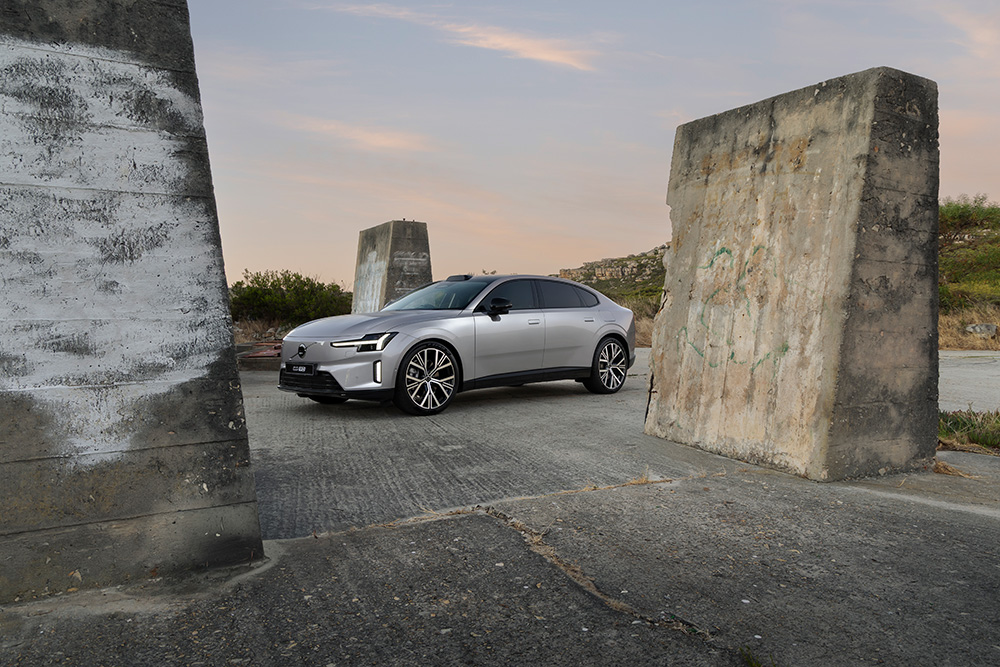
Volvo’s new ES90 rethinks what a flagship sedan should be in the electric age. Drawing on a lineage that stretches back through some of the brand’s most iconic saloons, while quietly nodding to more unconventional shapes of the past, the ES90 blends familiar elegance with a distinctly modern twist. It is at once a sedan, a fastback, and something approaching an SUV in stance, yet it never quite abandons its identity as a large executive car. The result is a design that challenges traditional categories, while signalling Volvo’s vision for its electric future with understated confidence.
When designing the new full-electric ES90, successor to the S90 flagship sedan in Volvo’s vehicle range, the creative team must have taken some inspiration from the coupe-like shape of the PV544 to create a vehicle that combines “the refined elegance of a sedan, the adaptability of a fastback, and the spacious interior and higher ground clearance associated with SUVs”.
According to Jeremy Offer, former head of Volvo global design and the man responsible for the ES90, the team adapted the sedan silhouette and added a hatchback for functional reasons. They also leveraged the proportions of the electric platform to give the car a higher stance and an elevated driving position. Yet he maintains that it is still fundamentally a large sedan.
While it may hark back to the PV544 in some respects, the ES90 lineage can be traced back to sedans like the Volvo Amazon, the 164 (the company’s first true luxury sedan), the 760 GLE, the 780, the 960 (which 30 years ago became the first S90), the S80, and the second generation S90 of a decade ago.
In its execution, the ES90 also follows in the tracks of the pioneering Jaguar I-Pace, introduced eight years ago. The I-Pace also blurred the lines between an elegant luxury sedan, a four-door coupe, a hatchback, and an SUV. Despite its interesting positioning and advanced technology, it was no great success, and production ended in 2024, about the same time Volvo announced the V551 project, the full electric replacement for the S90 sedan.
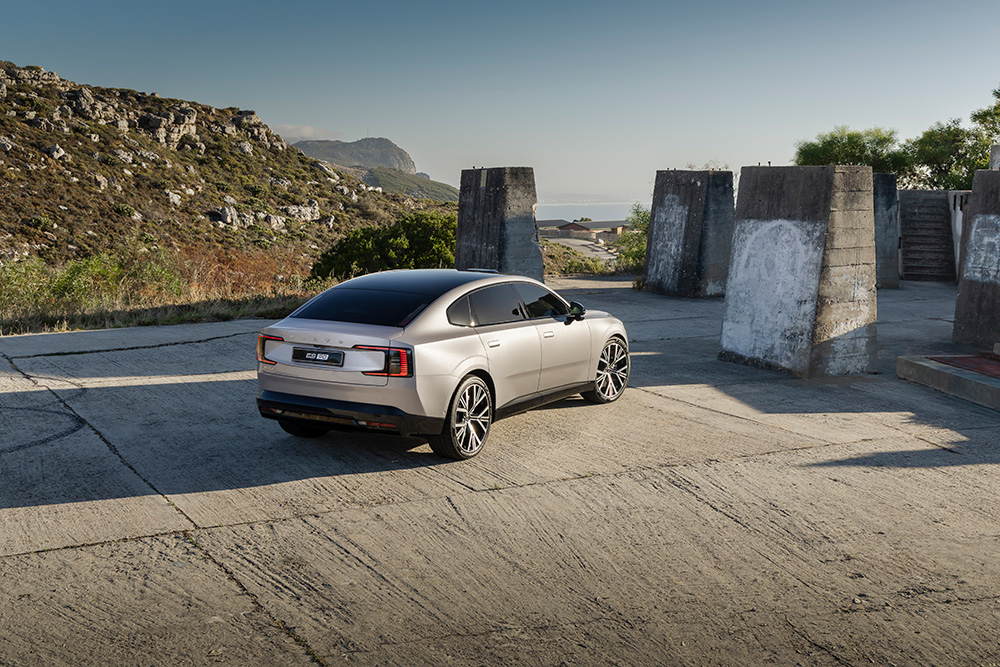
Now the ES90 is here, less than a year after its world debut, and although its styling may be divisive in terms of formal classification, the fastback sedan is quite attractive in the flesh. Its shape also serves a purpose, as its drag coefficient of 0.25 Cd makes it the most aerodynamic Volvo ever produced.
Following the Volvo design trend, the front fascia of the fastback sedan is distinguished by Thor’s hammer headlights, and an interesting addition is the active light interplay between the headlights and lower-placed daylight driving lights – depicting a hammer striking an anvil.
Being fully electric, the ES90 progresses in virtual silence, but complementing the light display with (optional) sound could add some light-hearted fun… and what better sound to add than the typical tink-tink sound of our indigenous blacksmith plover? Anyway. The rear of the ES90 features C-shaped LED taillights, a high-mounted brake light above the large rear window, and LED lights on each side of the rear window.
IMPOSING RANGE
Like the EX90, the new ES90 is underpinned by the Geely/Volvo SPA2 electric vehicle platform. It is the first Volvo model to feature a dual Nvidia Drive AGX Orin configuration, with the computer’s abilities to perform 508 trillion operations per second (TOPS).
The newcomer has an advanced 800-volt electric architecture supporting fast charging, and according to Volvo, it can be recharged from 10% to 80% in only 25 minutes. With a 92 kWh battery, Volvo claims the ES90 can drive up to 755 km (based on the WLTP test standard) on a single charge while maintaining exceptionally low energy usage of only 15.9 kWh/100 km.
This makes the ES90 well-suited for South Africa’s long distances, more so when considering that around 300 km of electric range can be added in 10 minutes at 350 kW rapid charging stations – just long enough for a cup of coffee and a quick leg stretch. The only problem is that currently, such chargers are very limited in the country.
QUIET PERFORMANCE, CALM INTERIOR
Even with rear-wheel drive only, the ES90 is a powerful performer. The single rear-mounted motor delivers a hefty 245 kW and 480 Nm of torque – enough to catapult the luxury limousine linearly from zero to 100 km/h in only 6.6 seconds.
An all-wheel-drive version with twin motors producing 330 kW and 670 Nm of torque (or an eye-watering 500 kW and 870 Nm in the Performance model) is available overseas and is under consideration for local introduction. However, given the rear-wheel-drive model’s ample performance, one must wonder whether these derivatives (with their associated price increases) are necessary.
The ES90 is available in Core, Plus, and Ultra trim levels, all of which include advanced safety and driver-assist systems, including Pilot Assist (without LiDAR), a standard panoramic sunroof, seven exterior colour choices, and wheel sizes ranging from 20” to 22”.
We embarked upon the snaking KwaZulu-Natal test route from Durban to the Natal Midlands in the Ultra derivative and this flagship model (with standard 360-degree camera system) impressed with its supersmooth ride quality and quiet comfort – mostly attributable to its adaptive dampening system and dual-chamber air suspension (as also found in the EX90) – although its 21” tyres sometimes caused it to tramline over undulated road surfaces.
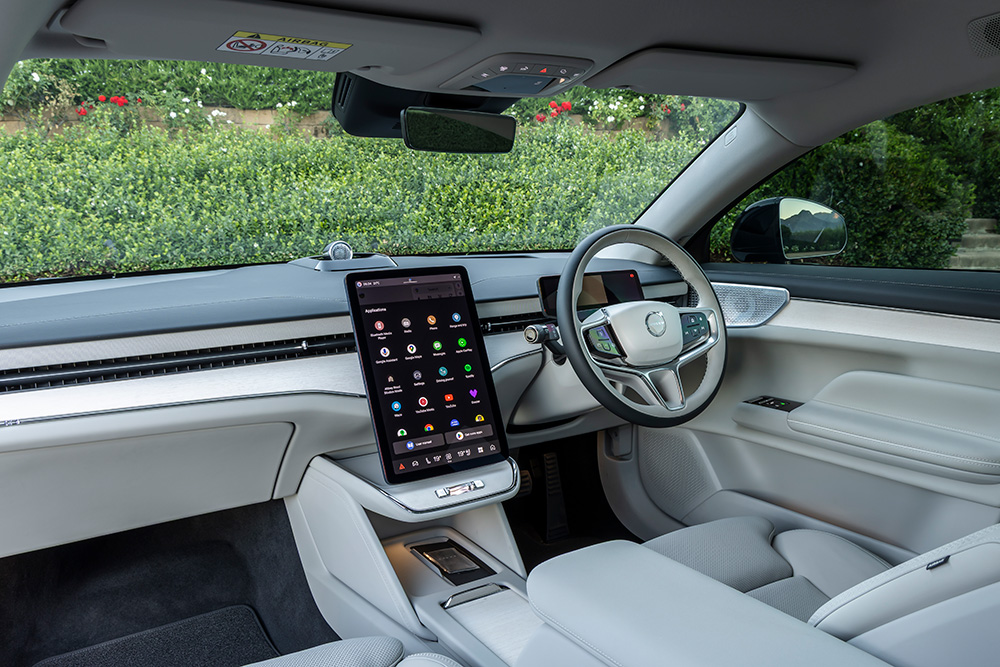
The roomy cabin of the understated Swedish executive sedan is an ideal space for long-distance travel, and its minimalist Scandinavian layout and discreet design, along with comfortable, heated and cooled leather seats (yes, leather is now available again in Volvos) and trim made of high-quality materials, contribute to a relaxed cabin ambience.
A high-quality Bowers & Wilkins sound system further amplifies the comfy lounge feeling, but, in my view, the electrochromic sunroof with variable settings does not really work in our sunny conditions. Also, the fact that virtually every command or setting must be made on the big central touchscreen, even for side mirrors and steering, is an irritation.
The ES90 has ample luggage space (446 litres with all seats in place, a generous 1,427 litres with the back seats folded down, and 27 litres in the frunk). The luxury sedan’s long wheelbase (3,102 mm) and low centre of gravity (thanks to the underfloor battery) ensure well-balanced handling in corners, although its weight can be felt under braking. Its big wheels and high ground clearance (178 mm to 188 mm) further improve ride comfort.
In the premium electric sedan market the ES90 competes against the BMW i5 eDrive40 and the Mercedes-Benz EQE 350+, as well as the Lexus RZ 500e (although its natural rival in the Lexus stable should in fact be the similarly named ES model) and with pricing from R1,590,000 for the Core, R1,655,00 for the Plus and R1,795,000 for the Ultra, the ES90 is competitively priced within the segment.
The retail prices also include a five-year/100,000 km warranty and service plan, an eight-year battery warranty, a GridCars wall charger and installation, three years of in-car data, and two years of free public charging.
LAST WORD
With its balanced combination of Scandinavian luxury, future-focused technology, relaxed ambience, and added long-distance prowess, the ES90 flagship sedan is an excellent addition to the Volvo portfolio. However, it is clearly aimed at the Chinese market, where luxury sedans, particularly extended-wheelbase sedans, are highly popular.
The I-Pace was ahead of its time in South Africa and was never accepted. In contrast to China, this market segment is shrinking locally. Even so, this impressive electric hatchback sedan deserves to be received better here than the I-Pace was back then.
Report by FERDI DE VOS | Images © VOLVO CAR SOUTH AFRICA