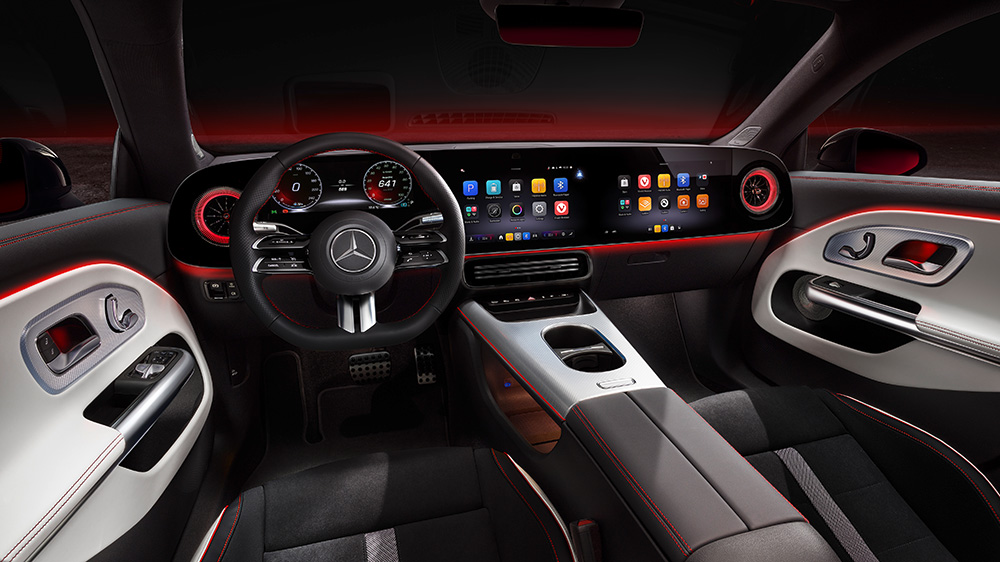
Cars have always been a very personal choice, and Mercedes-Benz understands its customers better than most. Making you feel special has always been part of the brand’s appeal, and now it aims to elevate that experience with its new Mercedes-Benz Operating System, or MB.OS.
Launching alongside the all-new electric CLA, built on Mercedes-Benz’s Modular Architecture platform, MB.OS represents a significant shift in how vehicles function and evolve. This ‘EV-first’ platform runs on an 800 V system, but the real breakthrough lies in the software that powers the car’s digital ecosystem.
MB.OS is a fully independent chip-to-cloud system developed exclusively for Mercedes-Benz vehicles. It connects the car’s hardware, high-performance computing units, proprietary cloud and over-the-air update capability into one seamless network. This means your Mercedes-Benz no longer needs to visit a dealership for software updates. Instead, updates happen automatically, often overnight, ensuring the vehicle continues to improve over time.
Much like a smartphone, MB.OS allows the car to gain new features as they become available. Owners can also activate additional functionality through Feature-on-Demand, enabling the vehicle to adapt long after it leaves the showroom. It ensures the car remains current, relevant and tailored to its owner.
However, the true strength of MB.OS lies in its artificial intelligence capabilities. The system transforms voice control into something far more intuitive and proactive. Instead of simply responding to commands, it anticipates your needs.
For example, if you tell the car that you are cold, it will not just open the climate control menu. It may increase the cabin temperature, activate heated seats and adjust airflow automatically. More importantly, it remembers your preferences and applies them in future without being prompted.
The system goes beyond basic voice control by enabling natural, conversational interaction. MB.OS can understand tone, context and intent, remembering previous interactions and responding accordingly. It integrates real-time data and uses natural language processing to provide meaningful, contextual responses, creating an experience that feels intuitive and personal.
What sets MB.OS apart is that it is not based on Android Automotive. Every element has been developed specifically for Mercedes-Benz, ensuring seamless integration between hardware and software. This unified approach improves performance across key systems, including advanced driver assistance technologies such as LiDAR-supported safety features and collision-prevention systems, enabling them to react faster and more reliably.
Biometric authentication adds another layer of personalisation and security. Using facial recognition or fingerprint identification, the system can recognise individual drivers and load their cloud-based profiles. This allows any MB.OS-equipped Mercedes-Benz to instantly adapt to its driver’s preferences.
MB.OS represents the next step in automotive evolution. It does not just offer a glimpse into the future. It brings it into the present, redefining what it means to interact with your car.

NEURALINK AND THE MINDS IT RESTS UPON
Medicine, miracles, and science often look very alike; whichever way you look at it, the option of offering freedom of movement through Neuralink to people who have never had the privilege is the combined effort of all three.
Officially, the world has twenty-one people with Neuralink implants as part of the extended human trials. Neuralink’s first patient, Nolan Arbaugh, paralysed from the shoulders down, had the ‘Link’ implant in 2024, gained the ability to control a cursor, play Mario Kart, and write text messages to loved ones with only the power of his thoughts.
Setbacks happen, though.
Within the first three months of Nolan having the link implant, 85% of the Neuralinks’ threads retracted, rendering them unresponsive. The science works, but the medicine has a problem. Implanting the device and making it durable has surprisingly been the more difficult problem to solve, the brain proving a difficult environment to tame.
Neuralink has since streamlined the implantation and achieved far more consistent results, shifting its focus from controlling cursors on a screen to operating robotic arms, vision restoration, and broader neurological treatments, going further than the miracle of restoring physical freedoms to people with paraplegia and building a brain operating system.
Two years on, Nolan Arbaugh is now working as a motivational speaker and is more independent than ever.
The science is proven valid, the medicine refined, but can they bring the Neuralinks miracle to the world?
Report by RUBEN VON STEEN