There aren’t a lot of firsts left in the automotive world, so when GWM unveiled their Hi4, Hi4-T, and Hi4-Z hybrid platforms at Auto Shanghai 2025 and said, “the new hybrid architecture Hi4 represents the world’s first intelligent control four-wheel drive hybrid technology,” I raised my eyebrows a few centimetres – at least. Four-wheel-drive hybrid technology isn’t exactly a new feat. In 1901, Ferdinand Porsche and Ludwig Lohner developed the first functional four-wheel-drive hybrid automobile. So, raising my eyebrows wasn’t uncalled for – but I probably should’ve saved it for what GWM actually meant by “intelligent control.”

CONTROLLED DUALITY
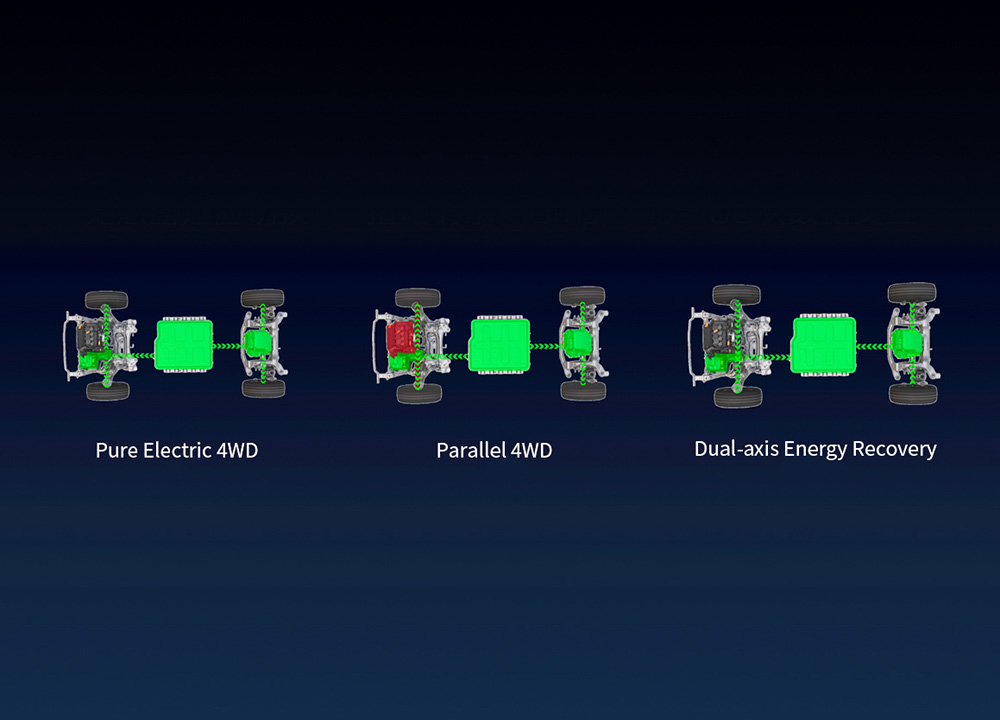
Utilising a dual-motor, dual-axis power distribution system that achieves a near-perfect 50-50 torque split, the platform employs GWM’s “breakthrough” iTVC (Intelligent Torque Vector Control) system. GWM claims that iTVC improves stability, comfort, and safety, with a maximum acceleration increase of 40% across the “full speed range.”
That “full speed range” is just the tip of the ICE-berg. With three power sources to choose from, GWM boasts nine driving modes, none of which you need to select manually. It shifts between modes in the blink of an eye, making over 100 data connections per second, delivering torque and power exactly where it’s needed, when it’s needed, before you even knew you needed it.
“Four-wheel drive experience, two-wheel drive price, four-wheel drive performance, and two-wheel drive energy consumption.” That’s the philosophy behind the Hi4 platforms, and what GWM aims to deliver in every possible scenario. With hybrid-dedicated internal combustion engines boasting a class-leading thermal efficiency of 41.5%, the real novelty lies in how they’ve deployed all this existing technology.
Note that most electric vehicles (EVs) and hybrids rely on either series or parallel motor configurations. A series setup uses the ICE to generate electricity for the motors, while a parallel system employs both the ICE and electric motors to drive the wheels, either independently or in tandem. The Hi4 platform combines both configurations, ensuring maximum efficiency and adaptability. Consider my eyebrows officially raised.
When it comes to the Hi4-T platform, it leans into a more robust parallel petrol-electric setup, designed to ensure “continuous strong power.” The electric motor helps keep the ICE in its peak torque range, offering better performance, reduced fuel consumption, and a smoother ride on tar roads. But what happens when that tar road ends?
The Hi4-T platform is integrated into GWM’s Tank range, adopting a mechanical 4WD non-decoupling structure with three differential locks, allowing the vehicle to send 100% of its power to a single wheel when off-roading gets properly wild. With AWD, 2H, 4H Lock, 4L Lock, and multiple drive modes on tap, there’s really no scenario this platform isn’t ready for.
To top it all off, both the Hi4 and Hi4-T offer fully electric ranges of 100 km and 110 km, respectively.
Claiming to be a “world’s first” might be a clever marketing technicality, but what’s not up for debate is just how capable these Hi4 and Hi4-T platforms are, and how brilliantly GWM has deployed existing technology. The Hi4 system will, for example, be deployued locally for the first time this month in the updated Haval H6 GT. They’re raising eyebrows across the industry, making the established players stop, look, and wonder: “Why didn’t we think of that first?”
Report by RUBEN VON STEEN | Images © BERNIE HELLBERG JR / GWM