



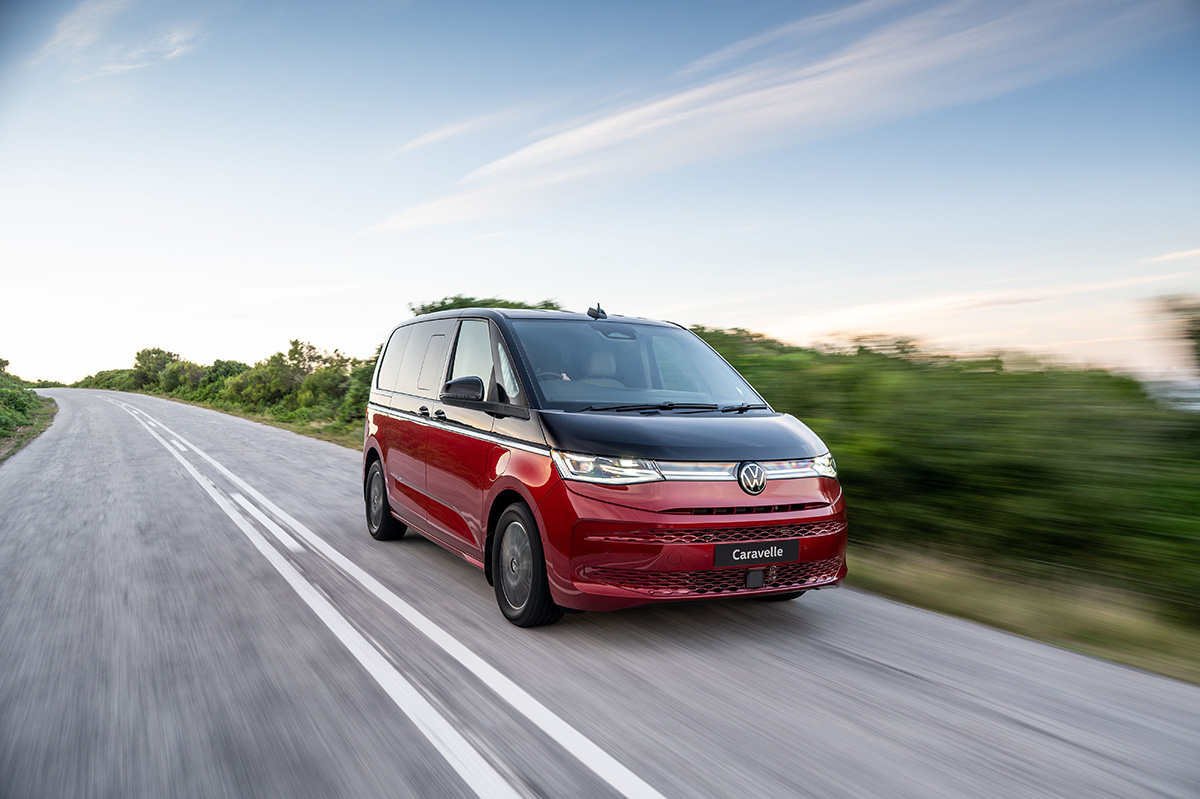
Few vehicles can trigger the same kind of nostalgia as a Volkswagen Bus. Many South Africans of a certain age will remember the ubiquitous “Volksie Bus” that seemed to be everywhere, taking us to school, on holiday, and back home every time. Now, the new Volkswagen Caravelle eHybrid carries that unmistakable DNA forward, though nothing about it feels even remotely old-fashioned.
The latest Volkswagen Caravelle is bigger, quieter, considerably more sophisticated and, for the first time in South Africa, electrified. At R1,794,000, it is also a long way removed from the utilitarian roots of the original Bus. Yet perhaps its greatest strength is that it doesn’t try to be an SUV. In a market increasingly dominated by large premium SUVs, the Caravelle offers something rather different.
Volkswagen’s Bus has a particularly deep connection with South Africa. More than seven decades ago, the first locally produced Volksie Bus rolled out of what is now Volkswagen Group Africa’s Kariega plant, beginning a relationship that would see generations of the Transporter become part of the country’s automotive landscape. The T3, in particular, continued in South African production until 2002, while subsequent generations evolved from relatively simple people-movers into increasingly sophisticated passenger vehicles.
The Caravelle name itself originated in 1983, when Volkswagen created a more passenger-focused, better-equipped derivative of the Transporter. This effectively marked the beginning of the Caravelle as a premium family and leisure vehicle.
That evolution has continued through the T4, T5, and T6 generations, with the T6.1 becoming a familiar sight on South African roads. By 2020, more than 10,000 T6 examples had been sold locally since its 2015 introduction, underscoring how established the name had become here. Now comes the T7, and it feels like the Caravelle has finally reached adulthood.
PREMIUM WITHOUT THE BADGE TAX
At almost R1.8 million, calling the new Caravelle pricey would be an understatement. However, context is important.
This isn’t a basic Kombi with a few luxury touches. South Africa gets the Caravelle exclusively with the new plug-in hybrid drivetrain and 4MOTION, while standard specification includes equipment that would have been firmly in luxury-car territory not too long ago.
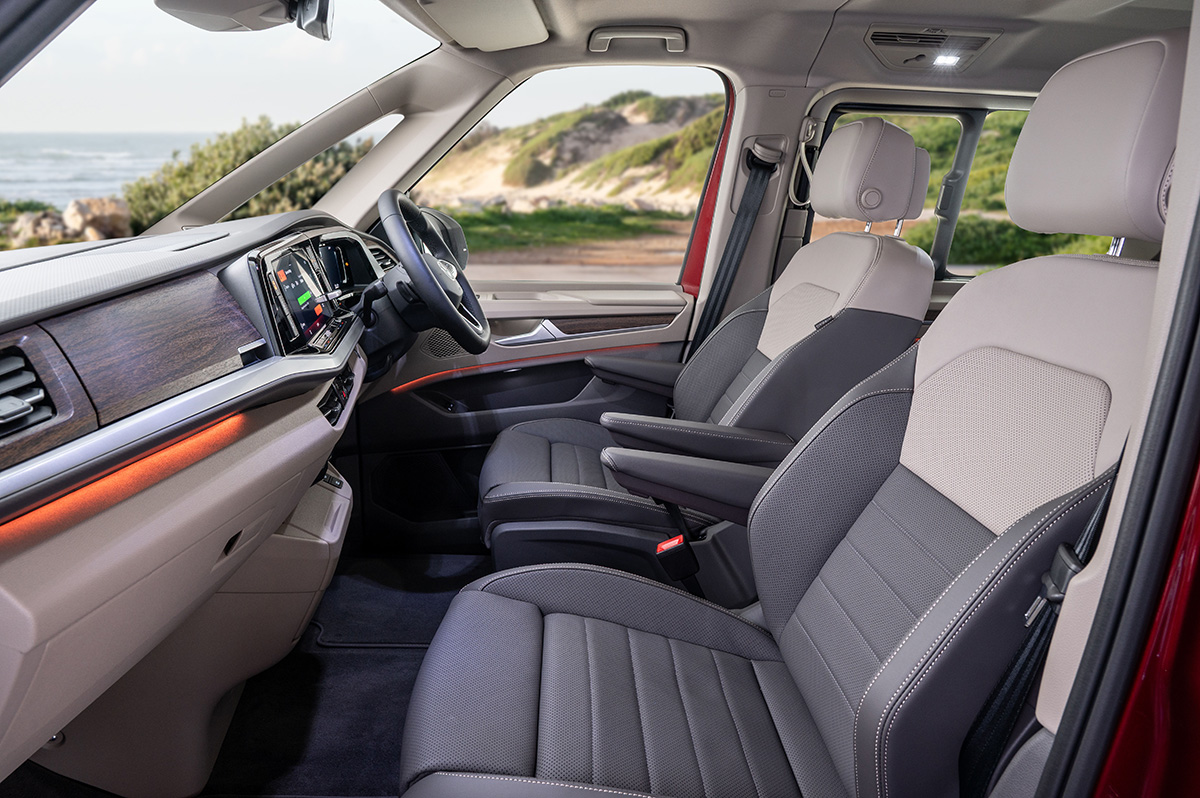
It has seven seats (all mounted on rails and individually adjustable), with the three rear seats removable when you need extra carrying capacity. A multifunction table provides a genuinely useful focal point for the passenger compartment, while electric sliding doors and a powered tailgate add considerable convenience.
Then there is the technology. A 10″ infotainment system and Digital Cockpit Pro are standard, as are three-zone climate control, 30-colour ambient lighting, IQ.Light LED Matrix headlights, adaptive cruise control, Park Assist, a rear-view camera and a comprehensive suite of driver assistance systems. The 13-speaker Harman Kardon sound system is another particularly welcome inclusion.
The result is a cabin that feels much closer to a premium SUV than the Caravelle’s commercial-vehicle origins might suggest.
CLEVER ELECTRIFICATION
The drivetrain is arguably the most interesting aspect of the new Caravelle. A 1.5-litre turbocharged TSI engine produces 130 kW and 250 Nm, working with two electric motors and a 19.7 kWh battery. Combined output is 180 kW and 350 Nm, with power sent through a six-speed DSG and an electrically driven 4MOTION system.
The clever bit is that there is no conventional mechanical connection between the front and rear axles. The petrol engine and front electric motor drive the front wheels, while a separate electric motor powers the rear axle when required. This allows the system to react rapidly (and seamlessly) to changing traction conditions and provides genuine all-wheel-drive capability without the weight and complexity of a conventional propshaft arrangement.
In normal driving, the Caravelle starts in EV mode, and the battery provides up to around 90 km of electric range. That makes considerable sense for a vehicle likely to spend much of its life shuttling people around. Plug it in overnight and many daily journeys can be completed without the petrol engine firing into life. On longer trips, the combustion engine takes over, removing the range limitations associated with a pure EV.
It is a particularly well-suited application of PHEV technology, with the transition between electric and petrol propulsion happening almost imperceptibly. The electric assistance also gives the Caravelle surprisingly effortless overtaking ability for something weighing more than two tonnes.
Charging is possible at up to 11 kW on AC, while DC charging is supported, making longer journeys more manageable. Maximum towing capacity is 1,570 kg.
A SURPRISINGLY GOOD DRIVE
For me, though, the Caravelle’s biggest surprise isn’t its technology, but the way it rides.
There is something wonderfully familiar about sitting high behind the wheel of a Volkswagen Bus. Yet, the new Caravelle delivers a level of refinement that my childhood Volksie Buses could scarcely have imagined. The ride is supple without becoming floaty, and the suspension does an excellent job of dealing with the sort of imperfect surfaces that characterise many South African roads. A key challenge for the Caravelle during the launch drive was our trip out to Palala Hotel and Spa in Limpopo, where severely rutted gravel roads were the only way to reach our overnight stay. Some were so bad, in fact, that I expected the Caravelle to shake every single nut and bolt loose. This didn’t happen, of course.
It also feels considerably more car-like to drive than its dimensions suggest. The steering is light, visibility is excellent, and body control is impressive for such a tall vehicle. At highway speeds, wind and tyre noise are well suppressed, making it an excellent long-distance option.
There was one blemish during our launch drive, however, the brake pedal feel, which is simply too soft and, at times, unpredictable. In a vehicle of this size and weight, especially one carrying up to seven people, I would prefer a firmer and more consistent relationship between pedal input and braking response. It doesn’t ruin the Caravelle’s overall driving experience, but it takes some getting used to and feels out of character with its otherwise polished nature.
LAST WORD
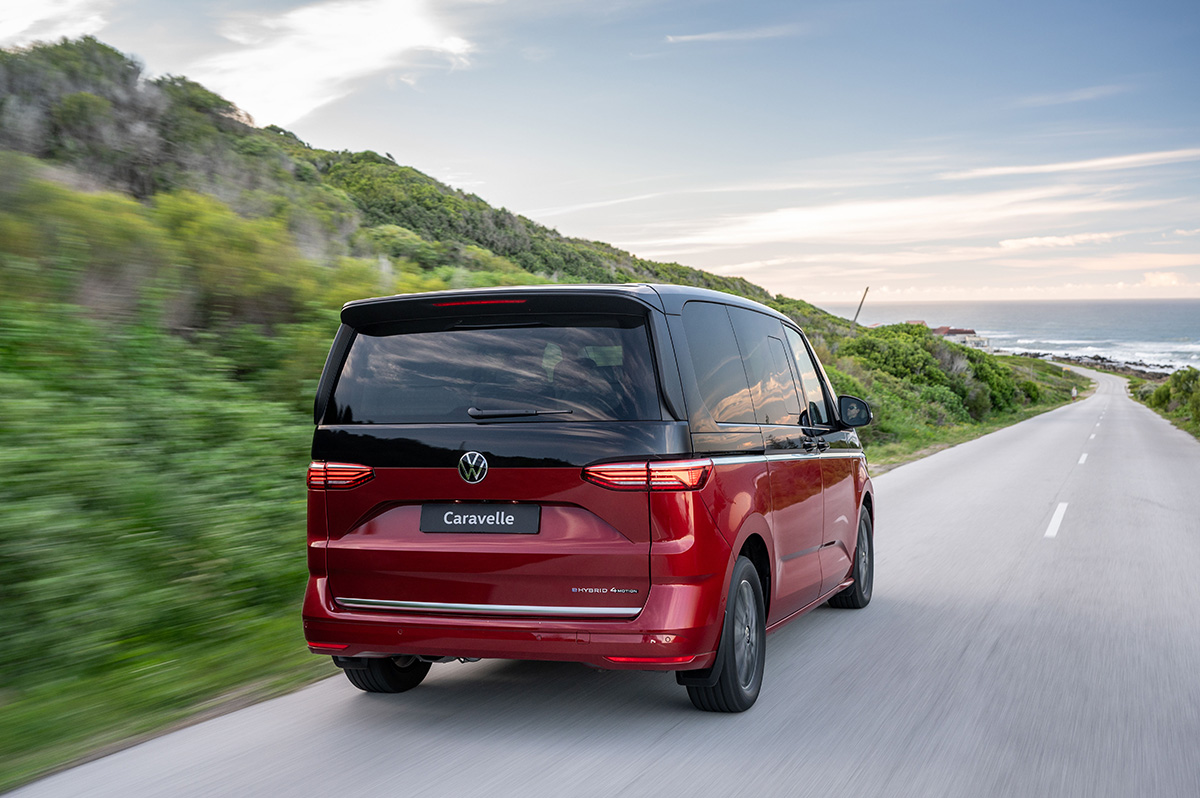
So, who buys a Caravelle at R1,794,000? Most likely someone who specifically doesn’t want an SUV. That’s the Caravelle’s greatest appeal. It offers the space and versatility of a large people-carrier, the refinement of a premium vehicle, and the novelty of something that isn’t another BMW X7, Mercedes-Benz GLS, or Land Rover Defender 130 parked outside the school.
It also occupies an interesting position beneath the Mercedes-Benz V-Class and EQV, with recent local comparisons putting the Volkswagen roughly R500,000 below these Mercedes-Benz alternatives.
That makes the Caravelle look highly compelling, delivering premium looks, excellent equipment, genuine versatility, and a clever PHEV drivetrain while retaining that unmistakable Volkswagen character.
The Caravelle may have grown up, but it hasn’t forgotten where it came from. For those of us who remember the old Volksie Bus fondly, there is something satisfying about discovering that the magic has survived. Even if these days, it comes with a Harman Kardon sound system, Matrix headlights, and a plug-in cable.
Report by BERNIE HELLBERG JR | Images © VOLKSWAGEN GROUP AFRICA

