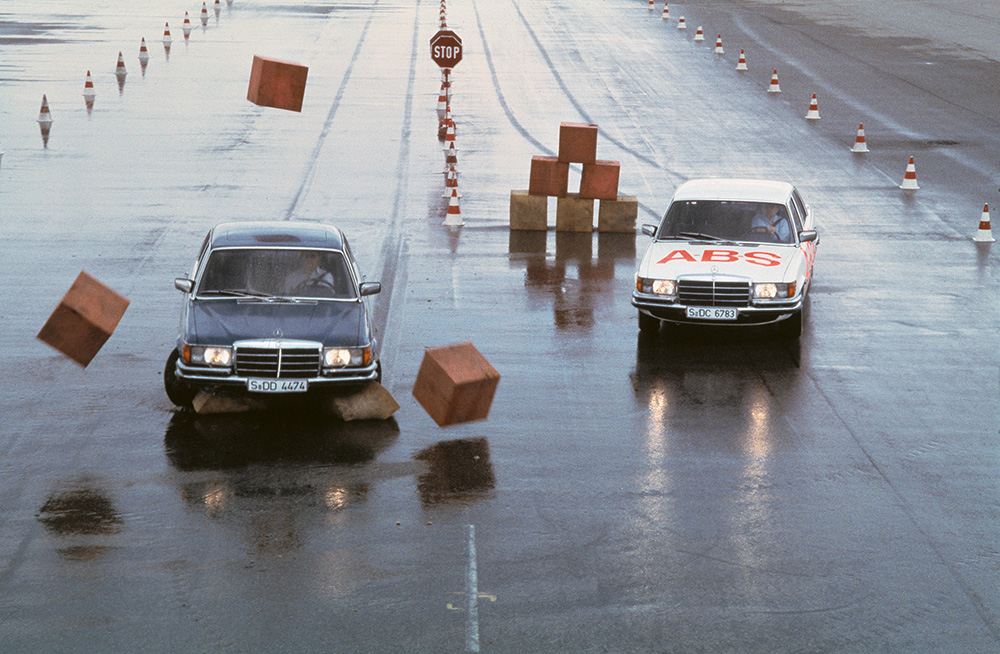
If there is one motoring breakthrough from Mercedes-Benz that genuinely reshaped how we all drive, beyond inventing the car itself, it is ABS. Introduced in production form on the Mercedes-Benz S-Class (W116) in 1978, the Anti-lock Braking System quietly changed the rules of emergency braking forever.
Developed alongside Bosch, ABS was the first electronically controlled braking system to be fitted to a series-production passenger car. Its job sounds simple, but the impact was huge. By preventing the wheels from locking under heavy braking, ABS allows the driver to steer while braking hard, especially on wet or slippery roads. Before this, a stamped brake pedal often meant skidding straight on with little control and plenty of panic.
What made ABS so powerful was not just the technology, but how it transformed driver behaviour in a crisis. Braking no longer meant choosing between stopping and steering. You could do both. That single change dramatically reduced accidents caused by loss of control and turned emergency manoeuvres into something predictable rather than desperate.
The ripple effect was enormous. ABS became compulsory on new cars in the EU by the early 2000s and rapidly spread worldwide, helped along by legislation in markets such as the United States. Today, it is so fundamental that we barely think about it, yet nearly every modern safety system traces its roots back to ABS.
It also laid the foundation for more advanced systems, including Mercedes-Benz’s own Electronic Stability Program, introduced in 1995. While innovations like crumple zones, airbags and ESP have saved countless lives, ABS stands apart because it prevents accidents before impact rather than simply managing the aftermath.
In teaching cars how to brake intelligently, ABS did not just improve safety. It redefined how vehicles behave when things go wrong, and that influence still underpins every confident stop we make today.
Report by BERNIE HELLBERG JR | Image © MERCEDES-BENZ