



DAWN OF A NEW PERFORMANCE ERA
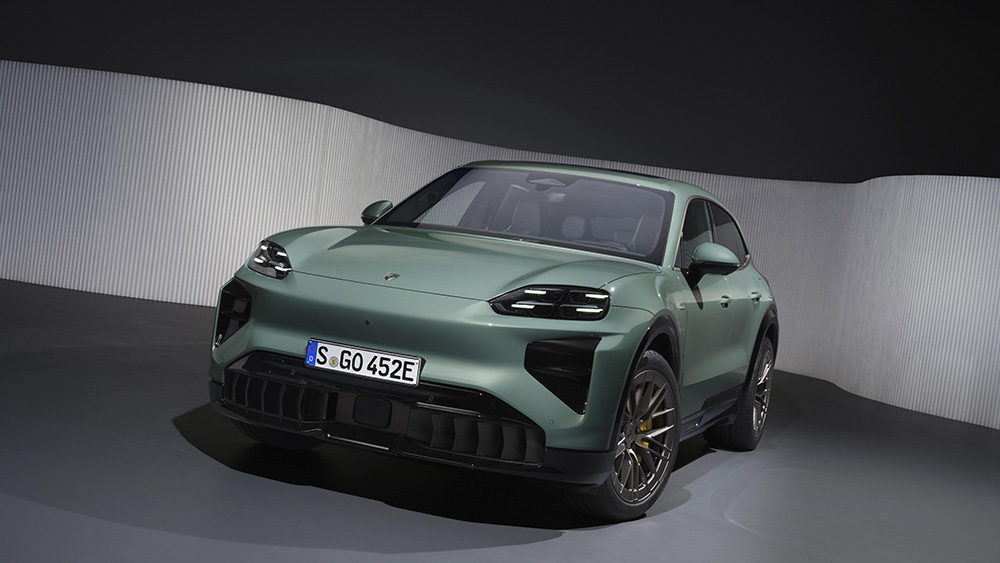
Porsche Cayenne Electric
Images © PORSCHE
Porsche has never been a brand that follows trends; it creates them. With the all-electric Cayenne, the Stuttgart marque has delivered what may be the most audacious model in its 77-year history: an SUV that produces 850 kW and 1,500 Nm, accelerates to 100 km/h in 2.5 seconds, yet can still tow 3.5 tonnes, ford rivers, and cover 642 km on a single charge. This is not merely an electrified Cayenne – it is the most powerful, most advanced, and arguably most complete production Porsche ever built.
The numbers are almost absurd. The Turbo Electric unleashes 630 kW in everyday driving, with a 130 kW Push-to-Pass boost available for ten seconds. Even the standard Cayenne Electric, with 300 kW rising to 325 kW under Launch Control, dispatches the zero-to-100 km/h sprint in 4.8 seconds and reaches 230 km/h. Both models recover energy at up to 600 kW under braking, meaning 97 per cent of everyday decelerations require no friction brakes at all.
Yet raw power has never been the Cayenne’s only virtue, and Porsche has refused to let electrification compromise versatility. The 113 kWh battery enables DC charging at up to 400 kW, enough to add more than 300 km of range in 10 minutes. For the first time in a Porsche, inductive charging is offered at up to 11 kW; simply park over the floor plate and the process begins automatically.
The chassis is equally sophisticated. Adaptive air suspension with PASM is standard, while the Turbo adds Porsche Active Ride, which virtually eliminates body roll. Rear-axle steering, torque vectoring, and an optional Off-Road package ensure the Cayenne Electric remains as confident on loose surfaces as it is on the Nordschleife.
Visually, the new model is unmistakably Cayenne, yet unmistakably future-focused. A drag coefficient of 0.25 makes it one of the most aerodynamic SUVs on sale, achieved through active cooling flaps, an adaptive roof spoiler, and extendable aeroblades at the rear on the Turbo. The interior introduces the largest display area ever fitted to a Porsche, with a curved 14.25″ driver OLED, optional 14.9″ passenger screen, and an 87″-equivalent AR head-up display.
Twenty-three years after the original Cayenne saved Porsche financially and redefined the performance SUV, its all-electric successor redefines it again.
AROUND THE WORLD IN UNDER EIGHT DAYS
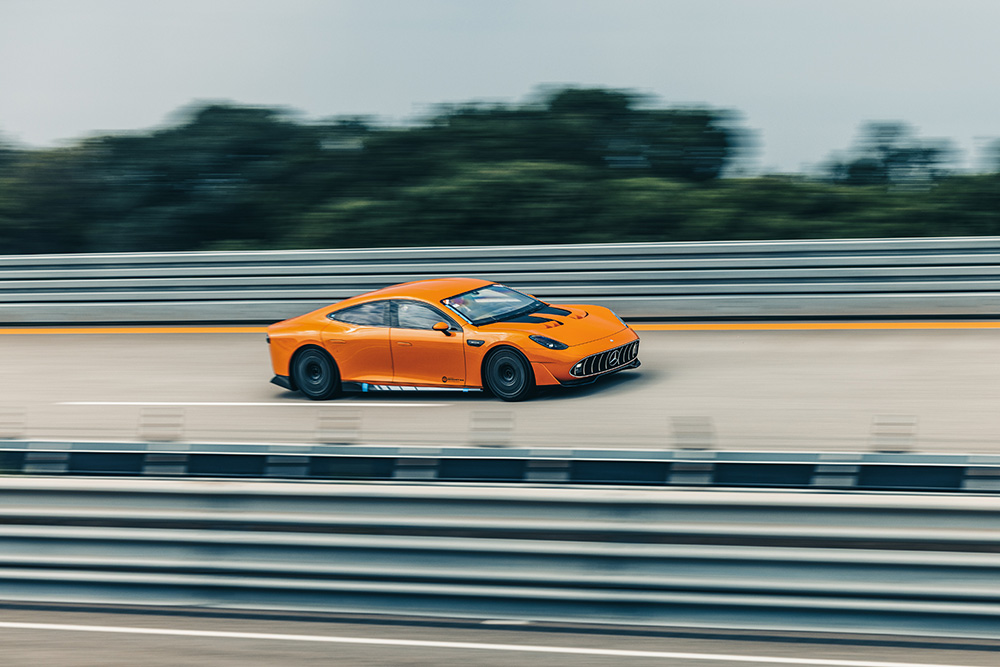
Mercedes-AMG CONCEPT GT XX
Image © MERCEDES-BENZ
Recently, Mercedes-AMG rewrote the rules for what an electric performance car can endure. Tested at Nardò, the legendary high-speed bowl in Italy, the CONCEPT AMG GT XX – a near-production prototype of the forthcoming AMG.EA platform – completed the equivalent of a lap of the Earth’s equator (40,075 km) in just 7 days, 13 hours, 24 minutes and 7 seconds. Two identical cars ran simultaneously and finished only 25 km apart after more than 3,177 laps each.
The numbers are staggering. Over 5,479 km in 24 hours obliterated the previous electric distance record by 1,518 km. The cars averaged more than 5,300 km per day, almost entirely at a sustained 300 km/h, with pit stops limited to ultra-fast charging sessions averaging 850 kW – far beyond today’s public infrastructure.
This was made possible by a drivetrain that will reach customers in 2026: three YASA-derived axial-flux motors delivering over 1,000 kW combined, paired with a new 80-volt battery using direct oil-cooled cylindrical cells. Power density is roughly triple that of conventional EVs, while the pack’s F1-inspired cooling keeps temperatures optimal even after repeated maximum-power laps and megawatt charging cycles. Five minutes at the bespoke Alpitronic charger added roughly 400 km of range.
The CONCEPT AMG GT XX is proof that electric hyper-performance can outlast, outrun and outcharge anything that has gone before. The future of Affalterbach just lapped the planet at 300 km/h. And it’s almost ready for the road.
REAL CARS FOR REAL MONEY
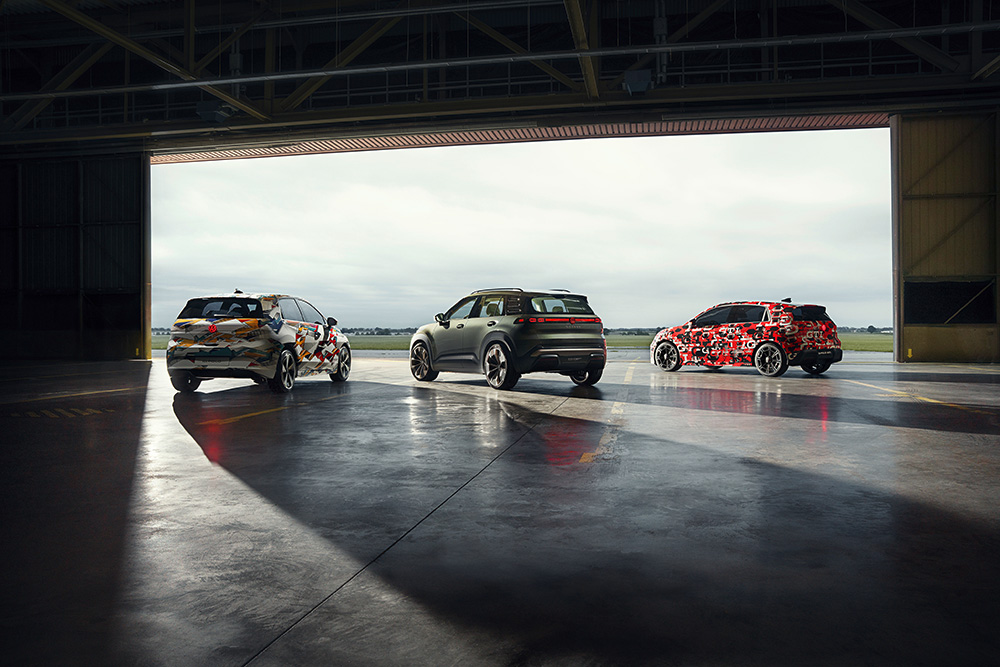
Meet “True Volkswagen”
Image © VOLKSWAGEN
At the recent IAA Mobility 2025 in Munich, Volkswagen unveiled the most comprehensive renewal in its modern history. Under the banner “True Volkswagen”, the brand aspires to return to its roots with clean, instantly recognisable design, obsessive build quality, intuitive operation, clever technology, and prices that make sense.
The centrepiece was four new all-electric models for the small-car and compact segments, all scheduled for market launch from 2026 onward. The ID. Polo and hotter ID. Polo GTI appeared in light camouflage, while the near-production ID. CROSS Concept previewed a compact electric SUV. The biggest cheer, however, greeted the ID. EVERY1 – a no-nonsense entry-level EV confirmed at €20,000 (approximately R 400,000). With these four cars, Volkswagen signalled that accessible electric mobility would once again carry famous names from its past.
Alongside the battery offensive, the brand refreshed its combustion and hybrid line-up. The second-generation T-Roc broke cover as a sharper, more mature million-seller, joining the recently renewed Tiguan, larger Tayron seven-seater, and new Passat range. Special editions such as the fiery ID.3 GTX FIRE+ICE added flair to the stand.
Three years of intensive restructuring crystallised in Munich. Volkswagen left the show having demonstrated that high volume does not mean low ambition: by 2030, it intends to lead the mainstream segment in technology, and the cars displayed in September 2025 proved the groundwork had already been laid.
For the first time in years, visitors left the Volkswagen hall believing that “the people’s car” had rediscovered both its soul and its competitive edge.