



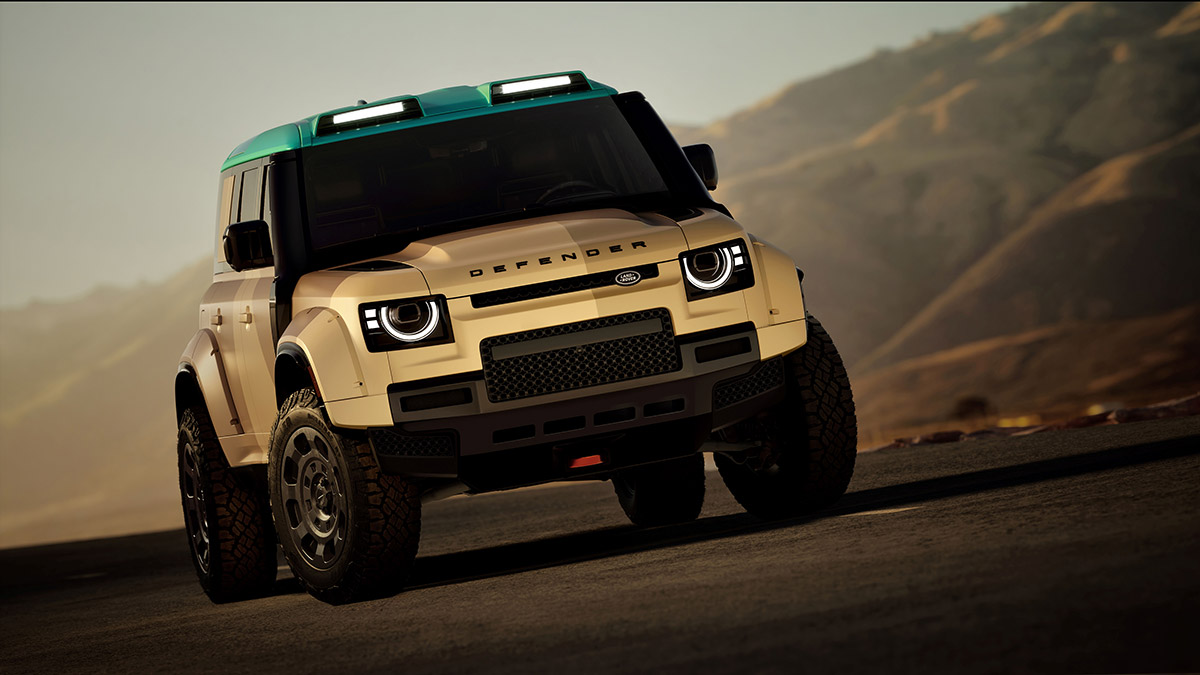
Few vehicles can claim to have earned their reputation in the unforgiving environment of the Dakar Rally before reaching the showroom floor. The limited-run Defender Dakar is one of them. Developed from the race-winning D7X-R and based on the formidable Defender OCTA, it promises to deliver competition-proven capability in a road-legal package unlike anything the British marque has offered before.
For decades, the Dakar Rally has served as the ultimate proving ground for off-road machinery. It is a place where searing desert heat, relentless dunes, rocky mountain passes and thousands of kilometres of punishment expose even the smallest mechanical weakness. Simply reaching the finish line is considered an achievement. Winning is something else entirely. That makes Defender’s latest announcement particularly significant.
Fresh from securing victory in the new Stock category at the 2026 Dakar Rally with its D7X-R competition vehicles, Defender has revealed plans to produce a road-going interpretation of its race winner. Appropriately named the Defender Dakar, the limited-edition model represents far more than another flagship derivative. Instead, it demonstrates just how closely the production Defender platform now mirrors the vehicle that conquered one of motorsport’s toughest events.
Unlike purpose-built rally prototypes that share little beyond their appearance with their showroom counterparts, the Defender Dakar owes its existence to the FIA’s new Stock category. Introduced for the 2026 World Rally-Raid Championship, the regulations encourage vehicles that remain fundamentally faithful to their production origins, preserving much of the original body architecture, drivetrain and mechanical layout while allowing carefully engineered upgrades for competition.
The Defender D7X-R race car retains the same D7x aluminium monocoque body architecture found in the production Defender OCTA, together with its transmission, driveline and 4.4-litre twin-turbocharged V8 engine. Rather than designing a bespoke competition vehicle from scratch, Defender’s engineers refined an already capable platform to survive one of the world’s harshest endurance events, and the results speak for themselves.
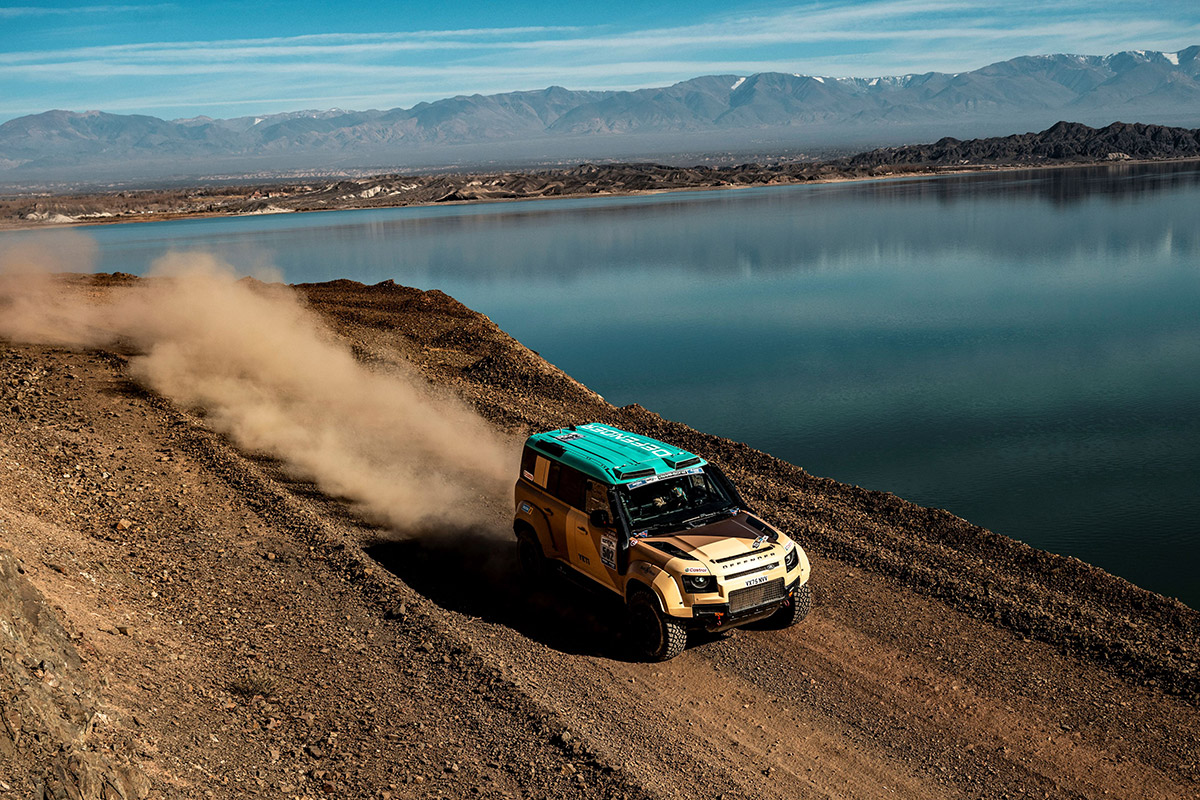
On its Dakar debut, Defender’s three factory-entered D7X-Rs claimed first, second and fourth places in the Stock category, while recording a remarkable 1-2-3 finish on ten of the event’s thirteen stages. Collectively, the cars covered around 24 000 kilometres throughout development and competition, underlining the robustness of the underlying platform.
It is from this achievement that the Defender Dakar has emerged.
MORE THAN AN OCTA WITH ACCESSORIES
At first glance, it would be easy to dismiss the Defender Dakar as a Defender OCTA dressed for adventure. That would be doing the engineering team a considerable disservice.
While the OCTA already sits at the pinnacle of the Defender range, the Dakar goes considerably further by incorporating lessons learned directly from competition.
The suspension geometry has been revised, while specially developed Bilstein Advanced Dampers have been carried across from the rally programme. New 35-inch all-terrain tyres mounted to forged 20-inch wheels provide additional ground clearance and improved traction over demanding terrain. Defender has also introduced dedicated Dunes and Gravel drive modes, along with an innovative Flight Mode originally developed for the D7X-R competition cars to better manage airborne landings across desert terrain.
Power comes from the familiar 4.4-litre twin-turbocharged V8, although unlike the competition vehicle, it is no longer restricted by FIA regulations. The result is a formidable 467 kW and 750 Nm, supported by enhanced cooling systems designed to cope with sustained high-load operation in extreme conditions.
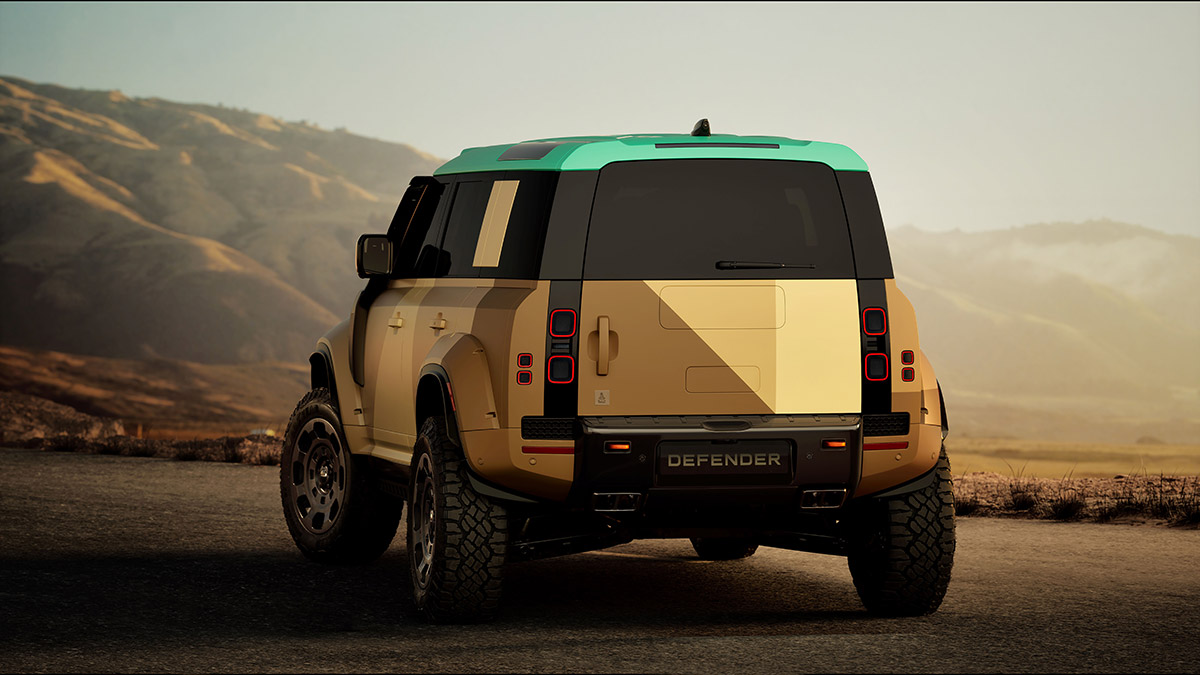
Visually, the Defender Dakar leaves little doubt about its intentions. A fixed metal roof, exposed carbon fibre bonnet, raised air intakes, roof-mounted auxiliary lighting, extended wheel arches with exposed rivets and substantial underbody protection distinguish it from the standard Defender range. These are not styling exercises for appearance’s sake, but components inspired by the functional requirements of rally-raid competition.
Inside, the changes continue. The cabin adopts a purposeful 2+2 configuration with specially developed front race seats, plus optional four-point harnesses for owners who want to explore the vehicle’s considerable capabilities off sealed roads. Rear stowage is designed to accommodate race helmets, while the load area includes dedicated mounting points for the spare wheel and air compressor, reflecting the self-sufficiency demanded by long-distance off-road travel.
A FITTING TRIBUTE TO DEFENDER’S HERITAGE
For Defender, however, the Dakar is about more than outright performance. It also represents the latest chapter in a story that stretches back almost eight decades.
Since the original Land Rover debuted at the Amsterdam Motor Show in 1948, the brand has built its reputation on taking people to places where conventional vehicles simply could not venture. Farmers, explorers, conservationists, humanitarian organisations and military forces have all relied on its legendary capability. More recently, the modern Defender has balanced that rugged DNA with the refinement, technology and comfort expected of a premium SUV.
The Defender Dakar arguably brings those two worlds closer than ever. Where previous halo models have focused largely on luxury or outright performance, this newcomer places the emphasis squarely on durability and extreme off-road capability. It is designed to celebrate what Defender does best, rather than attempting to become something it is not.
That authenticity is perhaps what makes the project so compelling. Rather than creating a motorsport-inspired marketing exercise, Defender has effectively reversed the process. The D7X-R competition car itself was developed from the production Defender OCTA, allowing knowledge gained in competition to feed directly back into the road-going vehicle. It harks back to an era when endurance racing genuinely improved production cars, rather than simply providing a platform for brand exposure.
It also places Defender in relatively exclusive company. Manufacturers have increasingly turned to high-profile motorsport programmes to reinforce their performance credentials, but very few have translated those achievements into production vehicles with this level of authenticity. Porsche’s 911 Dakar proved there was demand for rally-inspired road cars, while Ford’s Ranger Raptor has shown the appeal of factory-developed desert runners. The Defender Dakar occupies similar territory, although its roots in long-distance rally raid arguably make it even more purpose-built.
AN EXCLUSIVE PROPOSITION
Defender has confirmed that the Dakar will be produced in limited numbers, adding an element of exclusivity that is likely to appeal as much to collectors as serious off-road enthusiasts. The model made its public debut as a Design Preview at The Quail, A Motorsports Gathering, during California’s Monterey Car Week, sharing the stage with historic Defenders, the victorious D7X-R competition vehicle and a range of immersive Land Rover Experience displays.
Visually, buyers will be able to specify a distinctive Dakar Sand exterior paired with a Yanbu Turquoise roof, directly inspired by the race-winning D7X-R livery. Those seeking a more understated appearance can opt for Narvik Black or Alaska White, both of which are available with an optional matte protective film.
Reservations are expected to open during early 2027, with further technical details due to be revealed at the 2027 Dakar Rally in Saudi Arabia.
LAST WORD
In recent years, the performance SUV segment has become increasingly crowded, with many manufacturers chasing ever-larger power outputs and faster lap times. The Defender Dakar heads in a different direction.
Yes, its unrestricted twin-turbocharged V8 delivers an impressive 467 kW, but that is only part of the story. Its true appeal lies in the engineering beneath the surface – the reinforced suspension, rally-derived technology and uncompromising focus on durability that stem directly from one of the world’s toughest motorsport events.
Perhaps most importantly, it represents a level of authenticity that is becoming increasingly rare. This is not a styling package wrapped around a familiar SUV, nor is it an exercise in nostalgia. Instead, it is a machine shaped by thousands of kilometres of relentless competition, where reliability, resilience and capability mattered far more than showroom appeal.
Whether many owners will ever explore its extraordinary limits remains debatable. Like many halo vehicles, the Defender Dakar is likely to spend as much time in carefully curated collections as it does carving through dunes or tackling remote mountain trails.
Yet that almost misses the point. The Defender Dakar exists because Defender proved it belonged at the very highest level of off-road competition. Its desert success has laid the foundation for what promises to be one of the most focused and capable production Defenders ever made.
Report & Images © JLR SOUTH AFRICA

