



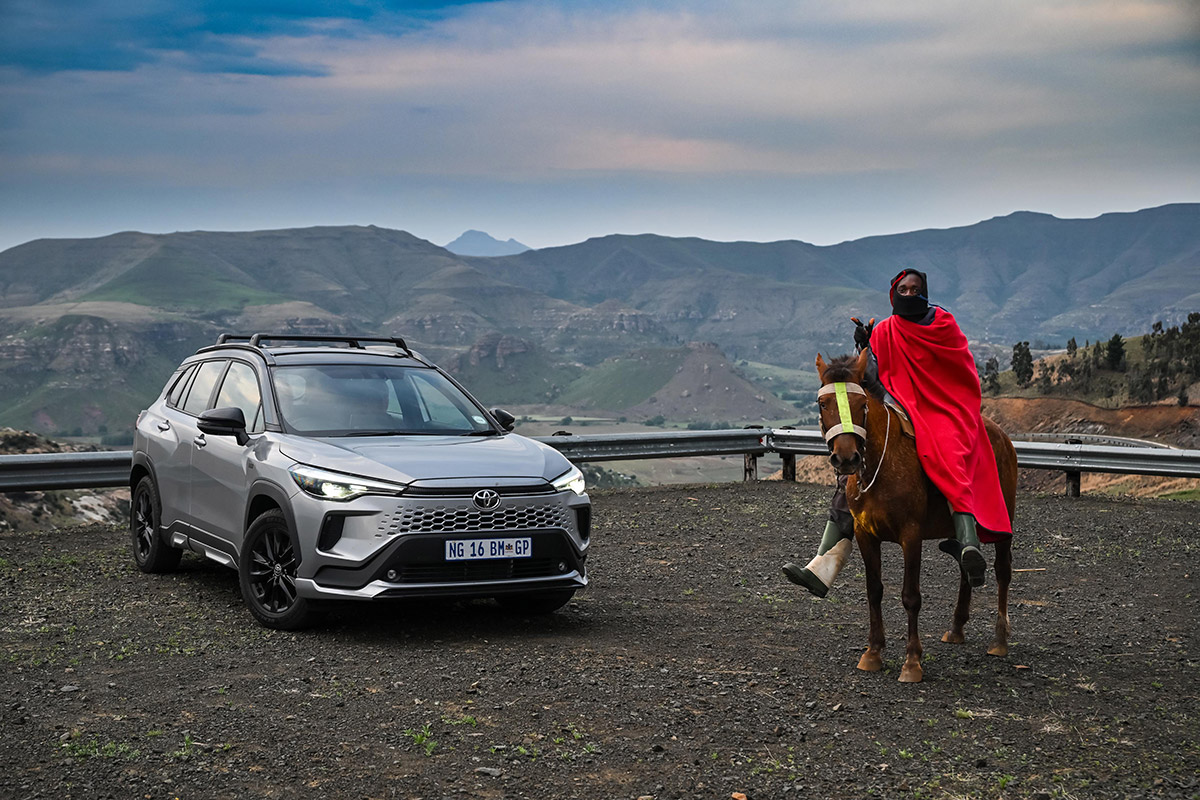
Since its introduction 60 years ago, the venerable Toyota Corolla has become the most successful car nameplate globally, with over 57 million sold worldwide, and close to two million produced in South Africa. To celebrate six decades of the Corolla, we visited six countries in 60 hours in a special-edition 60th Anniversary Corolla Cross.
In 1966, when the first Corolla rolled off the Toyota assembly lines, no one would have guessed this small car from a relatively unknown Japanese carmaker would revolutionise the world of motoring. Initially, Toyota planned to build only 30,000 a month, so imagine the company’s surprise when, in only four short years, global sales of the little Corolla reached a million.
Corolla soon became the top-selling nameplate in automotive history, and now – twelve generations and six decades later – it has achieved cumulative worldwide sales of close to 57 million. Since its local introduction in 1975, close to two million units of the ever-evolving range have been sold here, and more than a million have rolled off the Prospecton assembly line in Durban.
To celebrate the Corolla’s diamond jubilee, Toyota South Africa has introduced a special derivative of the Corolla Cross, the crossover SUV counterpart of the twelfth-generation E210 series Corolla. Previewed at the 2026 SA Auto Week in Durban, the 60th Anniversary Edition is based on the Cross 1.8 Xs but features unique (and well-designed) 60th anniversary decals on its side panels, boot, and door sills, and embroidered emblems on the front seat headrests.
We flew up to Durban to collect the vehicle, fresh from its Autoweek stand, for our planned crusade from South Africa through six countries – traversing Lesotho, Eswatini, Mozambique, Zimbabwe, Botswana and Namibia – within 60 hours.
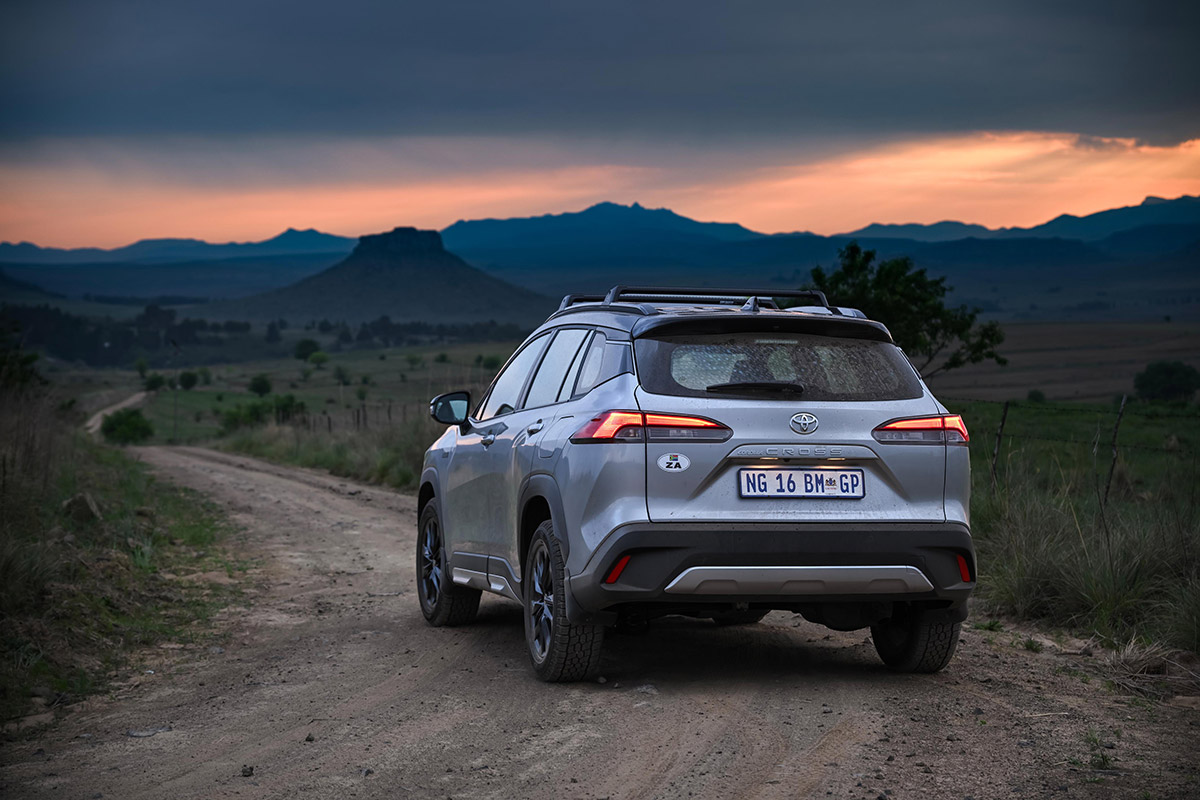
While planning the route, we realised more robust rubber than the Cross’s standard 17” Highway-Terrain tyres will be needed, so we sourced a set of General Grabber Cross A/S (All-Season) tyres from Continental Tyre South Africa, expertly fitted by Zubair Khan and his BestDrive Durban Central team.
Initially, we planned an early morning start to our journey from Wyndford Holiday Farm close to the Caledonspoort RSA/Lesotho border but – realising we would miss fantastic photo opportunities – we decided to do this leg in reverse, from Monontsha (Monantsa in Lesotho) to Caledonspoort, on our way from Durban to the Wyndford farm in the Free State Province.
This necessitated a change in timing procedures, as our self-imposed 60-hour travel time limit – excluding time lost during border crossings (as we could not control this) plus time allocated for videography and photos (as we had to document the trip) – would then need to be interrupted, as our Wyndford stay-over initially wasn’t included in the trip.
With the small border post closing at 16:00, we had to push on, and the 1.8-litre engine, delivering a modest 103 kW and 172 Nm of torque, worked hard over the undulating Natal Midlands roads. With constant climbs, we soon found the best way to make good progress was to keep the engine on the boil, as the CVT battled to get the Cross up to speed, so it was imperative to maintain momentum.
LESOTHO
Monantsa to Caledonspoort (clock started, travel time: 1 hour 47 min.)
Winding our way up the Maluti mountains, we made it to Monantsa with 40 minutes to spare. The border personnel were quite surprised to see a private vehicle coming through this way, but the procedures were smooth and quick.
After clearing the Lesotho side, we started the clock on the 60-hour countdown. Doing the snaking, undulating route at this time was a good call, as photographer Rob Till captured some amazing pictures (it’s even more picturesque than Golden Gate).
Despite many speed bumps in the numerous villages **en route**, the smooth, tarred road (completed two years ago and named after UN Secretary-General António Guterres) was easy to traverse. Crossing back into South Africa at Caledonspoort, we stopped the clock for our overnight stay at Wyndford.
The next morning, we restarted the clock an hour and 47 minutes into our journey, following the route over Bethlehem, Ermelo and eMvelo in Mpumalanga towards the Nerston border post between South Africa and Eswatini.
The Corolla Cross buzzed happily along the long and straight Highveld stretches of road, and the number of older Corollas still running in smaller towns and more rural Mpumalanga areas was remarkable… At Nerston, we stopped the clock, showing a total time of 6 hours 29 minutes, until we passed through the Eswatini border post at Sandlane.
ESWATINI
Travel time to Nerston border: 4 hours 42 minutes (Total time:6 hours 29 mins)
Having filled up in Bethlehem, our idea was to refuel at Sandlane (petrol is cheaper in Eswatini), but unbeknownst to us, the fuel station closed down, so we pressed on to Bhunya. The Cross, with a smallish 47-litre fuel tank, were now running on empty, and our stress levels were soaring.
Luckily, the twisty, badly deteriorated road (due to all the logging trucks using it) was mostly downhill, and we made Bhunya with two litres to spare… The facility’s card machine wasn’t working, so we had to draw extra cash, but even with transfer fees included, we still saved over R200 on the price in South Africa!
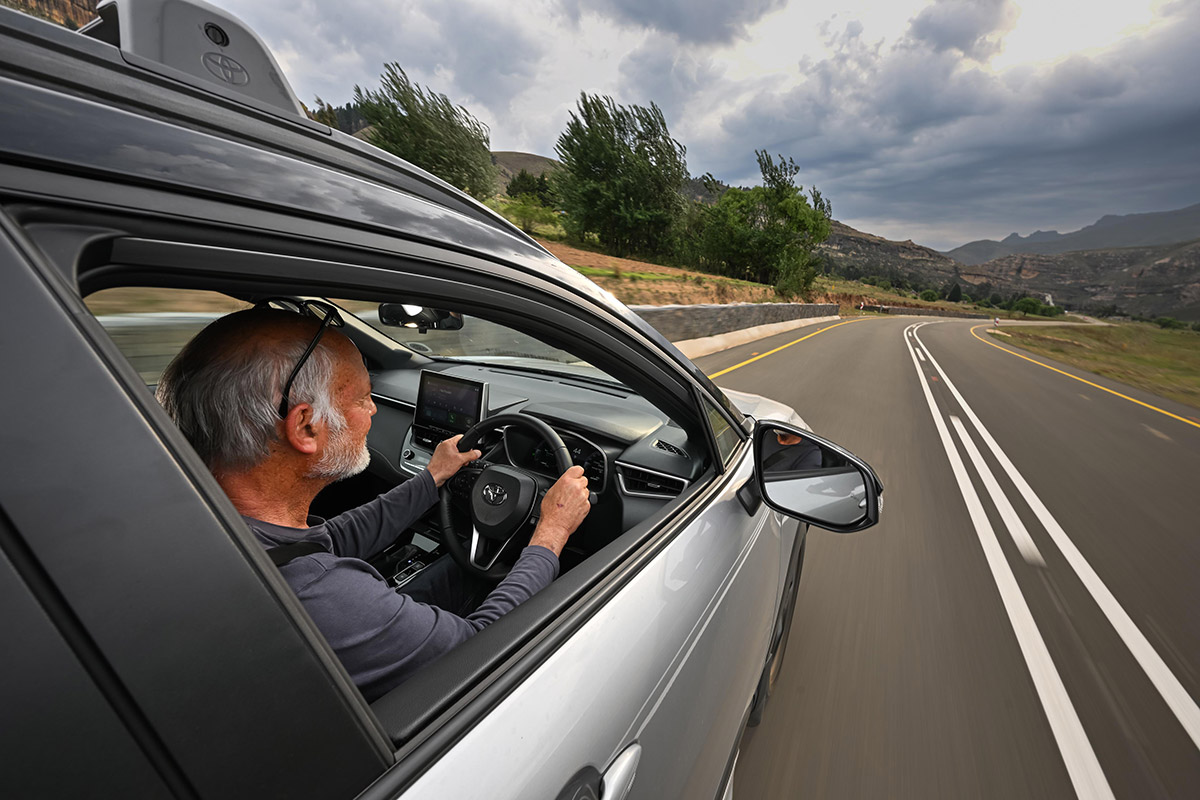
Manzini was busy, and it took some creative navigation (via wireless phone connection to the 10” central display) from companion Marnus Hattingh to get us out of the city and onto the brand-new freeway towards Matsapha airport. From there, it was easy to drive to Goba, on the border with Mozambique.
MOZAMBIQUE
Travel time to Goba border: 2 hours 34 minutes (Total time: 9 hours 3 minutes)
By now it was seriously hot (outside temperature of 38 degrees), and we appreciated the auto dual zone aircon with rear ducts in the Cross, as well as the cooled central bin keeping our drinks cold. Procedures at Goba on the Eswatini side went quickly, but on the Moz side, the personnel, while friendly, couldn’t understand why we didn’t want to stay over in the country.
It took some explaining, but we were on our way soon enough, aiming for Namaacha (as we did not want to go to the notoriously busy Komatipoort). Still descending, the pothole-strewn tarred road twisted down a spectacular pass, and we crossed old colonial bridges before climbing the Lebombo Mountains again.
It took us 53 minutes to picturesque Namaacha, a quaint old colonial town nestled in the mountain foothills, and a quick crossing saw us back in northern Eswatini, negotiating another pothole-strewn tarred road curling back towards Maphiveni before turning north through numerous green sugar cane plantations towards Mananga.
BACK IN SOUTH AFRICA
At Mananga, after 36 minutes of travel time, the crossing back into South Africa was seamless, but the road towards Mbombela was clogged with late-afternoon traffic. By now, we were over 10 hours on the road (and through eight border posts), and the non-stop throng of trucks, roadworks and stop-go’s on the N4 tested our patience.
We reached Mbombela just after nightfall, and after a good dinner headed off towards Sabie Star Chalets. From Mananga to Sabie took us 4 hours 37 minutes (including a fuel stop and dinner), and overnight stop included (7 hours 19 minutes); our travel time the next morning stood at 15 hours 6 minutes.
From Sabie, we faced some misty roads on the Panorama Route towards Tzaneen, but after joining the N1 at Louis Trichardt (where we filled up again), we made good time towards Beit Bridge. Here we were greeted by a kilometres-long truck queue, but the border procedures on the South African side went smoothly, and by 11:00 we had crossed the Limpopo into Zimbabwe.
ZIMBABWE
Travel time Sabie to Beit Bridge: 6 hours 15 min (Total time 28 hours 40 min)
With border papers for Zim now done online, the process was seamless at first, but when it came to vehicle papers and payment, a staff rotation and endless interference by “fixers” had us waiting in queue for over two hours! Speak about good systems sabotaged by poor execution.
By now, we were in a dilemma. Our target was the small Mlambapele border post at the Shashe River, on a route of unknown dirt roads… It was at least three hours away, and with the crossing closing at 16:30 (it was now 13:30), we were really pressed for time.
If we’d known what lay ahead, we probably would have turned back, but in true adventurer style, we pressed on, turning off the A6 main road towards Hwali, Seboza, Manama and Mashaba. The dirt road soon transmuted from smooth gravel to a rocky, sandy track (in some places, barely visible), detouring past broken bridges and through culverts, with nary a road sign anywhere…
Dodging ruts, culverts, ditches, and stray animals, we found the only passable bridge over the Tuli River, thanks to Marnus’s smart navigation (following a thin line on his phone). With time running out, we were now in rally mode, and the tyres and rims took a lot of hard hits.
The on-off acceleration and braking to avoid road obstacles also played havoc with fuel consumption (over 10 l/100 km), but the rugged tenacity and grip of the Grabber Cross tyres earned our respect. We reached the border post in a plume of dust with 15 minutes to spare…
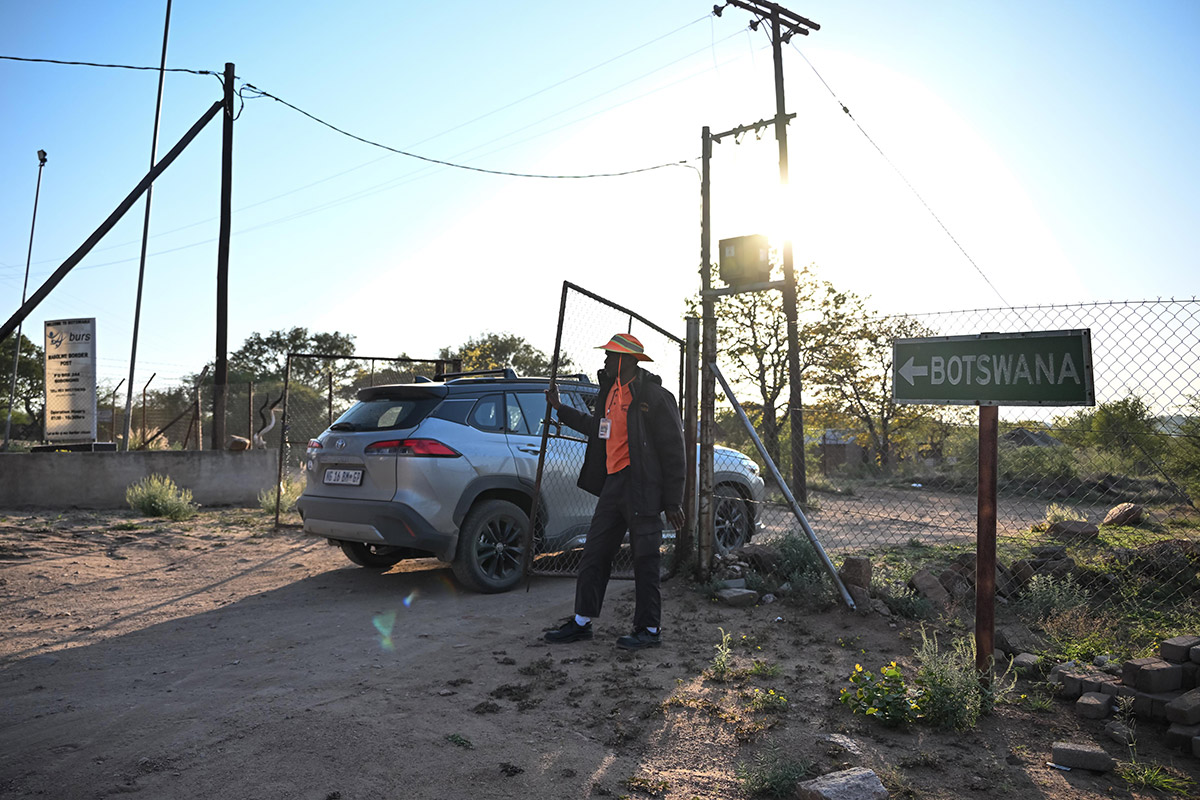
Paperwork done, we drove down to the Shashe River to find a 400 m stretch of soft sand facing our two-wheel drive SUV… Despite deflated front tyres, we bogged down twice, but with local hands helping and deft driving, we were across within 20 minutes… only to find the Botswana side border post closed.
BOTSWANA
Travel time Beit Bridge to Mlambapele: 3 hours 17 minutes (Total time 31 hours 47 minutes)
We explained our situation to the border guard (apparently Zim should have let them know we were crossing but didn’t), and luckily the friendly Botswana staff understood, and with the sun setting, we were on our way to Mabolwe. Here we filled up again before setting off for Martin’s Drift (Groblersbrug), travelling over Bobonong and Sefhophe.
Even after the pounding it took in Zim, the Grabber tyres were in good nick, and their ride quality on the smooth Botswana tarmac was superb. Just over three hours later, we were at Martin’s Drift (total travel time 35 hours 47 minutes), and crossed the Limpopo River again back into South Africa.
BACK IN SOUTH AFRICA (AGAIN)…
From here, we decided to push on to Northam, and the drive in the dark (the Cross has good headlights) was uneventful. It was a long day, as we reached our overnight destination (Northam Travelodge) just before midnight. After a hearty breakfast the next morning (day three of our trip), our total travel time – including 8 hours 25 min overnight – was 46 hours 58 minutes.
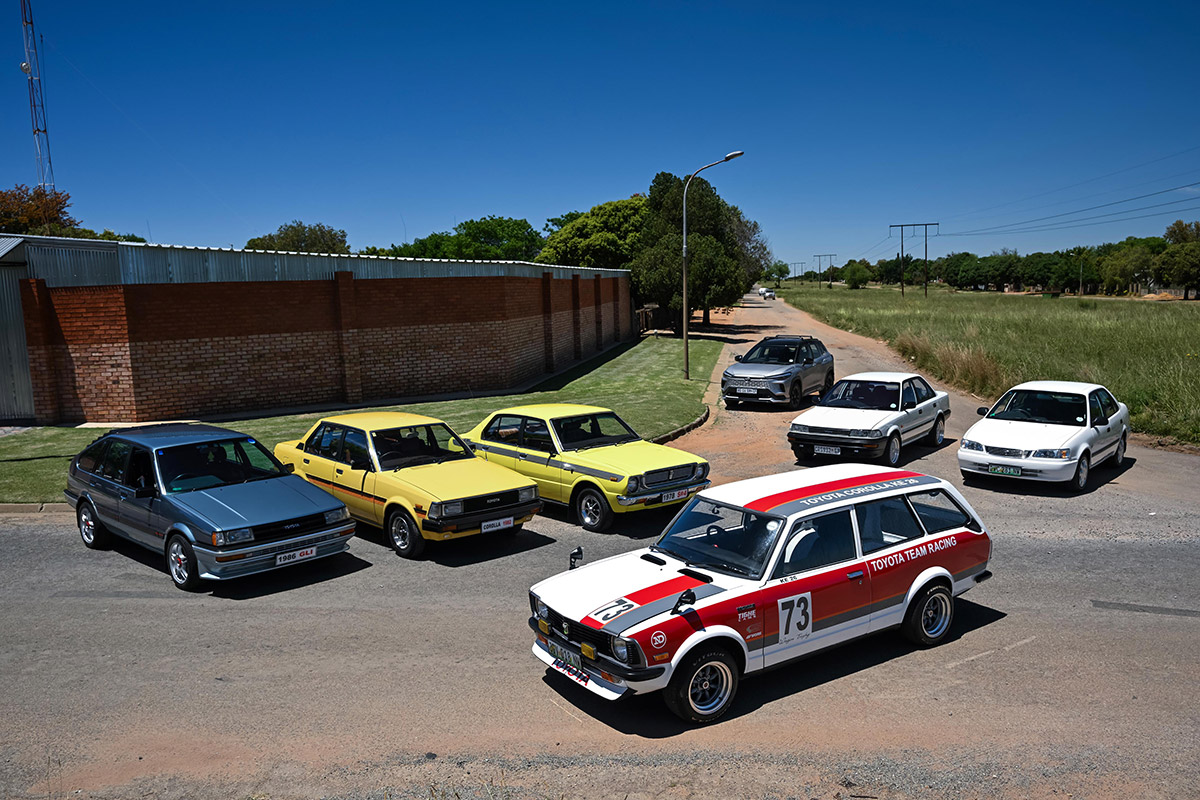
With five countries down and one to go, our itinerary included a visit to the private Toyota Museum in Klerksdorp, owned and run by Nico Fourie, his wife Tanya and son Dirco. Stopping the clock for two hours, Dirco guided us through the museum collection and helped us position six classic Corollas for a photoshoot with the Cross – a tribute to the heritage of the Corolla in the country.
The museum has over 100 classic, modified, and rare Toyotas, including “Tracy”, the famous 1997 Toyota Conquest driven from Cape Town to London in 2018 by the late 81-year-old Julia Albu, a 1963 Toyota Tiara, 1966 and 1972 Corona models, 1966 Stout, 1970 Hilux Mk1, a selection of Supras and some MR2 Mk1 and Mk2s.
For the shoot, we positioned the Cross with a rare KE72 fourth-generation Corolla station wagon, a 1987 third-generation SR4 (this was the first generation available locally from 1975), a 1982 fourth-gen model, a 1986 fifth-gen Avante GLi, a 1990 sixth-gen GLE and a 1998 eighth-gen derivative (South Africa skipped the seventh generation Corolla).
Saying goodbye to the enthusiastic Dirco, we started the last leg of our journey to Ariamsvlei in Namibia, with the clock reading 50 hours 46 minutes, giving us just over 9 hours to reach our destination. However, we still had to negotiate the notoriously potholed roads of the Northwest Province, and on this stretch one of the hardworking Grabbers sustained slight bubble damage.
NAMIBIA
Travel time Klerksdorp to Ariamsvlei: 8 hours 52 minutes (Total travel time: 59 hours 38 minutes)
Still, after a final petrol stop in Olifantshoek, we made it to Ariamsvlei (14 km from the South African side) with just over 20 minutes to spare. Our total travel time? 59 hours 38 minutes. Mission accomplished. However, we faced one more curveball. Our accommodation at Ariamsvlei was apparently not confirmed, so here we were in Namibia at 22:30 with no place to stay…
A few phone calls later, and with traditional Namibian hospitality, we found a place in Karasburg, 100 km down the road. With no time restrictions anymore, we enjoyed our stay at Avondsrus in Karasburg before returning to South Africa and Cape Town via Vioolsdrif.
Safely back in Cape Town after over 4,500 km on some of the toughest and roughest roads in the world, we could reflect on an amazing trip. Even in these conditions, the ever-reliable Cross 60th Anniversary Edition returned an average of 9.1 l/100 km but, to be brutally honest, without the General Grabber Cross tyres we most likely wouldn’t have been able to complete the trip.
Yes, one may wish for some extra grunt under the hood and a more responsive transmission, but as a comfortable, no-nonsense long-distance companion the Cross again bore testimony to the terrific reliability of the 60-year-old Corolla brand.
Bar serious off-roading, it will literally take you anywhere. No wonder Corollas still reign supreme as everyday transport in the furthest corners of the African outback.
Report by FERDI DE VOS | Images © ROB TILL