



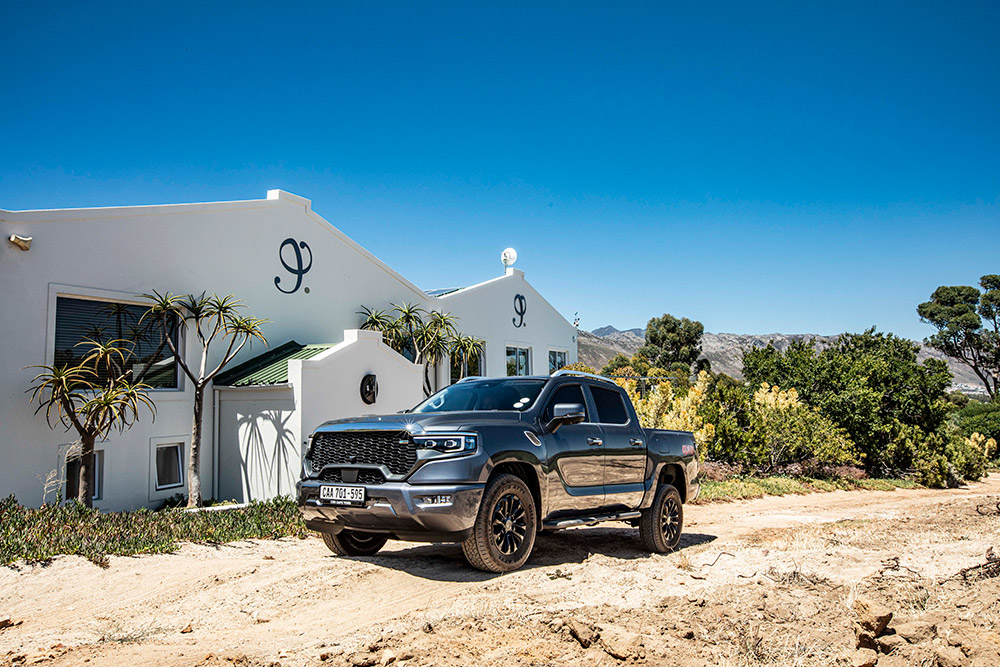
Following the sales success of their smaller Tunland bakkie derivatives in South Africa, Foton has now unleashed the big and bold V-Series on local soil. With the Tunland V9 prioritising refinement and comfort, we took the V-Series flagship to Journey’s End Winery and Vineyard near Somerset West to make acquaintance with their V-Series of wines.
After a six-year absence, Foton re-entered the country in 2024 with its trusty Tunland G7 (known as Tunland Yutu in China). Following brisk sales of the affordable G7, the Chinese automaker – an affiliate of the BAIC Group – recently added the big and bold, full-sized double cab Tunland V-Series to its local ranks.
Built to suit a wide range of South African lifestyles, the Tunland V7 is focused on durability and tough work assignments. With leaf-sprung rear suspension and a reinforced cargo box, the V7 is well-suited to heavy loads, challenging terrain and demanding daily use.
By contrast, the Tunland V9 prioritises comfort and refinement, and although we initially wanted to feature the V7 first, a V9 was available immediately, so we changed the schedule (and our script) to start with the flagship bakkie in Foton’s line-up.
Described as a full-size pickup truck, the V9 (known as the Mars 9 in China) is 5,617 mm long, 2,000 mm wide, and has a wheelbase of 3,355 mm – making it one of the biggest pickups now available in the highly contested one-tonne double-cab bakkie market.
Bigger than the BYD Shark and the sizeable LDV Terron (standing 5,500 mm long, 1,997 mm wide, 1,874 mm high, with a 3,300 mm wheelbase), it dwarfs the Ranger and Hilux. With its prominent grille, the huge V9 can easily be mistaken for an American pickup truck, like the Ford F150, Ram 1500, Chevy Silverado or a GMC Sierra.
While somewhat less bold (and slightly smaller) than the V7, the chromed grille and conspicuous front design of the V9 are a primary focal point, and during our short jaunt with the big newcomer, we were inundated by people admiring its looks, commenting on its in-your-face design and size, and requesting more information about the vehicle.
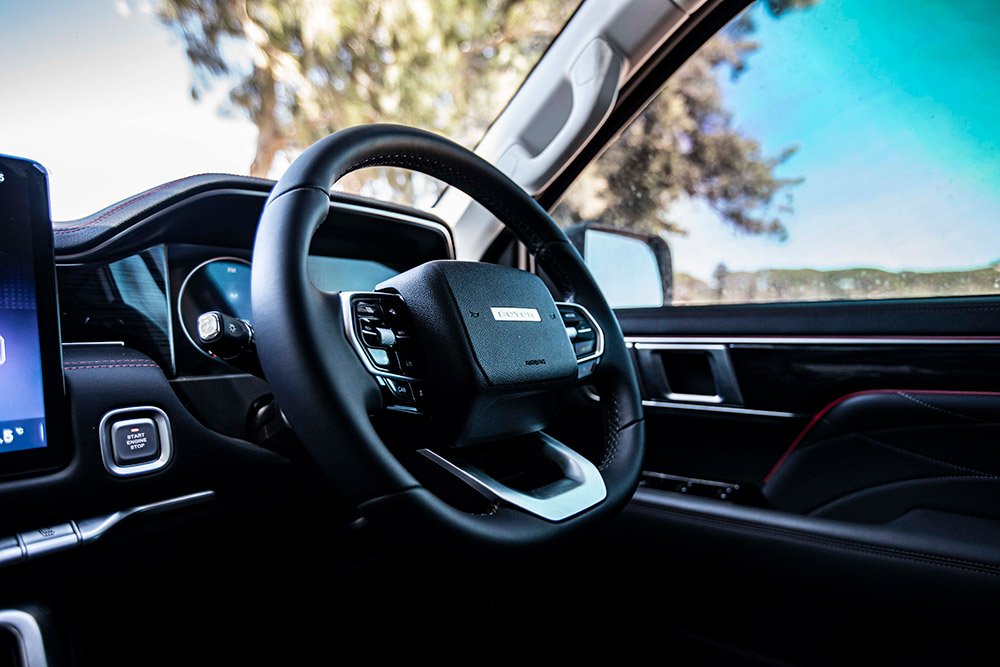
Big it is, with lots of interior space that will easily accommodate five adults and premium features such as a panoramic sunroof, leather upholstery, a 12.3″ infotainment display, and advanced driver‑assistance systems. However, there is a drawback to its size; it doesn’t easily fit into a standard-size garage, or small parking spaces for that matter, and it has a bigger turning circle (13,5 m), making it less agile in confined spaces and on narrow roads.
MILD HYBRID POWER
Locally, the Tunland V9 is powered by Foton’s 2.0-litre AUCAN Mild Hybrid diesel engine, co-developed with Cummins, incorporating a BorgWarner turbocharger and low-range 4×4 transfer case, and an eight-speed ZF automatic transmission, all managed by Bosch electronics.
On learning that the engine only delivers 120 kW at 3,600 rpm and 450 Nm of torque (from a low 1,500 to 2,600 rpm), I was concerned the V9 might be underpowered, but the 48V belt-integrated starter generator definitely helps the 2.2-tonne beast attain respectable acceleration figures (0-100 km/h in under 11 seconds).
The engine, with its soft yet typical Cummins clatter, has a laidback character, yet the 48V system gives the bulky V9 a nice shove from the get-go. It ticks over nicely at highway speed but does not like high revs or sudden inputs, meaning you need to plan overtaking manoeuvres ahead of time.
From the N2 highway, heading east towards Elgin, we turned off towards Sir Lowry’s Pass Village, and on this narrow, undulating road section, the V9 impressed with its road manners, feeling solid and balanced with little body roll, while its multi-link rear suspension nicely soaked up the bumps.
The V9’s power steering is precise but feels somewhat remote, and one needs to get used to the brakes, as they tend to initially overcompensate in terms of brake pressure, and then go soft – forcing you to apply more pressure to bring the hulking bakkie to a standstill.
We had to carefully navigate a narrow single-lane mixed-surface road leading up to the Schapenberg hills and Journey’s End, where we were met by director Tom Hanson-Smith and winemaker Michael Dawson at the wine cellar on the sprawling, picturesque estate.
SHARED HISTORY, SHARED V-SERIES
Journey’s End was acquired by the Gabb family, originally from Shropshire, United Kingdom, in 1996. Fittingly, the Beiqi Foton Motor Company, headquartered in Beijing and a subsidiary of the BAIC Group, was founded the same year.
Over three decades, the Gabb family restored the wine farm to what it is today, planting 40 hectares of beautiful vineyards on one of the most prestigious terroirs in South Africa to produce quality wines, mostly for export. Tom took us on a tour of the farm, showing us the vineyards and the cabins being refurbished (with accommodation for 30 people), while regaling us with the farm’s history, the milestones achieved, and the accolades received.
Journey’s End converted to solar power in 2014 and became fully Fairtrade certified in 2017. The farm is WIETA (Wine and Agricultural Ethical Trade Association) and IPW (Integrated Production of Wine) accredited and received the Ethical Company award at The Drinks Business Green Awards for Journey’s End Foundation’s work, which to date has provided over 7 million meals to the local community.
In 2021, the estate received a Water Management award. It attained WWF (World Wildlife Foundation) Conservation Champion status, one of only 45 South African wine farms to achieve this, for its continued commitment to sustainable farming and conservation of native fauna and flora.
This focus on ecological awareness to ethically produce excellent wines for all occasions aligns well with Foton’s New Energy Vehicle efforts, locally embodied by the 48V mild hybrid system in the V9 (overseas, the V-Series bakkies are also available with a PHEV powertrain).
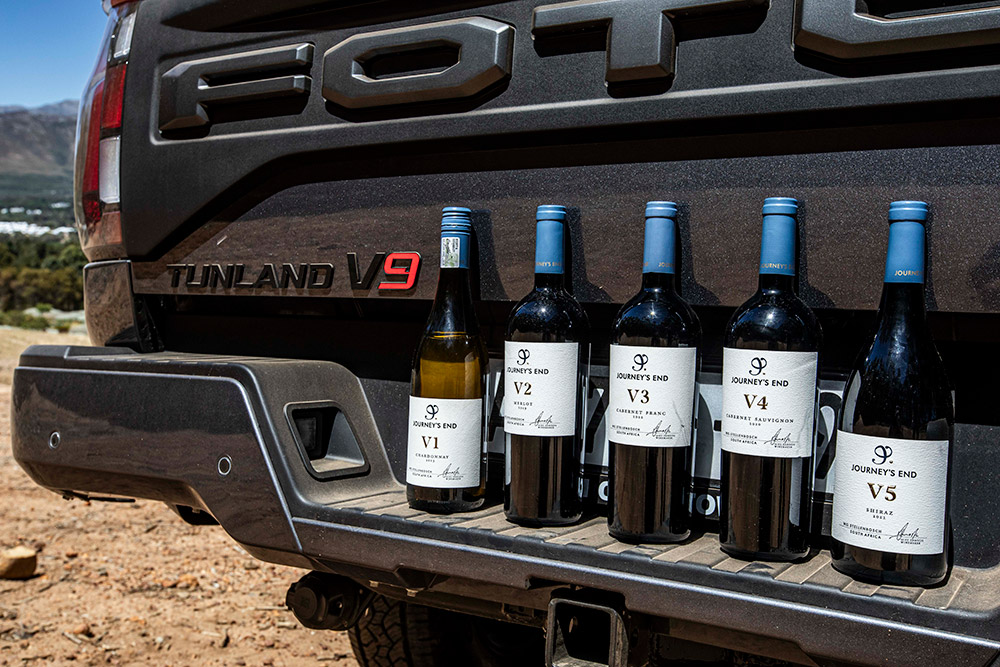
Besides this, Journey’s End also produces its own V-Series (it stands for Varietal Series), consisting of 2023 Chardonnay (V1), 2019 Merlot (V2), 2022 Cabernet Franc (V3), 2019 Cabernet Sauvignon (V4) and 2021 Shiraz (V5), dovetailing nicely with Foton’s more robust Tunland V7 and refined V9.
This vegan-friendly series of wines has also won numerous accolades, much like Foton’s Tunland G7, which won its class in the 2024 Bakkie of the Year competition…leading to the introduction of the bigger, bolder V-Series variety. Besides good consumption (we averaged 9.8 l/100 km on our short trip), this bulky but comfortable and refined new contender promises great value (the V9 4×4 LTD is now available for only R799,900) in a hotly contested segment.
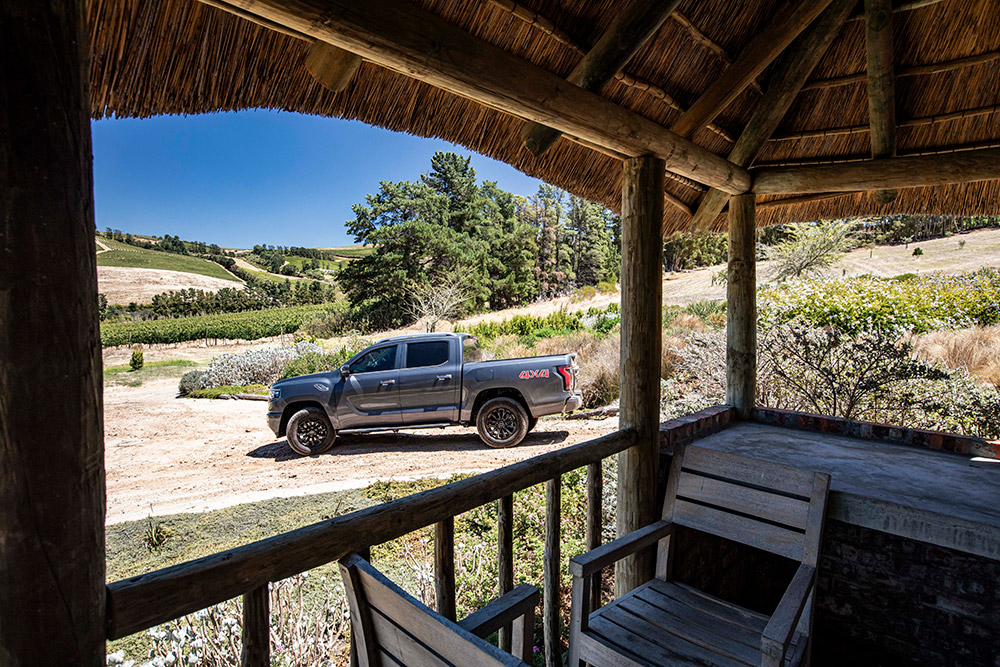
*Our thanks to Journey’s End marketing manager Thea van der Merwe and director Tom Hanson-Smith for their assistance in making our photoshoot possible.
Report by FERDI DE VOS | Images © RYAN ABBOTT