



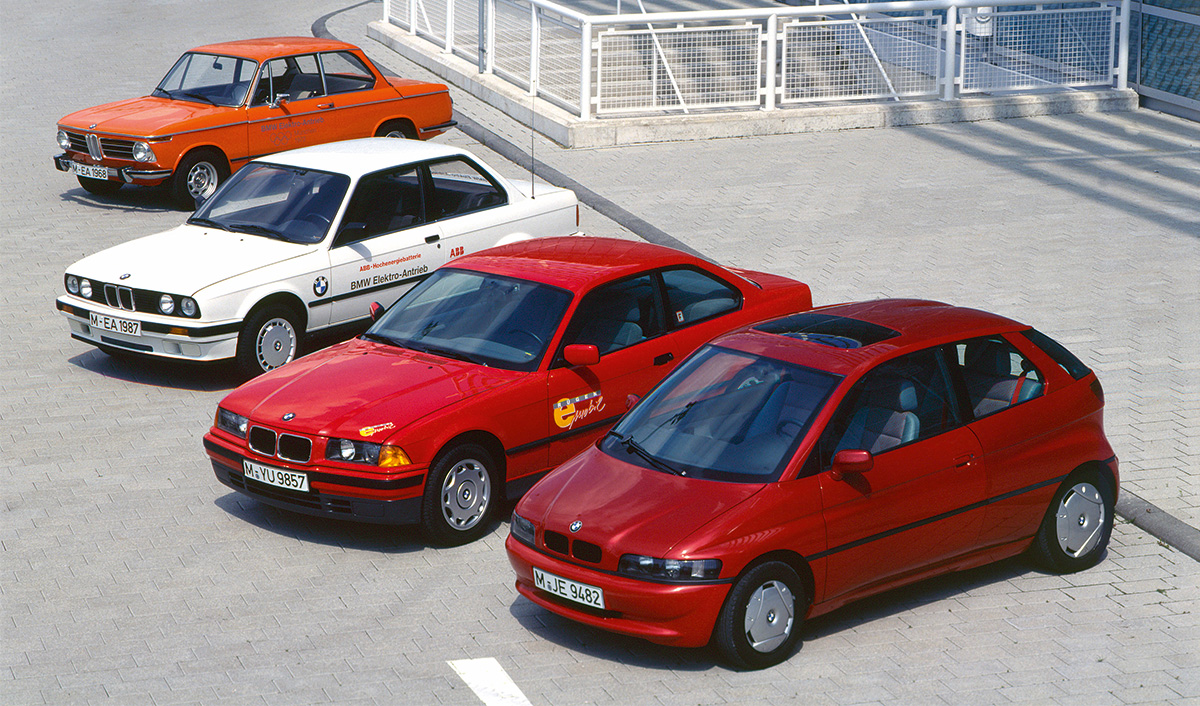
In the late 1960s, decades before BMW even considered building the i3, its first commercially successful EV, the manufacturer began researching electric propulsion technology, and by 1972 it had 1602-based prototypes up and running. The 1602 Electric had a modest range of just 60 km and a top speed of only 100 km/h, but these figures were competitive for the time.
The 1602 was followed by the LS Electric, based on the rear-engined subcompact 700 model. With 10.8 kWh capacity from 10 lead-acid batteries, its electric motor produced up to 17 kW (for a top speed of 65 km/h) and a range of only 30 km. Between 1987 and 1990, BMW followed with eight 325iX models converted from AWD six-cylinder vehicles to front-wheel-drive EVs
However, the 1991 E1 electric concept was BMW’s first viable city car BEV. Its 19 kWh sodium-nickel chloride battery pack gave it a claimed range of 160 km, and it could be fully recharged in around 6 hours. While the E1 looked production-ready, it was never produced, and the 2008 MINI E was BMW’s first (limited) production EV.
Only 600 MINI Es (with a 35 kWh lithium-ion battery pack and a rated range of 161 km) were produced, and they were never actually sold. They were followed by the ActiveE programme in 2012, with 1,100 1 Series coupe-based EVs produced, but this project lasted only two years – superseded by the i3, BMW’s first full-production EV.
Despite its unconventional look and untypical proportions for a BMW, the i3 was a huge hit for the automaker. Discontinued in 2022 after about 250,000 were built, the i3 was the first BMW EV available in South Africa, followed by the iX, the first BMW EV built on a dedicated EV platform. However, the i3, along with the 2019 Mini Cooper SE, can be seen as a precursor to the Neue Klasse EV models, including the new iX3.
Report by FERDI DE VOS | Images © BMW

