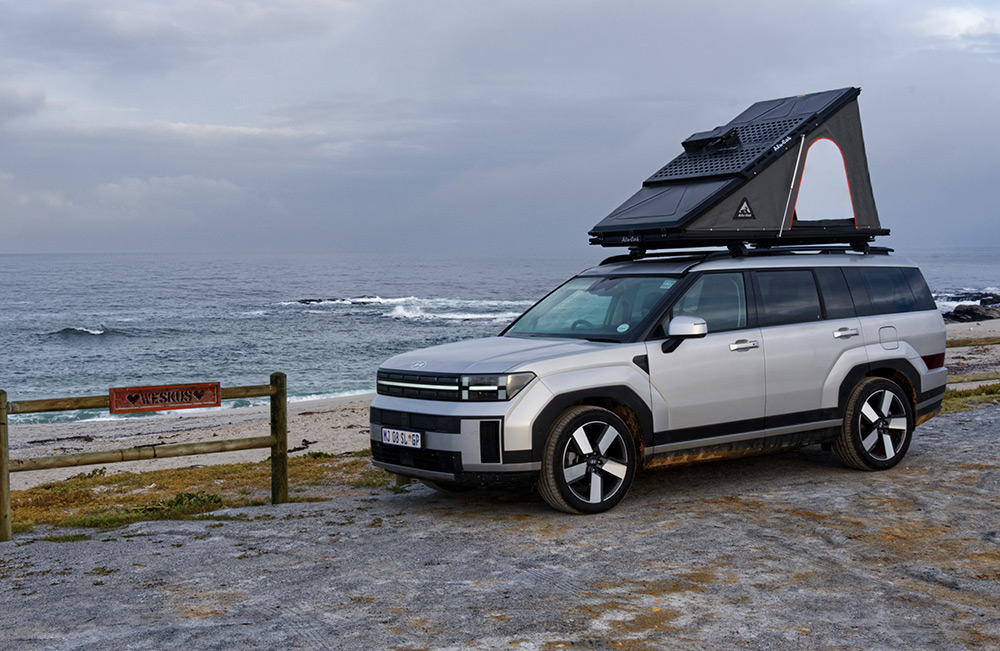
There is a certain allure to a road trip to Namaqualand and the West Coast. Deon Sonnekus visited this honest, sometimes barren part of the country bordering the Atlantic Ocean in the stylish new Hyundai Santa Fe hybrid, complete with a rooftop tent, to spend some time far from the madding crowd.
A ten-day road trip to the West Coast and Namaqualand presented a perfect opportunity to test the versatile new Hyundai Santa Fe SUV’s leisure-vehicle persona across a variety of surfaces and terrains.
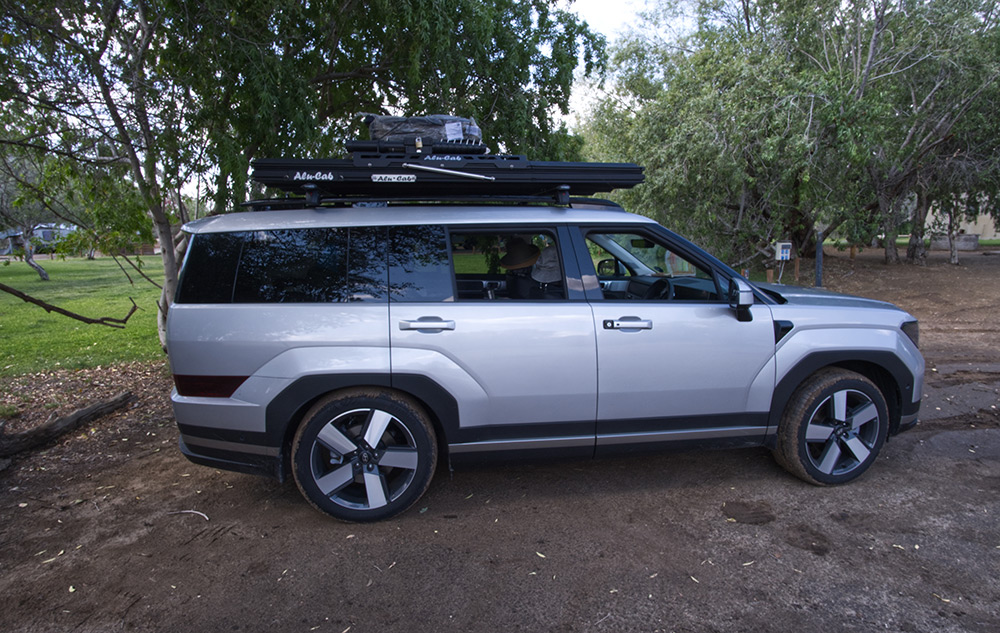
Despite being exceptionally stylish and luxurious, the Santa Fe still has a modest authenticity about it, and this was reinforced by the Alu-Cab rooftop tent it carried. This LT-50 Weekender tent is the lightest rooftop tent in the Alu-Cab range, with the lowest profile – essential if one would like to curb fuel costs on such a journey.
It was early on a Saturday morning when we steered the Santa Fe westwards from Pretoria to find the N14 for a 600 km stint to our first stop: Kathu in the Northern Cape. With cooking and camping gear packed in Alu-Cab boxes in the roomy load bay and music booming from the Santa Fe’s Bose sound system, we were soon rolling past mealie fields in the Northwest Province.
The flat, stretched-out terrain awaited the first good summer rains for the planting season, and from there, towards the Northern Cape, the landscape changed to the Bushveld with its familiar camel thorn trees.
An objective of the trip was to test the overall consumption of the hybrid Santa Fe (a 152 kW/265 Nm turbocharged 1.6-litre, four-cylinder petrol engine mated with a 44 kW/264 Nm electric motor for a combined power delivery of 175 kW and 367 Nm). On the first part of the journey, it yielded 7,1 l/100 km – outstanding for a big vehicle with a curb weight of 1,980 kg, before four passengers, luggage, fuel, and rooftop tent are added.

AUGRABIES FALLS
After an overnight at Kathu, we descended further into the Northern Cape for a two-night camping stay-over at Augrabies Falls National Park, where the Orange River flows and often thunders down an 18-km-long ravine.
The ease of camping with the Alu-Cab rooftop tent was tested in the well-tended rest camp of the park, where it took less than two minutes to open and lift the roof with the assistance of two gas compression struts, while the rest of the party erected tents and stretchers.
On a day visit to Riemvasmaak’s hot springs in the Augrabies area, we had our first encounter with gravel roads, which the all-wheel drive Santa Fe handled with ease. Power is constantly shifted between the front and rear axles according to road conditions.
When the sand got a bit loose and thick, one could switch to one of three available terrain-driving modes: Sand, mud, or snow. On tarred roads, the choices are between Eco, Sport or My Drive, where you can set the performance for each function. For open-road driving and on normal gravel roads, we kept to Eco mode with good results.
At Augrabies, we started to learn the do’s and don’ts of rooftop tents, especially how to keep sand out of the bed. We also learnt that zipping up the gauze door opening covers keeps insects (and the monkeys) out. After two nights listening to the constant soft rumbling of the Orange River at the “place of great noise” – the meaning of the Khoi word Augrabies – we ventured out on the N14 towards Springbok in Namaqualand.
Driving the Santa Fe down Spektakel Pass between Springbok and Kommagas charged the hybrid drivetrain’s battery almost to full capacity thanks to energy regenerated by the wheels. As a result, we could travel for quite a few kilometres on pure electric power in the 38-degree heat in the valley.
We then crossed the Buffels River on our route towards the rustic cottages at Die Houthoop, a guest farm a stone’s throw from Kleinzee, from where we were to start our drive down the West Coast. Kleinzee also introduced us to the chilly, rainy weather one can encounter in October on the West Coast, less than an hour after the heat in the Buffels River valley.
Kleinzee was a busy mining town with a population of about 4,000 at its peak, but after mining activities dwindled, its population declined to less than half of that. A drive through Kleinzee these days makes it seem like a one-horse town where the horse has bolted.
The following day’s travel started in soft rain, but improved as we reached Hondeklipbaai, 85 km south, for lunch at the Rooi Spinnekop Restaurant (Afrikaans for “red spider”, as crayfish is also called in this region). Louis and Nicolien Crafford serve a good food experience here, especially their fish fried in batter.
Our next camping spot at Koringkorrelbaai brought out the unpretentious, modest qualities of the West Coast and its people. An interesting fact about Koringkorrelbaai is that the Nazi sympathiser Roby Leibbrandt landed here during the Second World War with a radio sender and the mission to overthrow the government of Jan Smuts. This piece of history is told on a notice board at Koringkorrelbaai.
For the hardened camper, Koringkorrelbaai is heaven. The only amenities are pit toilets and stone bomas built as wind shelters for cooking. The allure is its desolation, as you can go for long walks without seeing another human being, but one needs to be kitted out well to camp in relative luxury at Koringkorrelbaai. All water, for drinking, cooking, and washing, is brought in, as well as one’s own firewood.

LAMBERT’S BAY
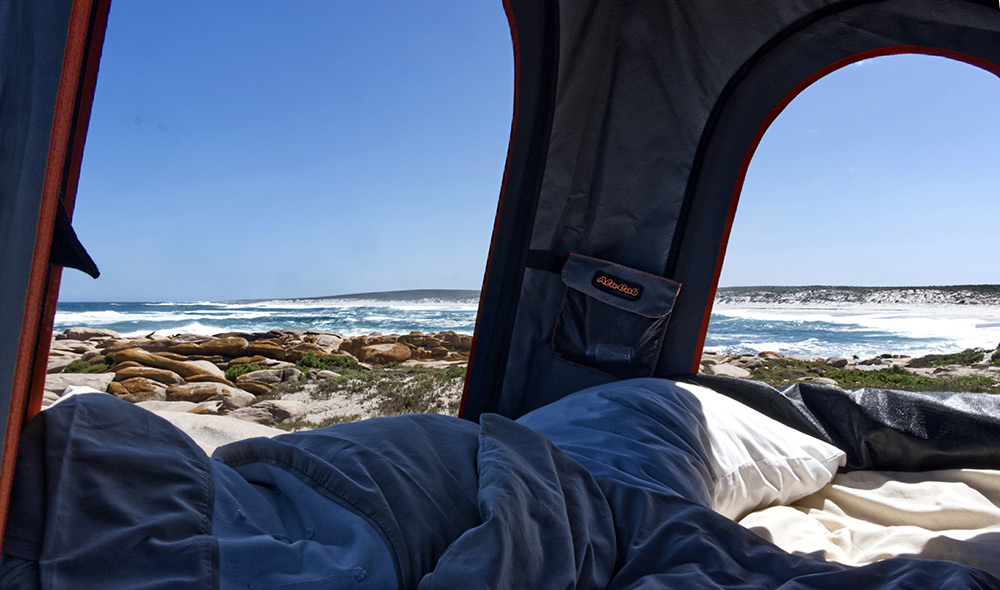
The sturdy Alu-Cab rooftop-tent offered good shelter in the stiff breeze and misty weather, but the persistent wind and wet weather prompted us to cut short our stay at Koringkorrelbaai and move on to Lambert’s Bay, a quaint fishing village that has become a popular tourist attraction on the West Coast.
A visit to the large breeding colony of gannets at Bird Island after breakfast at Isabellas Restaurant at the harbour is recommended, as is a lunch or supper at Muisbosskerm open-air restaurant 4 km outside town. Do try the shakshuka at Isabellas – it is out of this world.
After Lambert’s Bay, we laagered in the Malkoppan Camping and Caravan Park for three days. From here, one can take a drive to the Sandveld and nearby Leipoldtville, named after the father of the physician, poet, and author C Louis Leipoldt, to see one of the main potato-producing areas in the country.
The homeward journey was long but made easier by the outstanding ride quality of the Hyundai Santa Fe, thanks to its 2.8-metre wheelbase and roomy interior. Driving was also less taxing thanks to the Smart Adaptive Cruise Control, which maintains a chosen following distance from the vehicle ahead.
Driving past Clanwilliam on the N7 along the Olifants River past Klawer and Vanrhynsdorp was an eye-opener, with vineyards now stretching as far north as Lutzville. We also drove over the Vanrhyn’s Pass to catch the fantastic view of the Knersvlakte below. We followed one of the longest straight roads in the country from Calvinia to Brandvlei and, eventually, Keimoes next to the Orange River.
Here we had a delightful stay-over at Kokerboom Lodge before tackling the last stretch to Gauteng. On our round trip of 4,000 km in the Santa Fe, our average fuel consumption was 8,2 l/100 km. The roads on the route were good, including the N14; the Santa Fe’s performance was excellent, and it was a joy to travel through the heartland of the country to our western shores with its captivating beauty and interesting people.
Report & Images by DEON SONNEKUS