



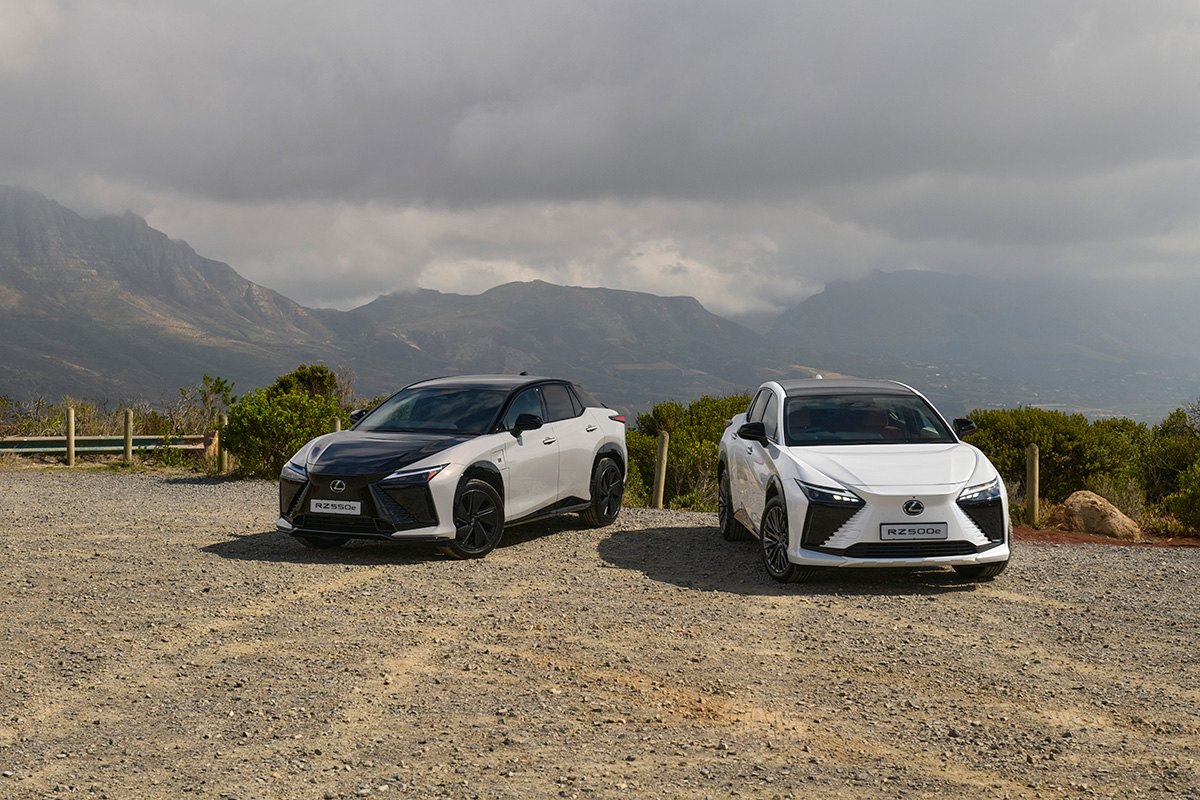
The transition to electric mobility has forced many luxury brands to rethink what defines their identity. For Lexus, a company long associated with refinement, craftsmanship, and quiet performance, the challenge is clear. The new RZ, the brand’s first dedicated battery electric vehicle, represents both a technological shift and a test of whether Lexus’s trademark qualities can translate seamlessly into the electric era.
Lexus has a rich, if occasionally gawky-looking, history of creating premium products that combine elegance, sportiness, exceptional handling, and beautifully crafted cabins. Over the decades, the brand has proven itself capable of delivering cars that feel impeccably engineered while still retaining a certain Japanese restraint in their design language.
What the Japanese brand does not have a long history of, however, is building fully electric cars.
The first serious step into that territory arrives in the form of the new Lexus RZ. Recently launched in South Africa and driven by us in Cape Town, the RZ is the brand’s first dedicated battery electric vehicle, and it arrives locally in three derivatives. The lineup consists of the Lexus RZ 500e EX at R1,649,400, the RZ 500e SE at R1,823,800, and the flagship RZ 550e F Sport priced at R1,938,600.
Positioned as a mid-size luxury SUV, the RZ quickly proved during the launch drive that a brand either has inherent quality engineered into its DNA, or it does not. In Lexus’ case, the transition from internal combustion engines to electric propulsion appears to have been achieved without any noticeable compromise.
BUILT ELECTRIC FROM THE START
The reason for that becomes clear the moment you dig into the vehicle’s architecture. Rather than adapting an existing combustion platform to house electric components, Lexus built the RZ on the dedicated eTNGA platform.
That decision may seem obvious, but in the rapidly expanding EV landscape, it has, historically, been surprisingly rare. By starting with a clean sheet, Lexus was able to address the unique packaging, structural, and driving characteristics associated with electric vehicles.
The result is a vehicle that feels cohesive rather than compromised. The battery pack is integrated into the floor, lowering the centre of gravity while improving structural rigidity. The layout also allows for a longer wheelbase and shorter overhangs, which contribute to interior space while maintaining tidy exterior proportions.
Equally important is the fact that Lexus did not fall into the trap of overdesigning the car simply because it is electric. The RZ adopts what the brand calls a “spindle body” design, an evolution of its well-known spindle grille concept that has been adapted for an EV with no conventional engine cooling requirements.
The result is unmistakably Lexus, but refreshingly restrained. History has shown that buyers, particularly those in the premium segment, rarely warm to overly experimental designs. Traditional elegance still sells.
THE STEERING EXPERIMENT
That said, the range-topping RZ 550e F Sport introduces an intriguing piece of technology that will likely divide opinion.
It is fitted with Lexus’ new “One Motion Grip” steer-by-wire system, paired with a rimless, aircraft-inspired steering console. In other words, the conventional circular steering wheel is replaced by something that looks suspiciously like it belongs in a cockpit rather than a luxury SUV.
At first glance, it looks incredibly cool. And, admittedly, it makes climbing into the driver’s seat feel like stepping into the future.
The problem, however, is that muscle memory is powerful.
During the drive, I repeatedly found myself reaching for a section of steering rim that simply did not exist. Lexus has recalibrated the system so that steering inputs require less than a full turn from lock to lock, which eliminates the need for hand-over-hand steering. Still, the sensation can feel slightly disconnected, particularly when pushing the vehicle through tighter bends. It sits somewhere between gimmicky and forward-thinking.
In a vehicle capable of advanced autonomous driving, it might make perfect sense. Whether Lexus’s traditionally conservative customer base will embrace the change remains to be seen.
BACK TO LEXUS NORMALITY
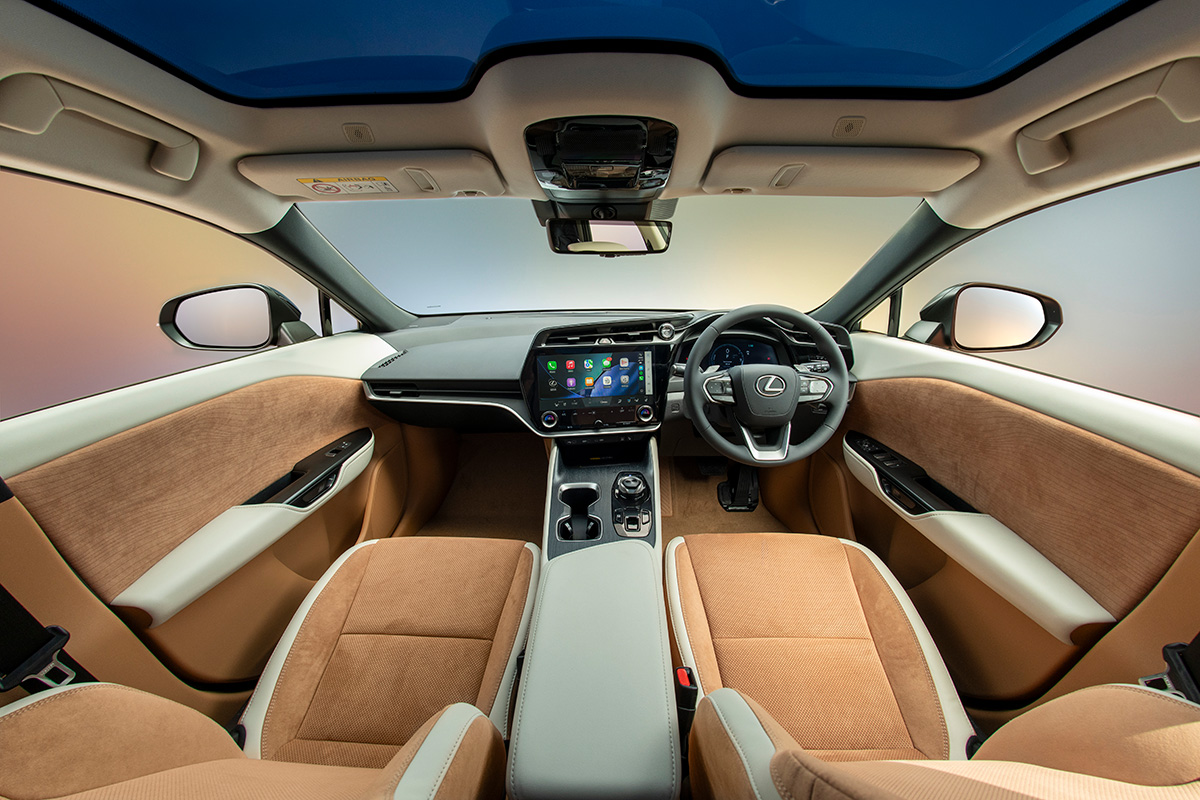
Fortunately, the second vehicle we drove during the launch event, the RZ 500e SE, reverted to a conventional steering wheel. Within minutes, it reminded me why Lexus has built such a loyal following over the years.
In fact, I quickly found myself thinking that the RZ might be one of the most enjoyable Lexus products I have driven in quite some time. That is, of course, with the exception of the ruggedly brilliant GX Overtrail.
Step inside and the cabin immediately reinforces the brand’s reputation for meticulous craftsmanship. Ergonomics are excellent, and the materials feel suitably premium throughout. A large 14″ touchscreen anchors the centre console, while higher-spec models add a 13-speaker Mark Levinson sound system and an optional dimmable panoramic roof that can switch between transparent and opaque at the touch of a button.
As you would expect from Lexus, the RZ is generously equipped with safety technology. Systems such as Active Cornering Assist, Intelligent Park Assist and a Panoramic View Monitor are part of the package, contributing to the brand’s typically comprehensive approach to active and passive safety.
EFFORTLESS PERFORMANCE
Under the floor sits a lithium-ion battery pack with a capacity of roughly 77 kWh.
In the 500e variants, dual electric motors produce a combined output of 280 kW and 537 Nm, enabling the SUV to sprint from zero to 100 km/h in just 4.6 seconds. The flagship 550e F Sport raises output to 300 kW while maintaining the same torque figure, trimming the acceleration time to a brisk 4.4 seconds.
Driving range varies by model but typically falls between roughly 369 km and 500 km, depending on specification.
On the road, those numbers translate into effortless performance. Plant the accelerator pedal, and the full weight of 537 Nm instantly presses you into the suede and cloth seats of the SE, or the suede, cloth, and artificial leather combination found in the F Sport.
Despite weighing around 2.1 tonnes, the RZ feels remarkably composed through corners. The low centre of gravity created by the underfloor battery pack helps the SUV remain planted as the road begins to twist. Around the scenic routes outside Cape Town, the RZ displayed a level of agility that belies its size.
Did the unconventional steering system in the F Sport detract from the vehicle’s handling capability? Not particularly. The chassis itself remains composed and responsive. However, the unusual steering interface is something you would need time to adapt to before confidently attacking more challenging sections of road.
LAST WORD
For Lexus, the RZ signals the brand’s commitment to a future where electrification plays a central role in its lineup.
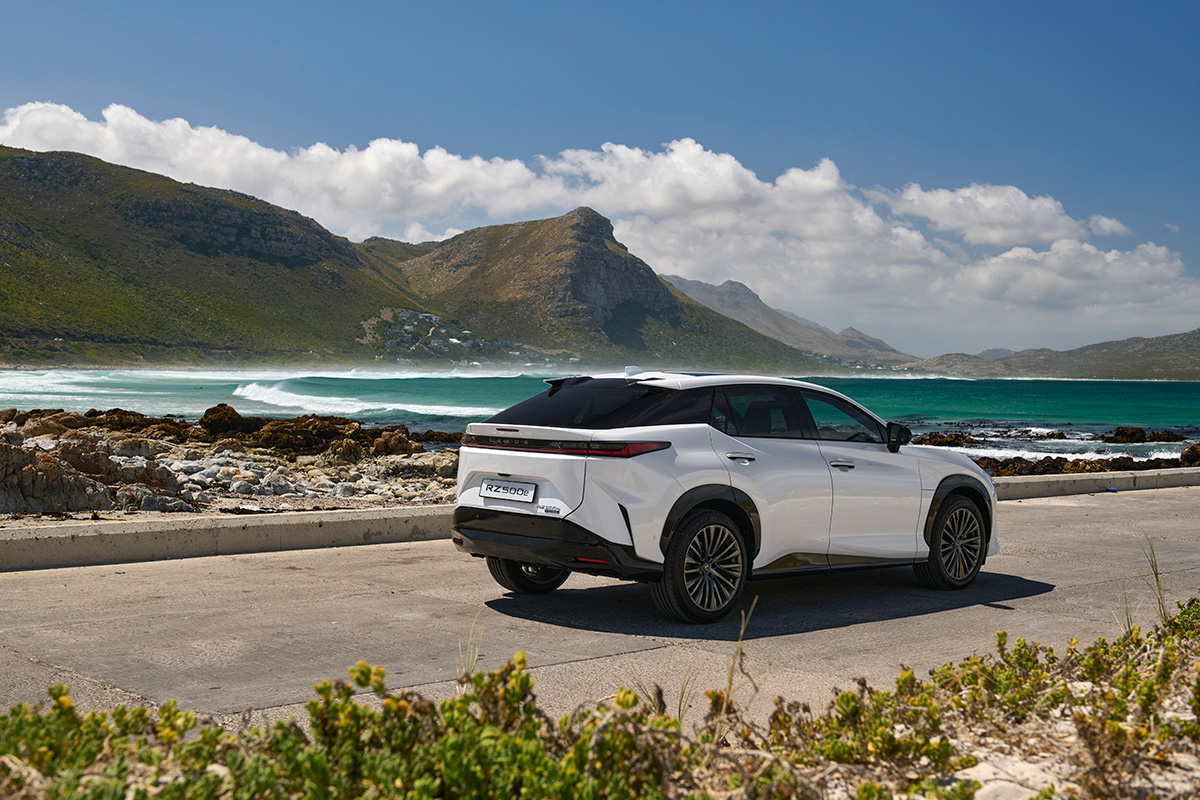
Judged purely as a luxury electric SUV, the RZ is an impressive effort. It is refined, thoughtfully engineered, and unmistakably Lexus in the way it prioritises comfort, craftsmanship, and quiet confidence. In other words, the RZ is exactly what you would hope Lexus’s first dedicated EV would be. Smart, capable, and effortlessly suave.
Report by BERNIE HELLBERG JR | Images © LEXUS SOUTH AFRICA

