



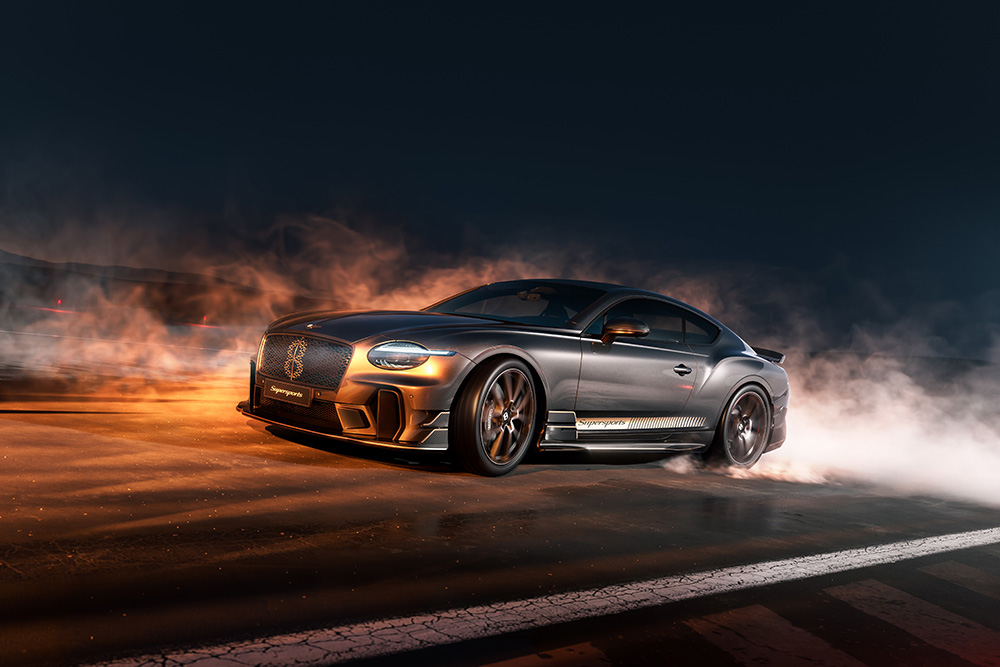
A century after the original Super Sports rewrote Bentley history, the badge returns on a Continental GT built for purists. The newly revealed Supersports sheds weight, drops all-wheel drive, and leans fully into rear-driven intensity, making it the most focused driver’s car Crewe has created in the modern era. With only 500 units planned worldwide and only a select few likely to reach South Africa, it stands as a celebration of Bentley performance heritage and a thunderous encore for pure combustion power in a changing world.
The Supersports name may be a familiar one, but in Bentley’s world, it has never been casual. Whenever Crewe dusts off this badge, it signals a turning point in the Continental GT story, a moment where comfort politely steps aside so performance can take centre stage. With the newly announced Bentley Continental GT Supersports, that moment has arrived again – and this time the script has been rewritten for the hybrid era by creating the only non-electrified, rear-wheel-drive Continental in the current line-up.
Only 500 examples will leave the factory in Crewe, each individually numbered. That instantly makes this Supersports one of the rarest modern Bentleys. Given the scale of our market and Bentley’s typically conservative allocations to South Africa, it is realistic to expect only a small handful to reach local customers. If you see one nosing up to a Melrose Arch valet stand or idling outside the Cape Winelands’ poshest hotels in a few years, you will be looking at a tiny club indeed.
A CENTURY IN THE MAKING
To understand why this car matters, you have to go back a hundred years. The Supersports story actually starts with “Super Sports” (two words rather than one) on the 3 Litre of 1925. That car received a shorter, lighter chassis and a more powerful engine, enabling it to become the first Bentley to exceed 100 mph. Only 18 were built, and they cemented an idea that would linger in Bentley folklore.
Fast-forward to the modern Continental era, and the name reappeared twice. The 2009 Continental Supersports arrived as a lighter, harder-edged version of the first-generation GT, with a 6.0-litre twin-turbo W12 good for 463 kW and 800 Nm. It would reach zero to 100 km/h in 3.9 seconds and run on to around 329 km/h, making it the fastest Bentley road car of its time and, in typical late-2000s fashion, even turned it into a flex-fuel science project.
The second-generation Supersports in 2017 turned the wick up again. The W12 was boosted to 522 kW and a colossal 1,017 Nm, enough to haul what was still a very substantial grand tourer to 100 km/h in 3.4 seconds and past 330 km/h. It was a wild, outrageous send-off for that generation of Continental – a last blast of old-school excess before the industry started talking seriously about electrification.
Now the name returns a third time, exactly a century after the original 3 Litre Super Sports, but the world around it has changed. The current Continental GT family is defined by the Ultra Performance Hybrid V8, a plug-in system with 575 kW and 1,000 Nm that powers the latest GT Speed and will also appear in the forthcoming Flying Spur. In that context, launching a non-hybrid range-topper feels almost rebellious.
THE ONLY NON-HYBRID BENTLEY
Under the Supersports’ vented bonnet sits a familiar twin-turbocharged 4.0-litre V8. Here it develops around 490 kW and 800 Nm, sent exclusively to the rear axle through a reworked eight-speed dual-clutch transmission.
On paper, that is actually less power and torque than the hybrid GT Speed, yet Bentley’s engineers will happily tell you that this car is about feel rather than bragging rights.
By stripping away the all-wheel drive hardware and hybrid system and taking a ruthlessly pragmatic approach to weight, Bentley has achieved something no Continental GT has managed before. The Supersports drops below two tonnes of kerb weight, finally shedding the “heavyweight bruiser” label and moving closer to the kind of mass you expect from a serious driver’s car.
The headline figures are still stout. Zero to 100 km/h takes 3.7 seconds, and the top speed is quoted at around 310 km/h, which puts the Supersports within shouting distance of its hybrid sibling’s numbers despite the power deficit.
Where it should really pull clear is in the way it responds. Less mass over the nose, no electric boost to smooth over everything, and rear-drive only mean the driver is no longer insulated from what is happening at the contact patches.
Bentley talks about lateral performance of up to 1.3 g on the right tyres and a far more playful character at the limit.
In other words, this is the Continental GT that wants you to work a little. You will still cover huge distances in great comfort. You might just arrive with your heart rate a bit higher.
AERO, STANCE AND THE ART OF LOOKING FAST
Even in standard GT Speed form, the latest Continental is a beautifully resolved design that owes much to coachbuilt Bentleys like the Bacalar and Batur.
The Supersports pushes that vocabulary towards something more aggressive.
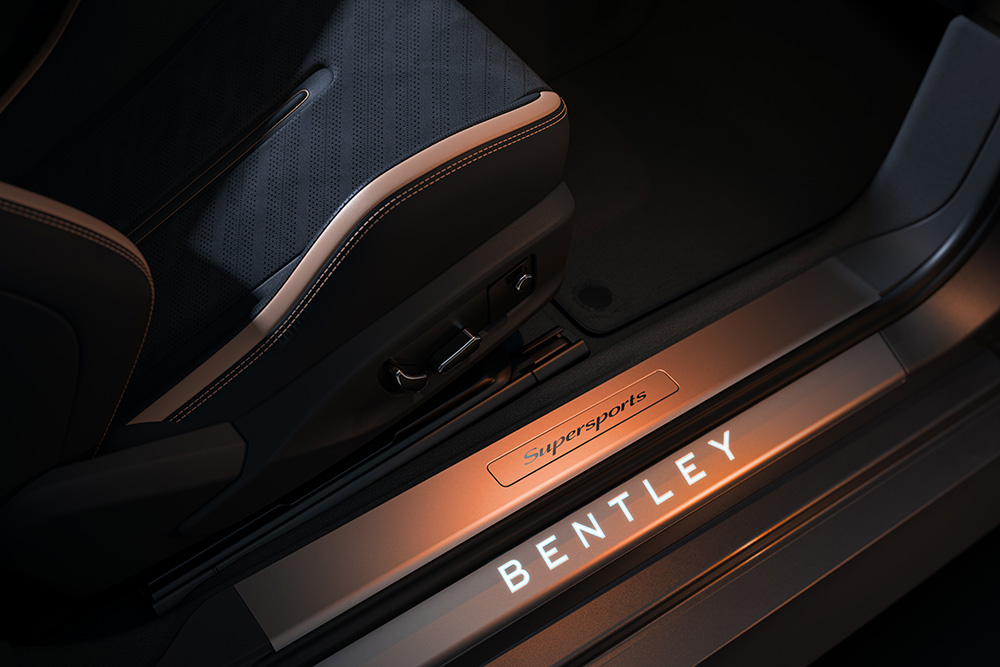
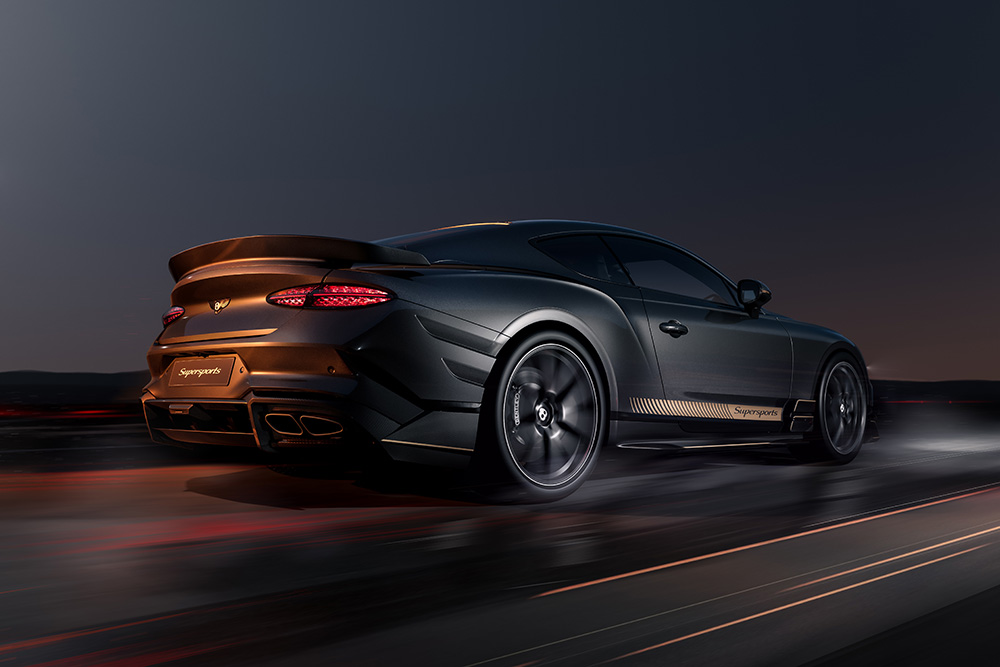
At the front, you get a deeper splitter, larger air intakes and plenty of exposed carbon fibre. Along the flanks, there is a prominent side skirt and a sculpted aero fin behind the front wheel, with “Supersports” script neatly worked into the surface.
At the rear, a fixed wing perches over the jewelled tail-lights and sits above a serious diffuser with quad exhaust tips that look like they belong on a GT3 racer.
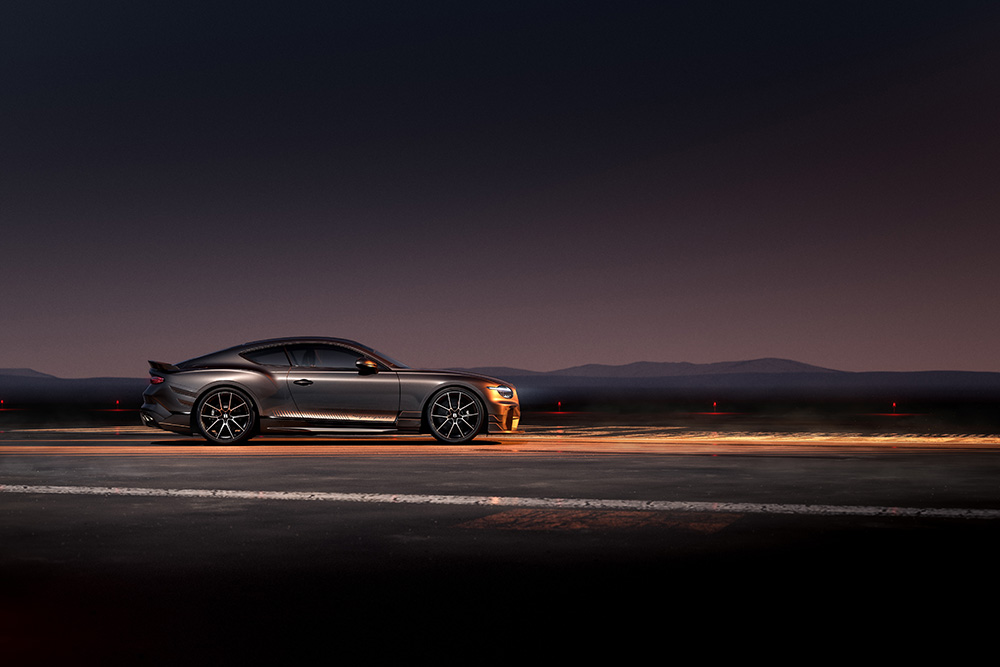
It is a familiar formula for a limited-run super-GT, yet there is still a certain restraint in how Bentley has executed it. Proportions remain muscular rather than cartoonish, and the detailing is crisp instead of shouty. It is the sort of car that will look utterly at home rolling through Sandton traffic at 30 km/h, but it will make far more sense seen in profile on a deserted stretch of Karoo road, nose dipped slightly under braking, wing slicing the air behind it.
The aero changes are not just for effect. Bentley claims significantly greater downforce at speed than the GT Speed, which should translate into greater stability and confidence during committed driving.
LIGHTWEIGHT LUXURY
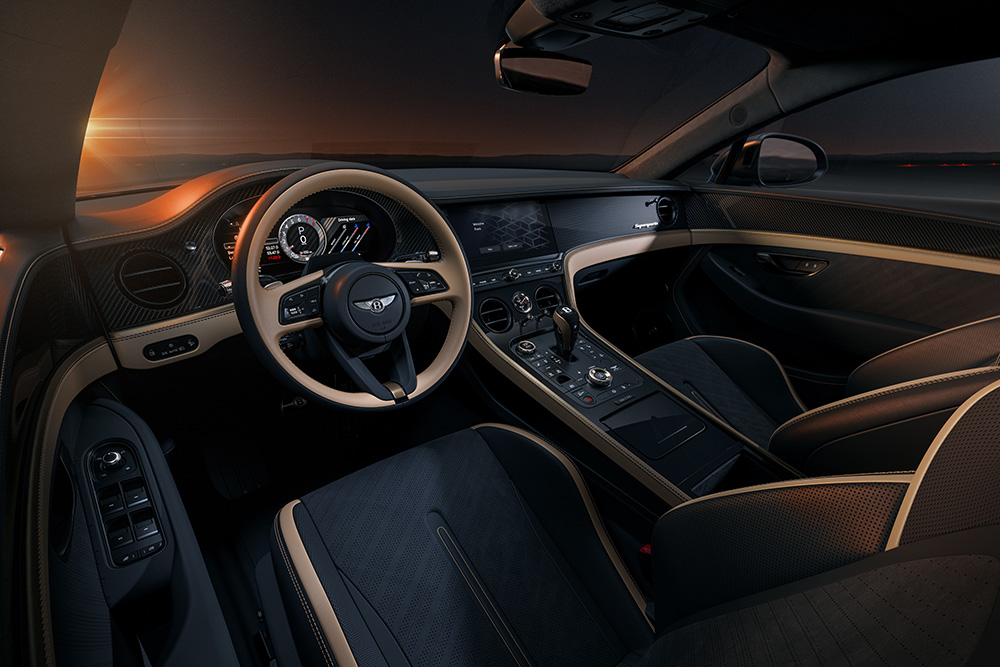
Inside, the Supersports does something that might sound like sacrilege for the brand. It gets a stripped-back two-seater cabin with fixed-back carbon-fibre bucket seats, less sound insulation and an audio system focused mainly on the front occupants.
That does not mean it suddenly feels like a club-sport special. The materials are still rich, with leather and Dinamica-style microfibre used in layered patterns, and there is even more visible carbon fibre than usual. Bentley being Bentley, you can spend days in the Mulliner configurator choosing veneers, stitch colours and special trims. If you want a loud exterior colour with contrasting pinstripes on the body kit and matching accents on the wheels, you can have it. If you prefer a subtle dark metallic with a near-monochrome interior, that is equally possible.
The weight saving here is about thoughtful subtraction. No rear seats. Less sound-deadening. Lighter wheels and brakes. A titanium exhaust system that shaves kilos and lets more of that V8 character into the cabin. Put it all together, and you end up with a car that feels more intimate, more focused, yet still inherently Bentley in the way it is stitched, knurled and polished.
POSITIONING IN THE CONTINENTAL FAMILY
The obvious question is why Bentley would build a non-hybrid performance flagship at a time when its own Ultra Performance Hybrid powertrain is being rolled out as the future of the brand. The answer lies in the kind of customer the Supersports is aimed at.
The hybrid GT Speed is the car for the owner who wants everything. Enormous power. Instant electric torque. Silent early-morning departures from the estate. The ability to glide into city centres on electric power alone in markets where that matters.
The Supersports goes after the driver who still values mechanical interaction above absolute numbers. Rear-wheel drive instead of all-wheel drive. An engine that relies on turbos and displacement rather than electrons. Less mass. More road feel through the steering and seat. In a very Bentley way, it is a halo car for keen drivers – the equivalent of a manual-gearbox special in a world of dual-clutch everything.
It also gives the brand an interesting narrative as it edges closer to full electrification. Bentley has already indicated that its timeline for going fully electric could be more flexible than initially planned, thanks to strong demand for plug-in hybrids and the looming arrival of its first electric SUV.
Against that backdrop, the Supersports feels like a celebratory encore for the combustion-only GT before the curtain falls for the last time.
SOUTH AFRICAN RELEVANCE
South Africa has always had a small but passionate Bentley community. Scan the classifieds, and you will find everything from early W12 GTs to the latest Azure models and GT Speeds, many of them clustered around Gauteng and the Western Cape.
A car as rare as the Continental GT Supersports will take that exclusivity to another level. Bentley South Africa has not yet confirmed local allocation. However, if you look at how other limited-run, high-ticket GTs have been distributed to our market in the past, a single-digit number of cars would not be surprising. When you are only building 500 units for the entire world and trying to keep key collectors happy in Europe, the Middle East, North America, and Asia, the pie slices get very thin.
For those lucky enough to secure a build slot, the Supersports promises a very different flavour from its hybrid stablemates. Think of an early-morning run up Chapman’s Peak or over Franschhoek Pass, with that titanium exhaust hardening its note as the V8 swings past the mid-range, the rear axle gently alive beneath you rather than just following the instructions of an all-wheel drive computer. This is still a car that can cross countries in a single bound, yet its real party trick may be how it shrinks around you when the road turns interesting.
A COLLECTABLE IN THE MAKING
It is always dangerous to call anything a future classic before the first customer car has been delivered, but the Supersports has the ingredients. It revives a historically significant name exactly a century after its debut. It is the first rear-wheel-drive Continental GT, the first to slip under two tonnes, and possibly the last purely combustion-engined performance flagship in the range.
Layer on the 500-unit production cap, the numbered plaques, the bespoke options and the fact that it sits alongside, rather than beneath, a more powerful hybrid sibling, and you end up with a car that feels special before you even press the starter button. For South African readers of Driven, it will be one of those cars we talk about far more often than we see – a poster Bentley in an era where posters increasingly feature battery capacities and range claims.
LAST WORD
Until we get our hands on a Supersports on local roads, the numbers and the claims remain just that. What is clear already, though, is that Bentley has built a Continental GT that speaks directly to people who still enjoy the sensations of driving. It is louder, leaner and more focused than any modern GT from Crewe, yet it remains every inch a Bentley in the way it looks after its occupants.
For a cover star, you want something with presence, heritage and a story to tell. The new Continental GT Supersports brings all three to the table. And somewhere in Crewe, you suspect W. O. Bentley would be quietly satisfied that, a hundred years on, his Super Sports idea is alive and well.
Report by BERNIE HELLBERG JR | Images © BENTLEY

