THE MORE THINGS CHANGE…
New Toyota Hilux Breaks Cover
Image © TOYOTA
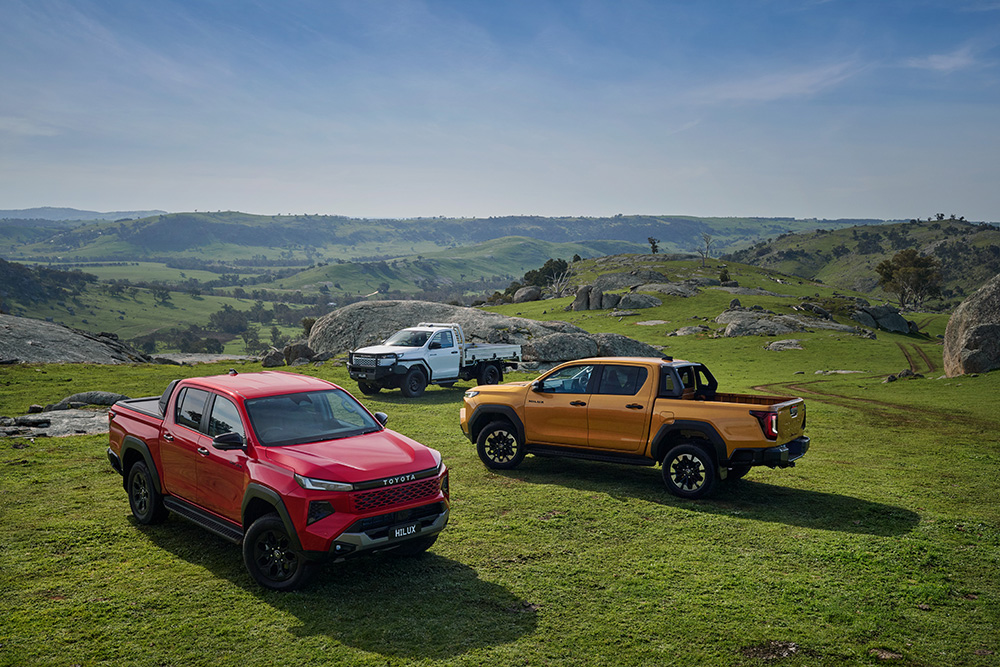
The world premiere of the much-anticipated ninth-generation Toyota Hilux was recently hosted in Bangkok, Thailand, by Toyota Motor Asia, and the new bakkie – to be built in South Africa and expected to make its local debut late next year – was simultaneously unveiled in Australia and Europe.
Designed by an Australian-led team, the newcomer’s bold, yet simplified and more rudimentary front grille, when compared to the iconic model’s current muscular, tougher front visage, immediately divided opinion and sparked heated online debate. Some pundits even suggested that Toyota is now following Chinese design trends.
This is patently untrue, since Chinese pickups in general still emulate more robust American truck design trends. The new styling direction – based on a “Cyber Sumo” design theme, according to Nicolas Hogios, Regional Design Chief, Toyota Australia – aligns with other Toyota models such as the Corolla Cross and RAV4 but, given its less than favourable reception, the level of acceptance by the broader buyers’ market remains to be seen.
Besides improvements in driveability and comfort, a new interior with enhanced multimedia and safety technologies, trusted diesel power, and a 48V hybrid version, the new Hilux establishes a milestone as the first model in the iconic vehicle’s history to be offered with a full battery-electric powertrain. A hydrogen fuel cell (FCEV) variant is scheduled to join the lineup in 2028.
In Australia, the new Hilux will be offered in 21 diesel derivatives, with single-, extra-, and double-cab configurations, 4×2 or 4×4 drivetrains, manual or automatic transmissions, and five grades. The new-look exterior design is matched by a completely overhauled interior (reminiscent of the new Prado) that delivers a significant uplift in modernity, comfort, technology, and ergonomics.
The redesigned, horizontal, three-tiered dash features a new digital instrument cluster – from 7.0” to 12.3” in size – with a new 12.3” multimedia touchscreen display offering wireless Apple CarPlay and Android Auto, satellite navigation and voice command, and expanded Toyota Connected Services functionality. The centre console is wider, with a taller sliding centre console storage lid.
Interior comfort has been enhanced with newly developed front and rear seats, including a driver’s seat with up to eight-way powered lumbar support adjustment and leather-accented upholstery, depending on the grade. The climate control offers simple, intuitive use with large buttons or knobs, and the redesigned steering wheel provides improved ergonomics and an updated button layout.
ELECTRIC POWER STEERING
Besides being the first Hilux with BEV powertrain, underpinned by an electric motor on each axle, paired with a lithium-ion battery, the new bakkie range is also the first to feature electric power steering and also the first Toyota to feature a new cabin detection alert system, which uses a radar to detect passengers in the rear seats and notify the occupants when exiting the vehicle.
Multiple refinements to the ladder-frame platform, including new hydraulic engine mounts and shear-type cabin mounts to reduce vibrations and enhance ride comfort, while increased front suspension tower thickness, revised frontal frame cross members, and a new front rail extension improve comfort, rigidity, and crash performance.
Carried over from the current range are the venerable GD6 four-cylinder turbodiesel engines – the 2.8-litre delivering 150 kW and 500 Nm of torque and the 2.4-litre 110 kW and 400 Nm of torque – and the six-speed auto and manual transmissions, as well as the 48-volt V-Active technology in the mild-hybrid models, offering smooth stop-start functionality and an extra 8.5 kW/65 Nm when accelerating from standstill.
The independent coil-sprung front and rigid-axle leaf-sprung rear suspension has been revised and offers a two-tiered tune, with springs and dampers designed for either heavy-duty work or more comfort- and adventure-oriented use.
The 4×4 system with standard rear-locking differential now features an improved and refined Multi-Terrain Select (MTS) traction control system with Multi-Terrain Monitor, and active safety technology has been enhanced with the latest Toyota Safety Sense driver-assistance technology suite.
The new Hilux is expected here late next year, and an extensive line-up of models will be available. However, it will be interesting to see whether it still features the same nose treatment or (as with the notorious initial “overbite” design of the current range) whether Toyota updates the styling.
NOT SA-BOUND
New Nissan Navara
Image © NISSAN
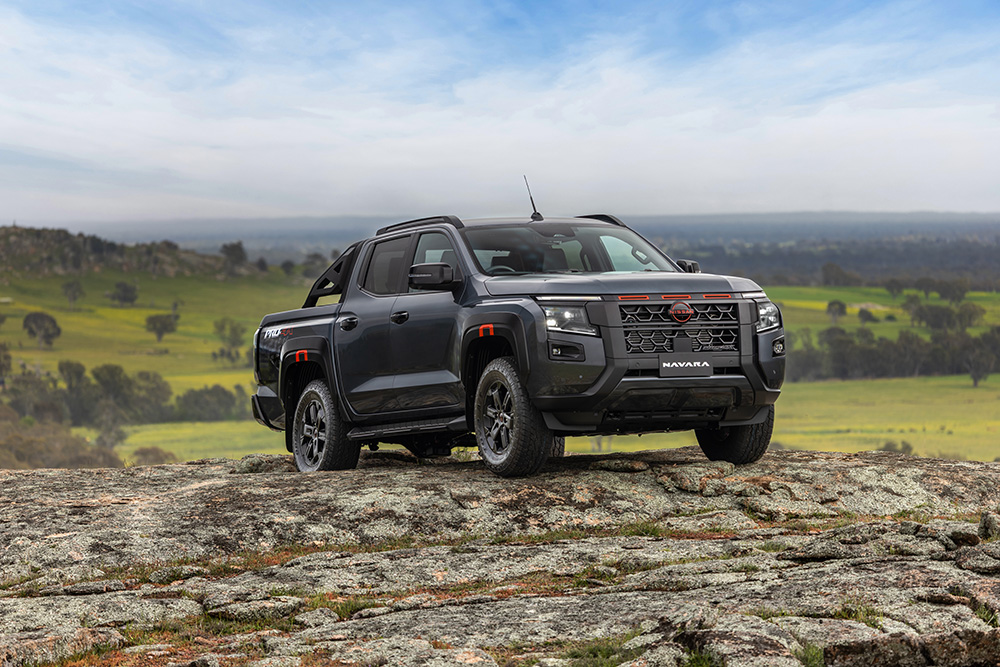
Nissan has unveiled the fourth-generation Navara pickup, internally known as the D27, in Australia. The range, the first new Navara in 11 years, shares its platform and drivetrain with the Triton of alliance partner Mitsubishi, and is built in Thailand. The D27 will be sold exclusively in Australia and New Zealand and will not be made available in South Africa.
There are numerous reasons for this, the most important being that the D23 Navara is built locally in three body styles (the D27 will only be available as a double cab) and exported from here to Africa. It also adds flexibility, as the plug-in hybrid version (called Frontier Pro in China) is based on a revised D23 platform,
The D23 is also set to receive an extensive facelift next year (see main image), and it seems Nissan is convinced this “evolved” Navara will still be able to compete with current rivals, as well as new products from Toyota and a host of Chinese manufacturers.
Developed and tested in the Oceania region, the D27 features a front suspension devised with input from Premcar, and all grades of the new Navara are fitted with this distinct, locally tuned suspension. Due to its shared platform, Nissan took a different styling route with the D27, incorporating a three-slot grille design that pays tribute to the D21 Navara.
The C-shaped headlamps interlock seamlessly with the grille, which features a pattern of smaller V-strut motifs within the mesh. Within the spacious interior, all grades of the new Navara are thoughtfully appointed, but the layout closely resembles that of the Triton.
All models are powered by the Mitsubishi-derived 2.4-litre four-cylinder turbodiesel engine, delivering 150 kW of power and 470 Nm of torque, matched to a six-speed automatic transmission. Two different four-wheel drive systems are available, with the “Easy 4WD” system available on lower spec models, while the ST-X and Pro-4X grades receive the “Super 4WD” system.
Conversely, the local D23 Navara is powered by a 2.5-litre four-cylinder turbodiesel mill with two power outputs: 120 kW and 403 Nm for models like the Single Cab XE and 140 kW/450 Nm for high-output versions like the Stealth double cab and LE models. With the future of the Rosslyn plant uncertain, it will be interesting to see how long the current Navara will still soldier on locally.

READY FOR ITS SA LAUNCH
BYD Sea Lion 5
Image © BYD
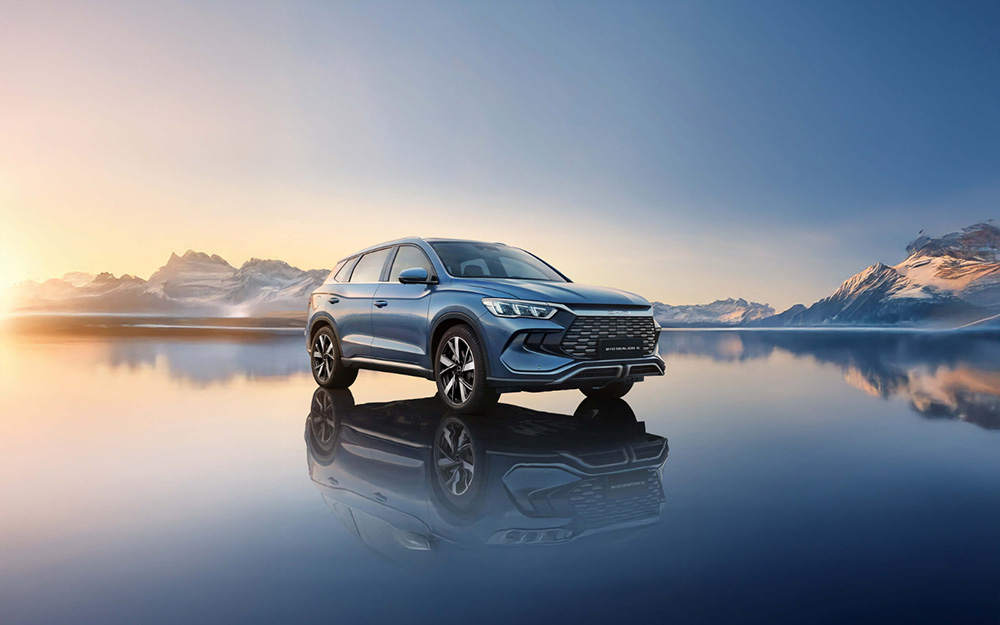
The BYD aquarium is set to expand further with the imminent launch of the Sea Lion 5 plug-in hybrid electric vehicle (PHEV), and the indications are that this new compact SUV will be the most affordable PHEV in South Africa, with prices starting from R499,900.
Built on BYD’s DM-i (Dual-Mode Intelligent) hybrid platform, the Sea Lion 5’s hybrid system pairs a 1.5-litre normally aspirated petrol engine (72kW/122Nm) with a single front-mounted electric motor (145 kW/300 Nm) for a combined system output of 156 kW.
Overseas, the Sea Lion 5 is available with a 12.9 kWh battery, allowing an electric-only range of up to 71 km on the NEDC cycle, and an 18.3 kWh derivative covering up to 100km, according to BYD. The 1.5-litre engine is fed by a 52-litre tank, and a combined fuel consumption of 4.6 l/100 km is claimed, which can drop as low as 1.3 l/100 km depending on battery usage.
The compact family SUV combines spacious versatility with intuitive technology, featuring a panoramic sunroof, keyless entry, wireless charging, intelligent voian ce control system, and a large infotainment screen that anchors its refined, modern interior.
The upmarket Premium version, in addition to a larger battery, features a larger touchscreen for the infotainment system, a 360-degree camera, a 15W wireless phone charger, two extra front radars, three extra speakers, and a panoramic sunroof, and this model will retail for around R579,900 – comfortably undercutting the new Geely E5 EM-A (R599,999) and Chery Tiggo 7 CSH PHEV (R619,900).
The Sea Lion 5 will be the eighth model in the Chinese giant’s growing local portfolio, which includes the recently launched BYD Dolphin Surf (South Africa’s most affordable EV), the BYD Sea Lion 6, Sea Lion 7, Shark 6, and Seal. Together, these vehicles represent BYD’s vision to make sustainable mobility accessible to all South Africans and support the country’s transition to cleaner transport and energy solutions.