



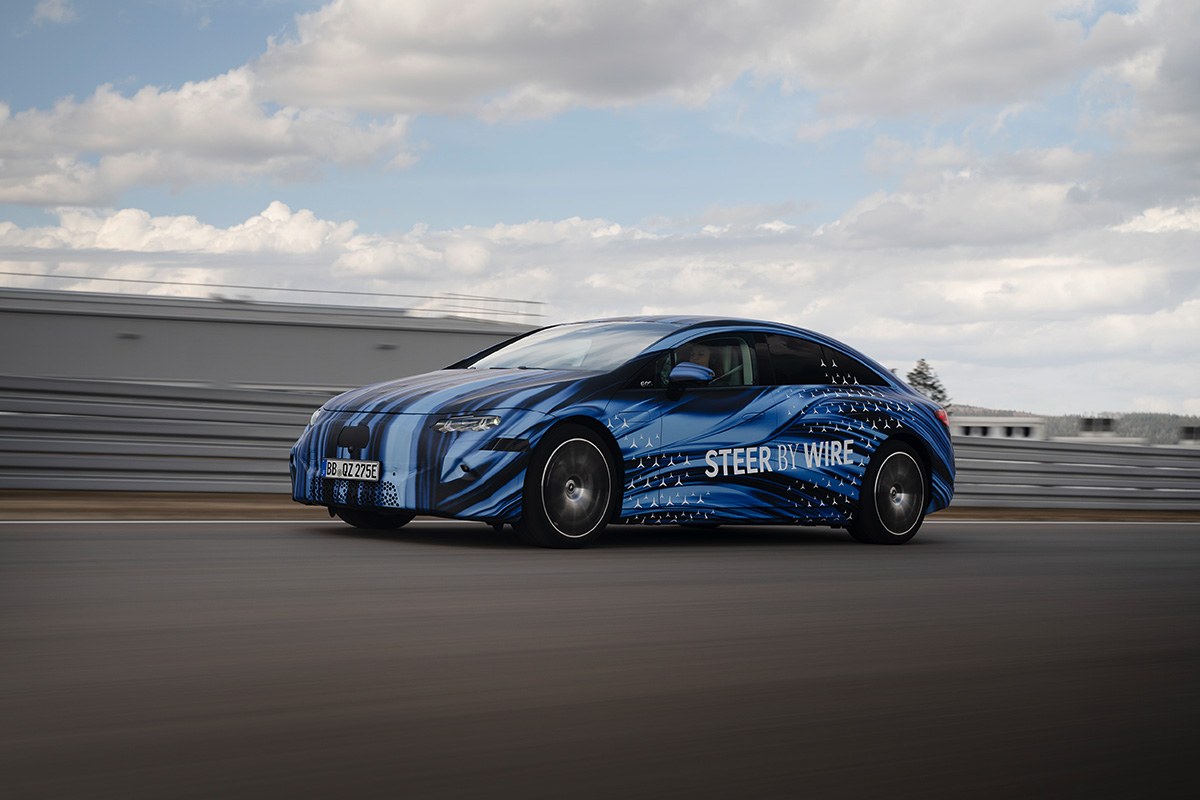
Back in 2013, we saw the first steer-by-wire system in an Infiniti, and the Tesla Cybertruck was the first to do it without a mechanical backup, but it looks like Mercedes-Benz has perfected the concept of steer-by-wire.
The idea of steering a car wirelessly doesn’t inherently sit well with most drivers. That’s because there’s no direct mechanical connection between the driver’s steering-wheel inputs and the wheels on the road. Instead, every movement is sent through an ECU that tells actuators on the steering rack how many degrees to turn the wheels. The amount of wheel movement depends on your speed, what driving mode you’re in, and what road surface you’re driving on.
Put plainly, it converts fixed ratios into a variable element using information processing.
When the idea was first introduced on the Infiniti Q50 in 2013, it still had a physical steering column connected to the steering wheel, for the very improbable chance that the entire electronic system would fail, using a clever clutch system that engaged the physical steering column when it detected an electronic fault.
Naturally, people complained. They didn’t like that they couldn’t feel the road anymore; the steering feedback felt numb and disconnected.
Luckily, the fix could be programmed in, and the next-generation Q50 offered more feedback and a weightier steering feel that eased some of steer-by-wire’s biggest critics.
Along came Tesla with their very controversial Cybertruck, and they were the first to decide that no mechanical backup was needed at all, only electronic redundancies built into the electronic system, taking it one step further by adding rear-wheel steering that was also controlled by an electronic system. The problem with the Cybertruck, though, is that when both the electronic systems and the backup systems failed, you had no steering control left at all.
Enter the Germans with the Mercedes EQS and, most importantly, with the understanding that drivers still need to feel something, feel involved, feel the road, while still giving them the best experience technology can offer.
Instead of just changing steering ratios to fit the situation, it also gives feedback from the tyres themselves and calculates how the steering would feel if it were mechanically connected by using the restoring forces of the tyres themselves. Of course, Mercedes also implemented electronic redundancy in the form of two signal paths that continually cross-check signals they obtain from multiple sensors and ECUs, which also have multiple backups.
Even if all that fails, the Mercedes EQS can still manoeuvre laterally thanks to its rear-axle steering and targeted wheel braking laterally via the ESP system. All this gives you the ability to completely lock out the EQS steering by just turning the wheel 170 degrees, meaning you never have to lift your hands off the steering wheel to navigate a tight roundabout, along with precise, calm handling at high speeds, and all of this was tested over one million kilometres of test benches, proving grounds and full road validations.
Steer-by-wire might not be something we asked for, but just like most innovations, we don’t know how much it can change our lives until it does.
SUBSCRIPTIONS IN CARS
FRIEND OR FOE?
Tesla paved the way by putting the continually updated self-driving feature behind a subscription paywall, but do you really need to pay to gain access to the full power of your engine, though?
BMW faced massive backlash after putting a monthly subscription on its heated seats in 2022, which would have cost you $18/R250 a month to use hardware already installed in your brand-new BMW; admittedly, they scrapped the idea in 2023.
It’s not just BMW, though. Mercedes, Audi, and VW, among others, have existing subscription services for digital and physical features like live traffic updates, faster acceleration, and self-driving features. Some are kind enough, though, to give you most of the features for free for a limited period after you buy the car new. Amazing, right?
Manufacturers do have a strong case. Digital features and services are continually upgraded, and manufacturers can add new features to older models via OTA updates. Should that effort and IP not come at a price? Isn’t the prospect of owning a continually evolving car worth something? Never mind the infrastructure needed to offer it in the first place.
That said, most of these “unlockable features” aren’t upgrades, but things vehicles have been able to do for years. It seems all too obvious that manufacturers would want to sell those features again to the second owner, while adding additional digital features while they are at it.
Report by Ruben von Steen

