



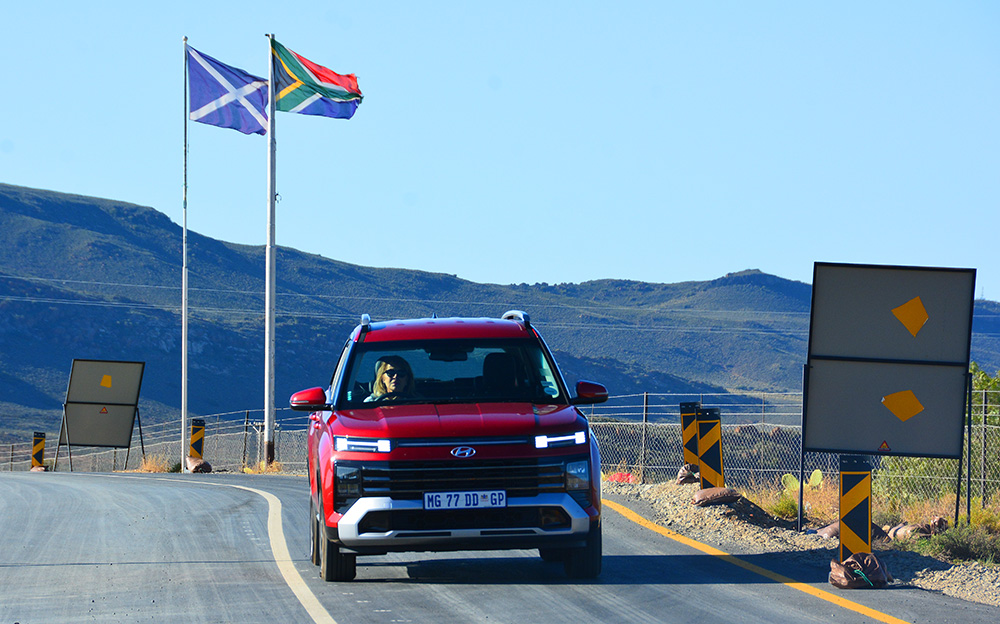
In its first guise, this Indian-produced South Korean compact SUV received a Greek-derived name. Now, in facelifted second-generation form, it has been rebranded with Spanish nomenclature. Jim Freeman visited some local fortifications in the new-ish Hyundai Alcazar.
Let’s be clear (well, as clear as possible): the previous Hyundai Grand Creta (introduced in 2021) was a slightly elongated version of the Creta compact sports utility…slightly stretched to add a third row of seats, converting a small five-seater into a vehicle of almost the same size capable of carrying seven.
Well, the new Alcazar is the same vehicle, recently facelifted by Hyundai’s design studios in India, and given a Spanish name that means “fortress” or “fortification” (as derived from Moorish castles).
Having had the benefit of a classical education, I know “fortress” derives from the Latin fortis (“brave”), but I also know – by dint of having been a soldier in my younger life – that “brave” is often synonymous with being stupid.
So, let us ignore the third row of seats in the new Alcazar for now, as they are so cramped as to be better used folded flat, to increase the load space from a paltry 180 to a respectable 579 litres, and focus on the positive etymological derivatives of fortis.
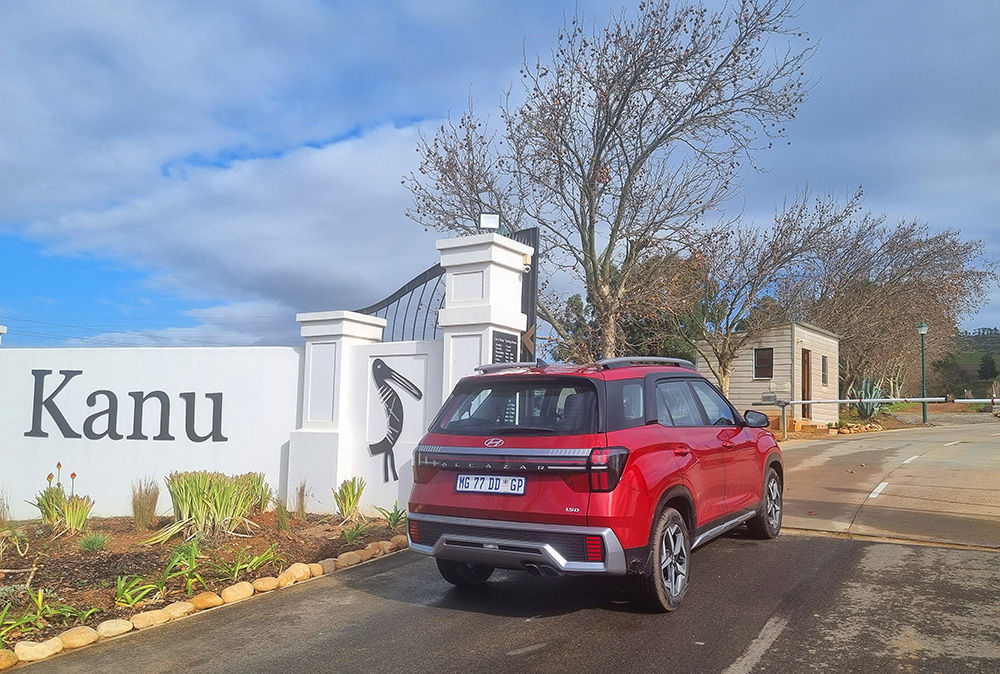
There is “fortitude”, defined in the Oxford English Dictionary as “courage in pain or adversity”. “Plucky” is sometimes used as a synonym, and this is the perfect description for the 1.5-litre turbodiesel-powered Alcazar’s performance in the vineyards at Kanu, a popular Stellenbosch wine estate, after several days of heavy rain had turned the soil into cloying gloop.
I entrusted the vehicle to Kanu farm manager Stefan Kriel, showed him how to engage “mud” mode on the drive control system, pointed him at a large patch of gloop on the trail and told him to have a go at it. Although only front-wheel-driven, the Alcazar gingerly but with lots of wheelspin slip-slid its way through the gunk.
It would have been easier if it had a ground clearance higher than 200 mm and was shod with more appropriate tyres (it comes fitted with Apollo Alnac 4G 215/55 R18s all round), but even so, the traction-control function was impressive, and showed the compact SUV had sufficient torque to pull itself out of trouble.
POSITION FORTIFIED
But then the South Korean company has always been full of surprises, offering more bang for buck than an army thunder flash. I remember driving my first Hyundais – an Elantra, Sonata, and Tiburon – soon after the marque arrived in South Africa in the early 1990s, and being astounded by the levels of luxury and sophistication offered at ridiculously low prices compared to its competitors.
This has not changed, as the new Alcazar is now available for less than the outgoing Grand Creta, with the Elite top model retailing for R699,900, including a seven-year/200,000 km warranty and three-year/45,000 km service plan. This fortifies its position in the highly competitive market for compact SUVs.
It is well-kitted out too, with steering wheel multi-function controls, lane-departure warning and lane-keeping assist systems, blind spot monitor and warning, fatigue detection, an information display with a touchscreen interface, and adaptive cruise control.
Standard features also include electrically adjustable and retracting wing mirrors, a panoramic sunroof, LED daytime driving and headlights, front and rear park distance control, Bluetooth connectivity, and keyless central locking. There are also front, rear, and boot USB ports, and apart from the usual anti-lock braking system (ABS), stability and traction control, the tested vehicle also featured a tyre pressure sensor and hill descent control.
ON THE OPEN ROAD
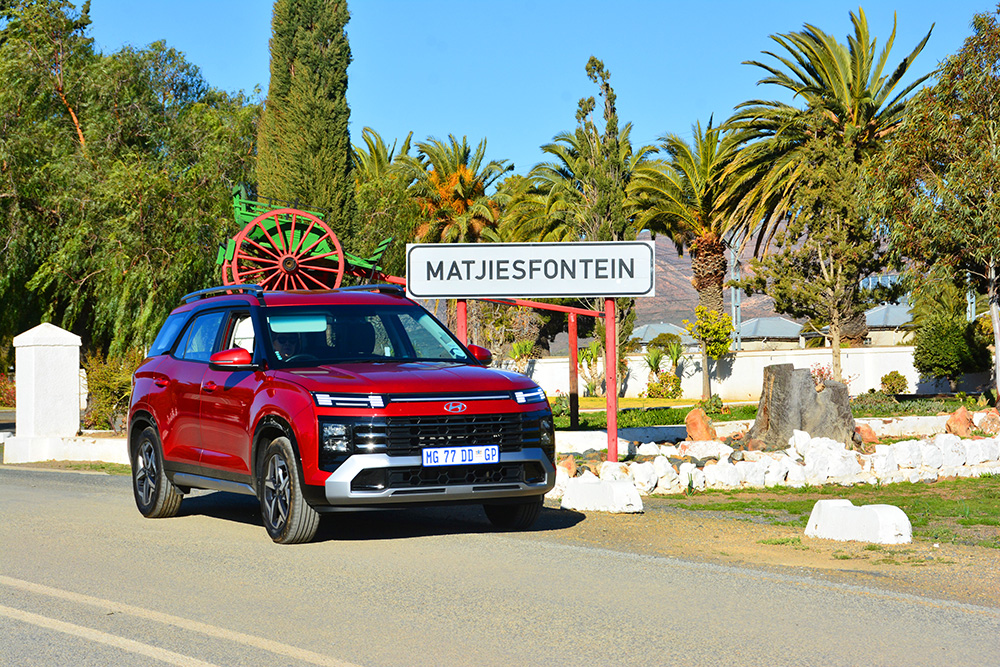
The second part of our two-day Alcazar jaunt entailed a six-hour round trip along the N1 freeway from Stellenbosch to Matjiesfontein. We wanted to include the Castle of Good Hope (probably the structure closest to a Moorish castle in the country) in the storyline, but extreme weather and other extraneous circumstances affected the time available.
Our choice of destination was, however, not as random as it seems, for there is a link between Kanu (originally part of a much larger farm known as Nooitgedacht) and Matjiesfontein, as both were used as fortified positions during the Second Boer War. Nooitgedacht, owned by mine magnate and politician Cecil John Rhodes, was used as a horse supply camp for the British Army and Kanu, incidentally, was used by the British as a rifle range.
MILITARY HEADQUARTERS
Matjiesfontein, and specifically the Lord Milner Hotel, built by James Logan in 1899 during the early stages of the war, served as headquarters for the Cape Command during the war, and was also used as a military hospital by British forces.
Approximately 10,000 troops were camped around Matjiesfontein during the conflict, and the village also housed a British Army Remount Camp with 20,000 horses, highlighting the strategic importance of the village as a military location. The hotel’s central turret was utilised as a lookout post and machine gun post during the war, and the village was also a refuge for reformers involved in the Jamieson Raid.
Pardon the pun, but with very little time to reach Matjiesfontein to make use of late afternoon sunlight for photography, I could not afford to “hold the horses” and gave the Hyundai free rein (within the boundaries of law, naturally). On the open road, the seven-seat SUV was in its element as a family vehicle.
We headed over the old Du Toits Kloof mountain pass instead of taking the Huguenot tunnel to test the Alcazar’s roadholding and transmission responsiveness on the steep ascent (which performed well on both counts), and then we took on the highway to assess drive quality. The kilometres passed quickly and soon we were driving through Touws River.
This reminded us of James Logan’s legacy of fortitude and good fortune. A railwayman in his native Scotland, he started as a porter on Cape Town station after landing in South Africa in 1877. Seeking to make his fortune, he was quickly promoted and moved to Touws River as district railway superintendent of the section between Hex River and Prince Albert after less than 18 months in the country.
Realising trains needed to be provisioned as they headed into the interior, Logan cornered the market, creating a business empire that stretched from Bulawayo to Cape Town. He resigned from the railways in 1883 to devote his full attention to his burgeoning catering activities, and based himself at Matjiesfontein, where he built the hotel and indulged in his other life-passion, cricket.
Report & Images © JIM FREEMAN

