



When Mercedes-Benz pulled the wraps off the refreshed S-Class on 29 January 2026 at the Mercedes-Benz Museum in Stuttgart, the timing was no coincidence. It was the brand’s 140th birthday, and the company used the moment to remind the world why the S-Class has been the undisputed flagship of automotive luxury for more than half a century.
The stalwart luxury saloon from Mercedes-Benz, the inimitable S-Class, has received the most extensive mid-cycle update in the model’s history, with over 2,700 parts (roughly 50% of the car) either newly developed or heavily revised. Production begins later this year at Factory 56 in Sindelfingen, although local customers will have to wait until 2027 for deliveries, despite the anticipation that already seems electric.
The S-Class story in South Africa is one of quiet dominance. While German rivals have come and gone, the S-Class has remained the default choice for captains of industry, government principals and anyone who understands that true luxury is measured in effortless kilometres rather than decibels. That reputation was forged long before the first official “S-Klasse” badge appeared.
The lineage begins in 1972 with the W116 – the car that formally introduced the Sonderklasse (Special Class) name. It brought the world the first anti-lock brakes on a production car and set the template for safety as a luxury feature. The W126 that followed in 1979 was a masterpiece of aerodynamics and restraint, and it introduced the airbag to the masses and became the best-selling S-Class of all time. The W140 of the early 1990s was almost comically over-engineered – double-glazed windows, soft-close doors, a whisper-quiet cabin – and earned the nickname “the vault” for good reason. The W220 brought aluminium construction and Airmatic air suspension; the W221 added night vision and the first radar-based safety systems, the W222 introduced full-LED lighting and the revolutionary Magic Body Control; and the current W223, launched in 2020, rewrote the rulebook with its digital cockpit and Level 3-ready autonomy.
Each generation has added layers of technology while preserving the core promise: serenity at any speed, on any surface. The 2026 refresh honours that heritage while bringing the S-Class firmly into the second half of the decade.
SUBTLE POWER MOVES
Visually, the changes are evolutionary but confident. The grille is now larger (up around 20%) and, for the first time on a standard S-Class sedan, can be illuminated with a constellation of three-dimensional chrome stars – a feature that will turn heads at night, though European regulations may delay its arrival in some markets. The new Digital Light headlamps feature a twin-star motif that projects subtle three-pointed-star patterns onto the road ahead, while the taillights echo the theme with star-shaped light modules. New wheel designs up to 20”, and an expanded Manufaktur palette (40 fresh exterior colours, 25 new Nappa leather interiors) give configurators fresh life. The overall stance is slightly bolder, yet still recognisably S-Class.
TECHNOLOGY MEETS TRANQUILLITY
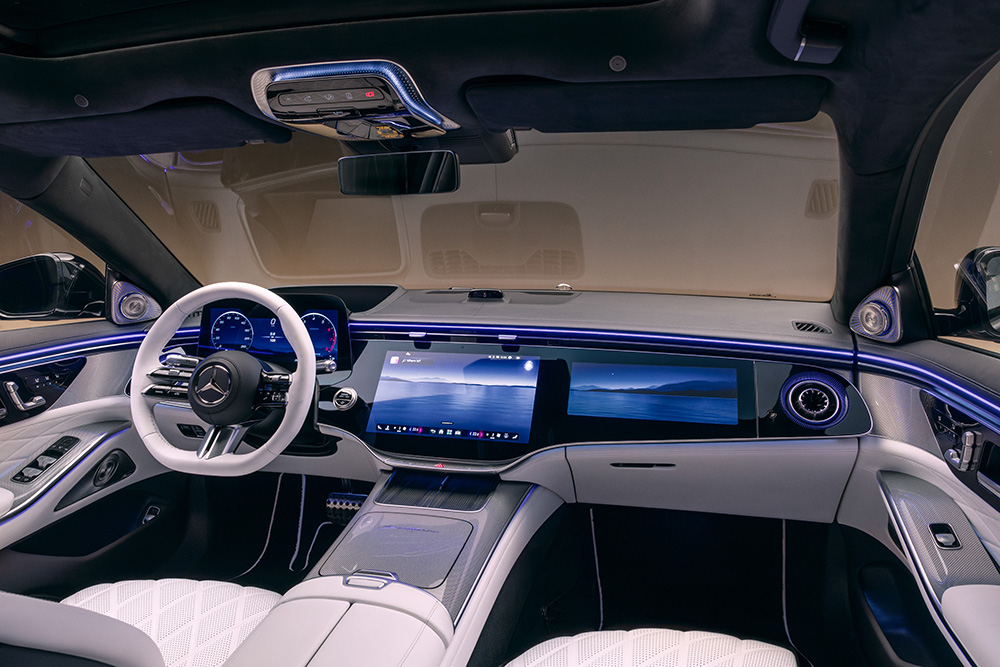
If previous S-Class iterations are anything to go by, the updated cabin will feel more like a private jet lounge than ever. At the heart of the transformation is the new Mercedes-Benz Operating System (MB.OS), a purpose-built supercomputer that powers the entire infotainment and vehicle architecture. The MBUX Superscreen is now standard, with improved ergonomics: the driver display sits more upright, the central screen is pushed slightly rearward for better reach, and the passenger screen remains. In the rear, two 13.1” detachable tablets run native apps – YouTube, Disney+, even video-conferencing capability – turning the back seat into a genuine mobile office. Four-seat configurations with a fixed rear console are far more widely available, and every seat can now be fitted with heated seatbelts – a frivolous addition for some, but a brilliant touch for others.
Augmented-reality head-up display, Digital Vent Control that automatically adjusts air vents to your preferences, expanded ambient lighting themes and a “welcome home” animation that greets you with soft lighting and a gentle seat massage all reinforce the S-Class’s role as a sanctuary on wheels. For South African executives who spend hours in the car between Johannesburg, Cape Town and Durban, these details matter.
POWERTRAINS TAILORED FOR A NEW GENERATION
Under the bonnet, the powertrain menu has been comprehensively refreshed to meet stricter Euro 7 emissions standards while delivering more refinement and, in many cases, more performance. All variants now run 4Matic all-wheel drive as standard on the diesel models – welcome news for Gauteng’s summer thunderstorms and the occasional gravel shortcut.
Diesel remains the smart choice for many South African buyers, and the updated straight-six OM 656 family continues. The S 350 d 4Matic produces 230 kW and 650 Nm (plus a 17 kW/205 Nm mild-hybrid boost), while the S 450 d 4Matic ups the ante to 270 kW and 750 Nm. Both promise sub-6.5 l/100 km combined and effortless highway cruising – exactly what is required when the next fuel stop is 400 km away.
Although the S 450 and S 500 are likely not destined for South Africa, other markets will get an updated M 256 Evo inline-six in the S 450 4Matic (around 280 kW, up to 600 Nm) and S 500 4Matic (around 330 kW, 600 Nm with brief overboost). But the star of the show for performance-minded owners (and a model likely to be sold here) is the new M 177 Evo 4.0-litre V8 in the S 580 4Matic. Now fitted with a flat-plane crank, revised intake and exhaust, and higher-flow turbos, it delivers around 395 kW and 750 Nm – enough for a claimed sub-4.5-second zero to 100 km/h sprint – while the 48-volt mild-hybrid system smooths out every transition. Fuel consumption is listed at around 10.5 l/100 km, which is respectable for the performance on offer.
Plug-in hybrids will be particularly interesting in South Africa. The S 580 e 4Matic combines the updated six-cylinder with a more powerful electric motor for a combined system output of around 480 kW (some sources cite higher) and an electric-only range of over 100 km – enough for most daily commutes in the major metros while still offering effortless long-range capability when the battery is depleted. Mercedes has also confirmed that the V12-powered S 680 (450 kW) and the armoured Guard variants continue, as does the range-topping AMG S 63 E Performance for those who want extreme power and drama.
Chassis upgrades are equally significant. Rear-axle steering is now standard at 4.5 degrees (optional 10 degrees on long-wheelbase models), Airmatic air suspension is standard across the range, and the optional e-Active Body Control can use cloud-based road data to pre-emptively adjust damping – a system that should shine on our variable road surfaces. Safety remains class-leading, with expanded sensor arrays, more airbags (up to 15) and the latest iteration of the Drive Pilot Level 3 system (where legislation permits).
Pricing and exact model allocation for South Africa will only be confirmed closer to the 2027 launch, but expect the range to mirror the current line-up’s logic: the S 350 d as the volume seller, the S 580 e for those chasing lower company-car tax and urban zero-emission running, the S 580 V8 for the passionate few, and Maybach and AMG variants at the top. Current S-Class pricing starts at around R2.58 million for the S 350 d L, so the refreshed car will likely start at over R2.7 million once specifications and import duties are taken into account.
For South African buyers, the appeal remains unchanged: the S-Class is the car that makes every drive a masterclass. Whether you’re logging 50,000 km a year between meetings, or a collector who simply wants the best-engineered luxury sedan money can buy, this refresh delivers more of what has always made the S-Class special – plus the technology and efficiency demanded by the most discerning buyers.

LAST WORD
Mercedes-Benz has never rested on the S-Class’s laurels, and this most ambitious update proves the point. The king has not only retained its crown – it has polished it, added a few more jewels, and reminded everyone why it has worn it for 54 years. In South Africa, where distance is part of the national character and status is measured in quiet confidence rather than noise, the refreshed S-Class will feel right at home.
Report by BERNIE HELLBERG JR | Images © MERCEDES-BENZ

