



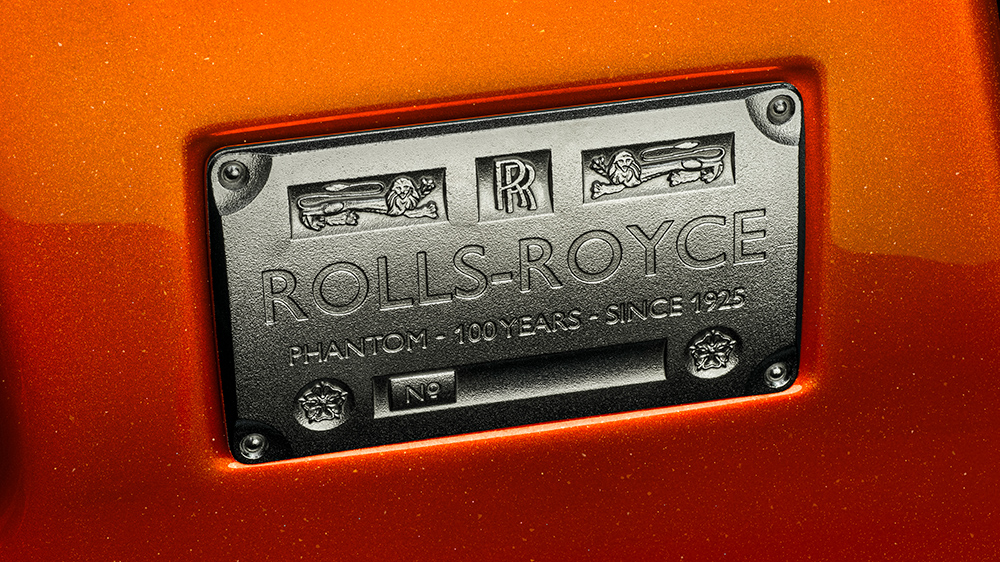
The Phantom occupies a unique place in the history of Rolls-Royce. For the last 100 years, it has represented the very best in luxury, engineering excellence, fine materials and highly skilled craftsmanship. Throughout its long history and across eight generations, the Phantom nameplate has been reserved for the pinnacle model in the marque’s portfolio – the very apex of excellence, an icon of icons.
For a hundred years, the Phantom has stood at the pinnacle of all Rolls-Royce cars – a cultural phenomenon that both reflects and influences the world around it. From its earliest days, Phantom has been one of the most desired rewards for success and a potent symbol of power and prestige on the world stage.
Beyond status, it has always offered its owners a canvas for personal expression, transformed through bespoke craftsmanship into a moving work of art. Across music, politics, art and beyond, Phantom has been present at many of history’s defining moments. The stories that surround it – and the images they have inspired Rolls-Royce designers to create – reveal its extraordinary reach and enduring connection to greatness.
Rolls-Royce first earned the accolade of ‘the best car in the world’ with the 40/50 H.P., universally known as the Silver Ghost, launched in 1906. The key to its legendary reputation was Henry Royce’s principle of constant improvement to its underlying engineering. By 1921, Royce realised the Silver Ghost’s design had reached a point where it could not be further improved, and work began on its replacement, named the New Phantom.
Although no specific documentary evidence exists, it is safe to assume that the Phantom name was coined by Rolls-Royce’s ever-inventive Commercial Managing Director, Claude Johnson, as he understood the power of names like Phantom, Wraith and Ghost to convey the products’ quietness and grace.
As was custom at the time, Rolls-Royce supplied only rolling chassis, with the form, styling and appointment of the car itself left to independent coachbuilders, who created bespoke bodywork to the owner’s specification. Rolls-Royce offered the New Phantom in both long-wheelbase and short-wheelbase forms, and its generous proportions allowed owners to specify almost any detail or indulgence they wished.
On 8 May 1925, The Autocar magazine published its review of the new model, and from this, it was clear Rolls-Royce had succeeded in maintaining and furthering the qualities established by the Silver Ghost. However, as the design of the original New Phantom closely followed that of the Silver Ghost (so closely that it is sometimes referred to as a “Super Ghost”), Royce continued to refine the design until, in 1929, the Phantom II arrived.
A CONTINENTAL TOURER
However, Royce was still not satisfied, as he felt even the short-wheelbase Phantom II was irritatingly oversized for his personal use. Thus, a more compact, sporting Phantom II variant was developed – a close-coupled car, 26EX – ‘EX’ standing for ‘Experimental’. Although neither the Rolls-Royce sales department nor the factory was keen on the concept, a highly successful continental sales tour demonstrated that there was great demand for a car capable of high-speed touring over long distances.
Rolls-Royce successfully met this demand with the now highly prized Phantom II Continental, and by the time of Royce’s death in 1933, the company was very aware that luxury car customers were seeking models that offered more power without sacrificing comfort or excellence.
American competitors such as Cadillac, Lincoln and Packard were responding with straight-8, V12 and even V16-cylinder engines, which were rapidly eclipsing the large-horsepower, in-line six-cylinder units that had served Rolls-Royce so well for so long, so given the company’s experience with aero engines, the next Phantom was powered by a V12 engine.
This new engine, “giving greater engine smoothness, flexibility, silence and acceleration” that its straight-six predecessor was not only more powerful with up to 180 hp (133 kW) available but also more compact, allowing a shorter bonnet and larger passenger compartment. Comfort was further improved with independent front wheel suspension.
While the new Phantom III was never able to match its American rivals on price, Rolls-Royce’s reputation ensured that it remained the car of choice for those seeking the greatest possible comfort and desiring to be seen driving the very best.

A CHANGING WORLD
When war broke out in 1939, 14 years after the introduction of the Phantom, Rolls-Royce ceased all motor car production. When peace returned in 1945, the company found itself in an entirely different world – but one it had anticipated and prepared for, as it correctly foresaw the need to make its cars less complex, easier to service, and significantly less expensive.
The solution was the Rationalised Range, debuting in 1946 with the Silver Wraith, but it seemed to be the end of the road for the flagship Phantom. However, it was saved by two serendipitous events: the production of four experimental EX cars with a straight-eight engine (one of these officially named Silver Phantom and unofficially known as Big Bertha), followed by a smaller, lighter saloon version, known as the Scalded Cat.
At the same time, the Royal Household was seeking to replace its ageing fleet of Daimlers, and in 1950, Rolls-Royce was asked to supply a formal limousine for Royal duties. The company produced a “one-off” straight-eight long-chassis limousine with coachwork by H. J. Mulliner. It was given the codename Maharajah and remains in active service under that name to this day.
Requests for similar cars followed, and the company decided to resurrect the Phantom name for these prestigious cars. Over the next seven years, the marque produced just 18 examples of the Phantom IV. However, in 1959, the Phantom V was launched – with splendid coachwork from Park Ward & Co. and other independent companies, including James Young Ltd. and H. J. Mulliner & Co.
Two cars, known as Canberra I and Canberra II, were built for the Royals, featuring transparent Perspex cupolas over the rear compartments and concealed lighting to better view the occupants on formal occasions. After 13 years and 832 examples, the Phantom V was upgraded enough to be designated as Phantom VI, and most of the 374 examples were limousines.
The last Phantom VI, a landaulette, was delivered to the Sultan of Brunei in 1993. It was also the last body-on-chassis model Rolls-Royce produced, and its discontinuation effectively ended the tradition of coachbuilding until it was revived at Goodwood in 2017 with “Sweptail”.

PHANTOM REBORN
When the Rolls-Royce marque was relaunched at Goodwood, a “Phantom-type” model was the natural and obvious choice for its inaugural vehicle. The design concept incorporated signature elements inherited from previous generations. Ian Cameron, Rolls-Royce’s first design director of the Goodwood era, formed a specific team to create the interior design for the much-anticipated new model.
The first Phantom VII was handed over to its new owner at one minute past midnight on 1 January 2003. Unlike every Phantom that had gone before, it was built entirely in-house by Rolls-Royce Motor Cars, featuring a spaceframe bodywork designed as a single unit rather than being coach-built. Over its 13-year lifespan, the Phantom VII again cemented Rolls-Royce as the world’s preeminent super-luxury motor manufacturer.
In 2017, Rolls-Royce presented Phantom VIII, built on an improved version of the all-aluminium spaceframe used on Phantom VII and specifically designed to be the ultimate canvas for bespoke commissions. This has led to some of the most technically ambitious and challenging projects ever undertaken by the marque’s designers, engineers and specialist craftspeople.
Commissions such as Phantom Syntopia, Phantom Oribe, Phantom Koa and Phantom ‘Inspired by Cinque Terre’ all incorporate features, materials and engineering innovations never seen before in any motor vehicle. Each is unique, a one-of-one creation that will never be repeated, echoing the very first and the unique Phantoms individually hand-built for their commissioning owners.
For 100 years, the Phantom name has occupied a unique position in the Rolls-Royce product family and story. From Henry Royce’s original New Phantom to today’s Phantom VIII, the essential purpose behind Phantom has remained the same: to build a vehicle that offers owner-drivers and passengers alike the most comfortable, satisfying experience available in the world at that moment in time. As it enters its second century, it remains an authoritative statement of connoisseurship, enjoyed by those who shape our world.
Report by FERDI DE VOS | Images © ROLLS-ROYCE MOTOR CARS

