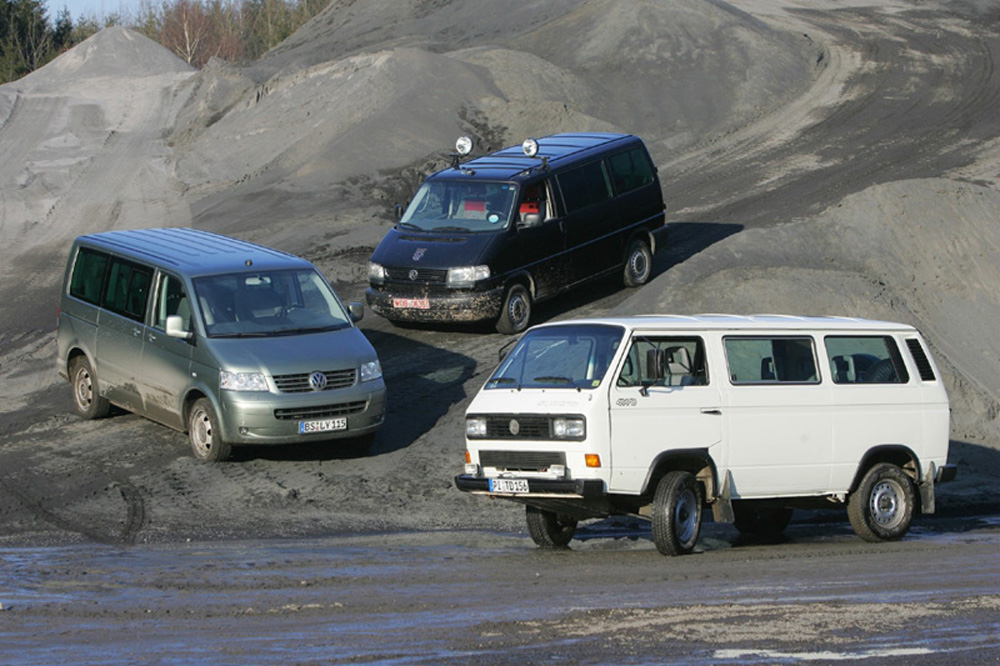
The iconic Volkswagen Bus not only celebrates 75 years of production this year but also 40 years of all-wheel-drive, commencing with the now legendary T3 Syncro. To celebrate this double anniversary, we took the latest T6.1 Kombi Trendline plus 2.0 BiTDI 146 kW to meet a unique example of its original forebear, an immaculate T3 Syncro with diesel power.
The first Volkswagen Transporter – or T1 for short – left the production line in Wolfsburg, Germany, on 8 March 1950 and since then more than 12.5 million VW Buses have followed, nearly all produced in Hanover from 1956 (but also in erstwhile Uitenhage from 1968 to 2002).
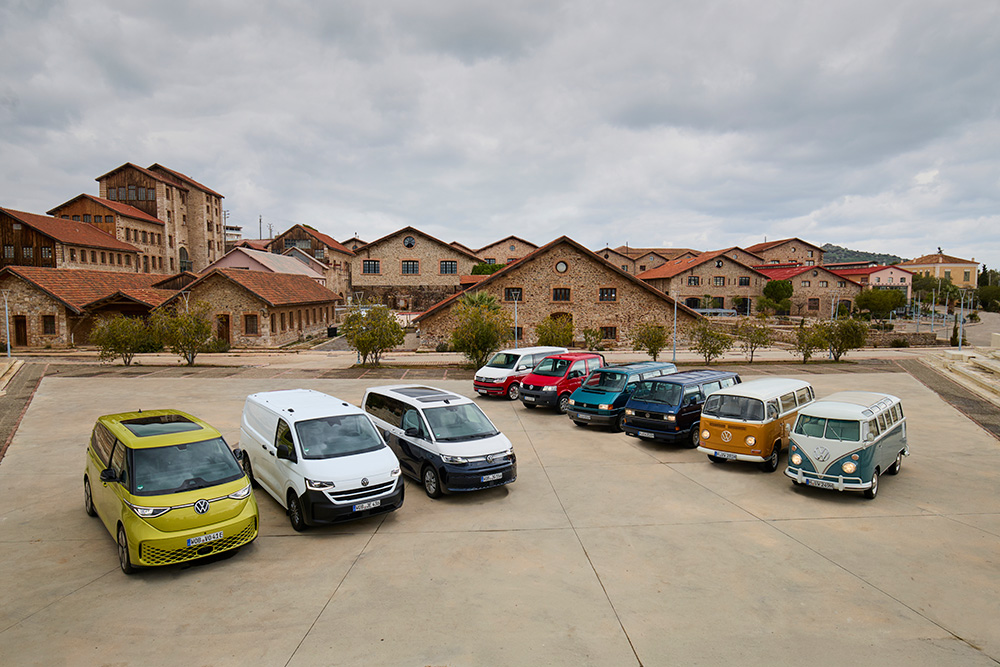
This makes it the most successful European derived commercial vehicle of all time and over the past 75 years and six generations it has attained cult status. From the T1 to the latest sixth generation T6.1, one platform always provided the basis for all derivatives – from transport vans to camper vans and executive bus icons.
However, the era of electric mobility necessitated a transformation of the all-rounder and thus a paradigm shift in Volkswagen’s strategy: ‘One VW Bus for all’ has now become ‘The right VW Bus for everyone.’ But besides celebrating its 75th anniversary, the indomitable Bus (or “Bulli”, as it is known in Germany) celebrates another milestone this year: 40 years of the all-wheel-drive.
This enviable legacy started with the T3 Syncro, and this original all-wheel drive model has since become a classic icon in South Africa, prompting us to take the latest T6.1 Kombi Trendline plus 2.0 BiTDI to Syncro Hospital, run by Syncro expert Stuart David in Pretoria, to meet an interesting example of the original T3 Syncro.
SAHARA TESTING IN THE T2
Although the first all-wheel-drive VW Bus model went into production in 1985, the story of the Syncro began much earlier – in the 1970s, when the then head of development for the Transporter product line, Gustav Mayer, converted a rear-wheel drive T2 to all-wheel drive.
Mayer loved travelling and had a passion for the Sahara Desert. He did this in a normal T2 but, at some point he had had enough of shovelling his van out of the North African desert sand, so he and his team built an all-wheel drive T2. The tests with the first prototype, also in the Sahara dunes went well and in 1978, construction of five T2 test vehicles with a selectable front-wheel drive began.
However, the T2 – launched in 1967 – was approaching the end of its life cycle and development continued with the new T3, first introduced in 1979. Interestingly, the floor structure of the T3 had space for a propshaft and front axle differential from the outset. Volkswagen cooperated with specialist company Steyr-Daimler-Puch to further develop the all-wheel-drive system and the first Transporter and T3 Caravelle Syncro were introduced in 1985.
Initially, final assembly of the T3 Syncro took place at the Steyr-Daimler-Puch plant in Graz, Austria. In contrast with the T2 test vehicles, the T3 Syncro did not have selectable all-wheel drive but – more conveniently – a front axle permanently integrated via a propshaft and viscous clutch.
This system proved to be very robust and delivered excellent performance under most conditions, as proven during the local launch in October 1985 in the Namib Desert. Many local off-road experts can attest to this; as long as one wheel touched the ground, the Syncro just kept on going.
Besides the viscous clutch setup, the Syncro differed from the normal T3 using different springs and harder shock absorbers to stand 60 mm higher, a 4+G gearbox with a very short gear for off-road driving, and a multi-part underbody guard. Diff-locks front and rear as well as a rough terrain package were available as options.
From 1987, the T3 Syncro was also available with 16” wheels, extensive body modifications, larger brakes and a rear axle lock as standard for extreme off-road use. The reinforcements increased the off-road payload to one tonne and ground clearance to 246 mm (+25 mm). A total of 2,138 of these heavy-duty versions (including 60 flatbed bakkie derivatives, now super rare) – out of the total 45,478 T3 Syncros built – left the Graz production halls up until 1992.


T3 IN SOUTH AFRICA
The T3 Bus proved so popular in South Africa that while production in Europe ended in 1992, it was produced locally for another decade, only discontinued in June 2002 due to the supply of parts becoming an issue. This also led to some unique South African derivates, following a facelift in 1991.
These models had a grille and headlight combination unique to the country, modified front door sheet metal, bigger side windows behind the B-pillars (leading to these models referred to as Big Window T3s), different grilles in the D-pillars, a padded dashboard, smaller glove box and ventilation operated by round knobs rather that slide levers. The indicator lenses were changed from amber to smoked lenses from 1999 onwards.
Also, the 2.1-litre Wasserboxer engines were replaced with five-cylinder Audi units in the Microbus and Caravelle and with Golf-derived 1.8-litre four-cylinder engine in the Kombi and Van models. The five-cylinder T3s were initially (from 1991) equipped with a 2.5-litre engine (100 kW) but this was superseded in 1995 by a 2.6-litre unit (also 100 kW) with five-speed transmission, larger ventilated disc brakes and two styles of alloy wheels.
A slightly lower spec 2.3-litre five-cylinder engine (90 kW) was introduced alongside the 2.6i, equipped with a four-speed transmission. Near the end of production a flagship Caravelle model, the “Exclusiv” was introduced with two rear-facing seats, a fridge and a folding table in the back of the vehicle and Carat alloy wheels. A Microbus 2.6i with similar features but different alloys was known as the “Activ”. The last T3, a gold-coloured Microbus 2.6i, rolled off the production line on June 16, 2002.
According to Stuart David about 1,840 T3 Syncros, including 89 Big Window T3s built from 1991 to 1992, were sold locally, many of them still running. “I’ve been involved with Syncros for over thirty years, and during this time I have probably seen or serviced about 600 of them…” he said while getting into a beautiful blue T3 with, intriguingly, a diesel badge above the fuel cap.
“Over the years, many have undergone conversions, and nowadays it’s hard to find an original example,” he added. Many T3s with 2.1-litre engines were furnished with Ford V6 power (remember the Daan Jacobs and JT Conversions Buses with 108kW Essex V6s shoehorned into the engine bay?) and some underwent Oettinger conversions – fitting either 3.2-litre or 3.7-litre flat-six engines delivering 121 kW or 132 kW.
“About 45 of these WBX6 engines from Oettinger were imported to South Africa,” said David, “However, no local Syncros had diesel power. These derivatives, most with 1.6-litre turbodiesel engines, were only available overseas.” He pointed at the blue T3 Syncro: “This one started life as a 2.1-litre model but later received a 1.9-litre turbodiesel engine from a Golf III, making it quite unique. And it still runs like a dream.”

THE PRESENT, AND THE FUTURE
Over the years, the all-wheel-drive Bus derivatives set some interesting records. After the T4 Syncro arrived in 1993 (now front-wheel-driven with water-cooled engine power) a team from Volkswagen Commercial Vehicles in 1999 completed the legendary Panamericana from Alaska to Tierra del Fuego faster than any other traveller on four-wheels had done before.
The T5 4Motion was introduced in 2004, the all-wheel-drive system now incorporating an axially compressed multiplate clutch running in an oil bath. The part-time all-wheel-drive 4Motion models were available as a Transporter, Caravelle, Multivan and California. In 2010 the system was enhanced with a new multiplate clutch and electronically controlled high-pressure pump.
From 2015, this 4Motion system was adapted for the sixth generation (T6) and used in the T6.1 – as in the Kombi version we were driving – from its introduction in 2019. However, the imminently expected seventh generation Transporter range will be divided into three product lines: the Multivan including the new California, the all-electric ID. Buzz including the ID. Buzz Cargo commercial version, and the new Transporter including the Caravelle.
Various all-wheel-drive derivatives will also be offered, including the Multivan and California with plug-in hybrid all-wheel-drive (eHybrid 4Motion) and rear axle with electronically controlled differential. In the case of the all-wheel-drive ID. Buzz Cargo Pro 4Motion and ID. Buzz GTX models, all four wheels will be driven exclusively by electric power.

LAST WORD
With the advent of the T3 Syncro 40 years ago the slogan for Volkswagen’s all-wheel-drive models was introduced: “Where we’re going, we don’t need roads.” The T3 Syncro holds a special place in South Africa’s motoring folklore but there is no doubt that the T3 and T4 Syncro, as well as the later T5 (it is still considered a milestone model and a collector’s dream) and T6 4Motion models have made significant contributions to the Syncro story.
Over 75 years the Volkswagen van has become a global icon, and the all-wheel-drive versions are considered legendary by globetrotters, tradespeople and campers who often have to drive their vehicles on unpaved terrain. And in 2025, the all-wheel-drive versions of the Multivan, California, Transporter, Caravelle and ID. Buzz are set to continue the T3 Syncro’s story.
Report by FERDI DE VOS | Images © BERNIE HELLBERG JR/VW AG