



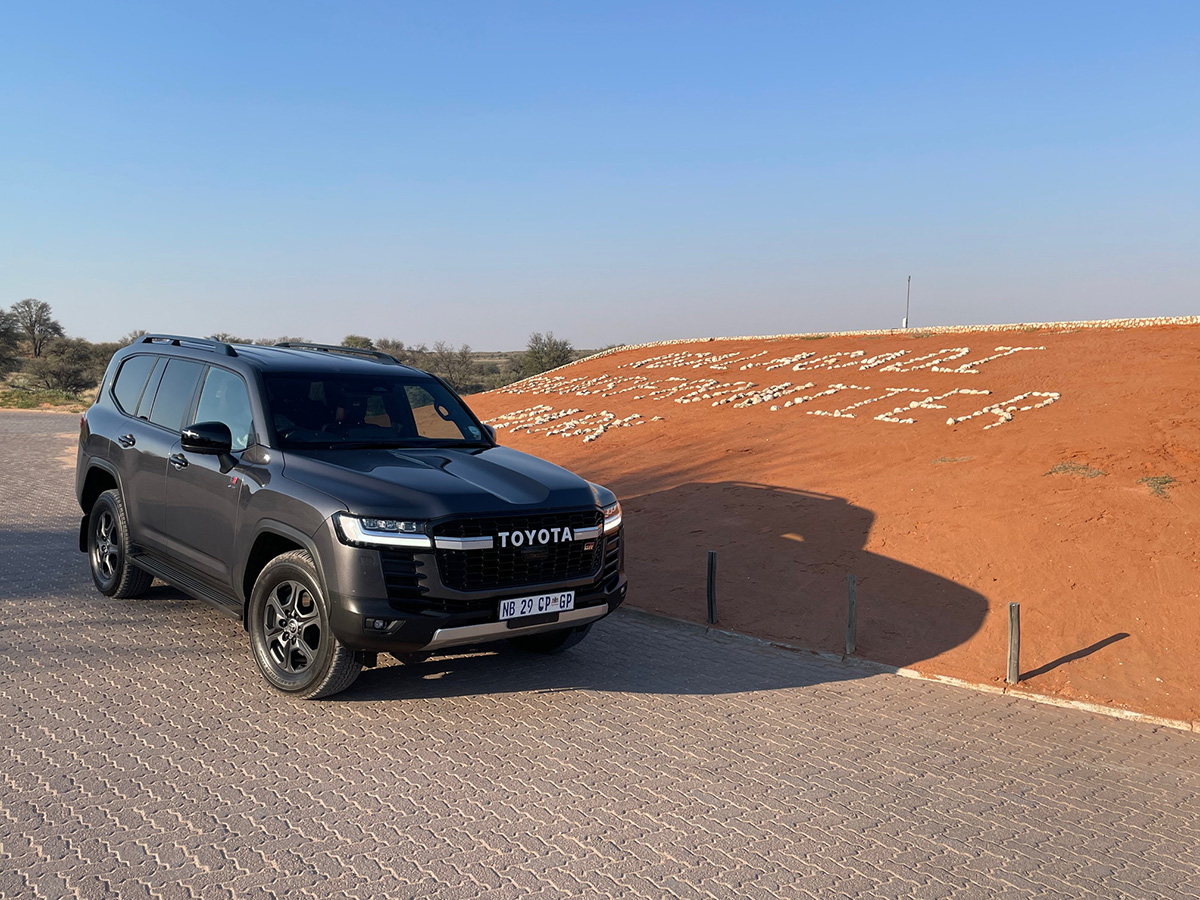
The Land Cruiser legacy started 75 years ago, in 1951. To commemorate this milestone for an iconic 4×4 vehicle with legendary status in South Africa, we took the recently introduced and powerful new Land Cruiser flagship – the 300 HEV – for a 1,600 km trip from the 95-year-old Kgalagadi Transfrontier Park to the Kruger National Park, celebrating its centennial this year.
In July 1951, when test driver Ichiro Taira drove the second iteration of Toyota’s Jeep BJ prototype up to the sixth stage of Mount Fuji, the first vehicle to reach that height, he likely didn’t realise this astounding feat would eventually lead to the establishment of a brand that would become legendary over the next 75 years.
From the iconic FJ40 to the 70-Series, the Prado and the recently released entry-level Cruiser FJ, the Toyota Land Cruiser has established itself as an indestructible, go-anywhere machine built to survive the harshest environments on Earth. Engineered for reliability under brutal conditions, it is trusted by aid organisations, remote explorers, overlanders, farmers and militaries worldwide – with sales now surpassing 10.4 million units across more than 170 countries.
So, to celebrate this amazing legacy forged over decades, it was only fitting to use the latest Land Cruiser model introduced locally, the powerful new 300 HEV in GR-S trim, for a special cross-country journey – not only to commemorate 75 years of Land Cruiser but also to celebrate 95years of the Kgalagadi Transfrontier Park, and 100 years of the Kruger National Park; both areas where Land Cruisers of all kinds and descriptions still thrive.
KGALAGADI CRUISE
A Graphite Grey Metallic 300 HEV GR-S, gleaming in the Northern Cape sun, was waiting for us when we arrived in Upington. With tastefully understated GR trimmings, conspicuous white Toyota lettering on the bold front grille and small HEV logos, this new 3.5-litre twin-turbo petrol hybrid model now joins the proven 3.3-litre diesel derivatives, and ushers in a new chapter for the flagship Cruiser.
Combining electrified performance with the durability and refinement that have made the nameplate an icon, the GR Sport HEV is now the most powerful production Land Cruiser ever. Its 3,445 cc V35A-FTS V6 engine delivers a whopping 341 kW at 5,200 rpm and 790 Nm of torque at 2,000-3,600 rpm (combined output) – a far cry from the modest 63 kW and 215 Nm produced by the Type B engine of the original BJ, interestingly also from a 3.4-litre six-cylinder petrol engine (in-line, without turbos, obviously).
Toyota’s compact i-Force Max HEV system, consisting of a single electric motor-generator sitting directly between the twin-turbo engine (the same power unit as used in the Dakar-winning Toyota GR DKR Hilux T1+) and a ten-speed automatic gearbox, and a compact 1.9 kWh lithium-ion battery, fills in low-end turbo lag and provides a sharper throttle response off the line when compared to standard models.
This was immediately evident on the straight R360 road leading towards Askham and the Twee Rivieren rest camp, where the Nossob and Auob rivers meet, in the Kgalagadi Transfrontier Park. Passing a convoy of Harley motorcycles, the surge of power from the hybrid powertrain – accompanied by beautiful V6 engine acoustics – was impressive, to say the least.
Even though big and heavy (with a 2.7-ton kerb weight, the GR-S HEV is around 160 kg heavier than the normal petrol model), the flagship Land Cruiser felt quite nimble on the road, and never sluggish (even in Eco mode) – with the bespoke gearbox seamlessly transmitting power to all four wheels, making overtaking a breeze.
Interestingly, the Kgalagadi Transfrontier Park originated exactly 20 years before the first Land Cruiser with the proclamation of the Kalahari Gemsbok National Park in July 1931 to protect the local arid ecosystem and wildlife. In 1948, the Union of South Africa and the Bechuanaland Protectorate (now Botswana) reached an informal verbal agreement to cooperate in managing the contiguous wildlife areas.
This effectively established the first trans-frontier wilderness area in southern Africa. In the early 1990s, a joint management committee was formed, leading to an approved unified management plan in 1997 to share entrance fees and coordinate tourism, and to form the Kgalagadi Transfrontier Park.
Driving in the park, straddling the border between South Africa and Botswana, the number of Land Cruisers, mostly Prados and 300s, on the sandy trails was conspicuous. After good rains, even the red Kalahari dunes were covered with foliage – and here the big Cruiser, despite its sportier GR-S trim, felt right at home.
With a plethora of off-road assistance systems and abundant power, the luxury SUV felt unflappable, whether negotiating the soft red sand or traversing rocky outcrops, and shod with sensible 18″ tyres, it displayed admirable ride comfort off-road.
TRAVERSING CRUISER COUNTRY
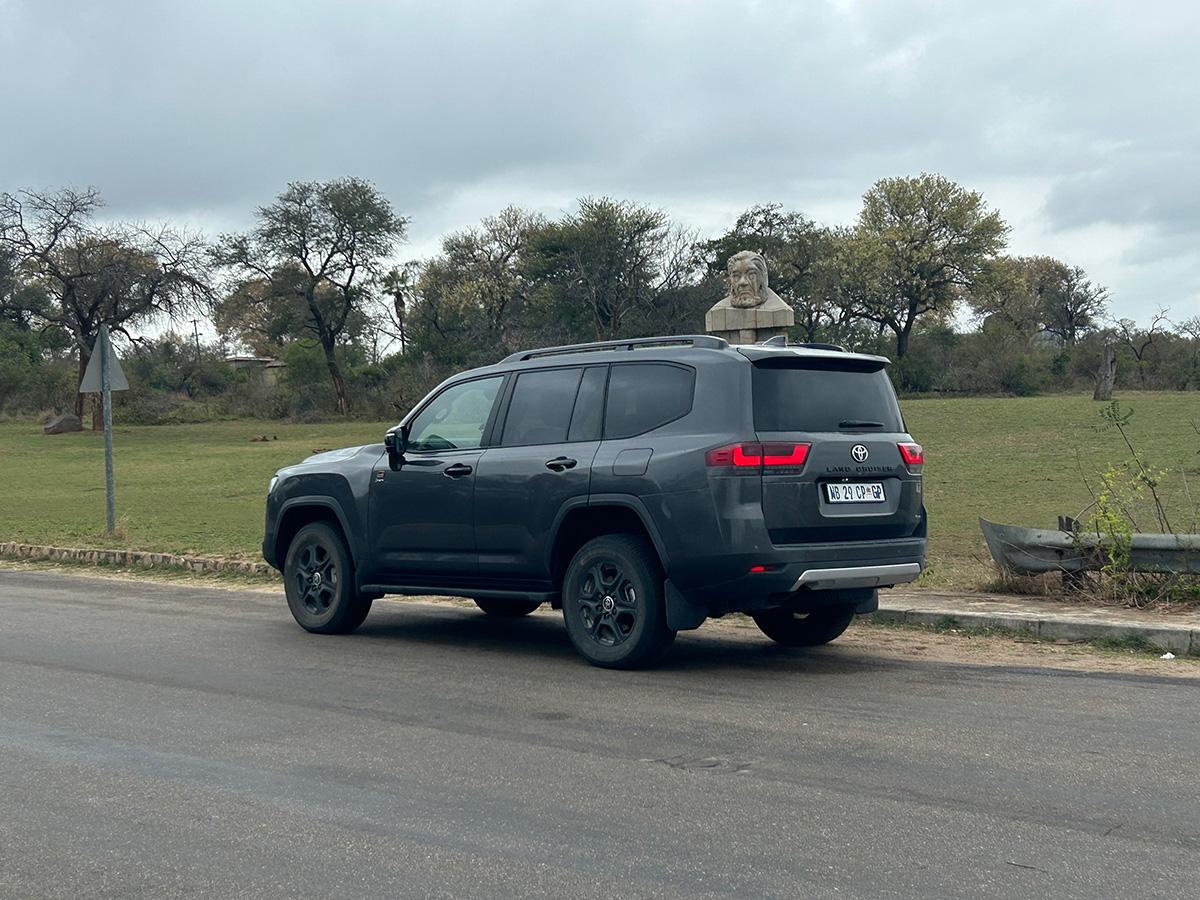
Leaving the rest camp early the next morning, we traversed the country from west to east – a 1,100 km trip – negotiating every conceivable road condition and surface on our route through four provinces leading towards the Kruger National Park in Mpumalanga.
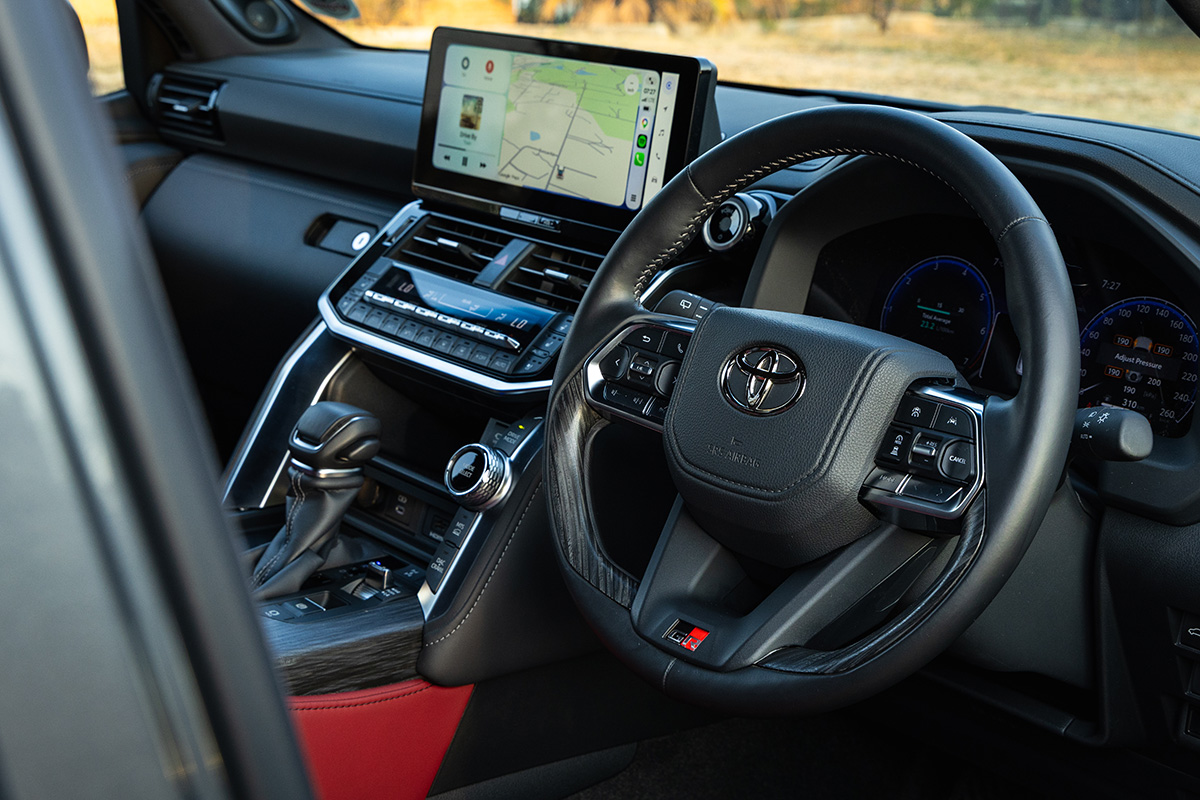
However, the premium black-and-dark-red two-tone leather-accented power-adjustable seats with embossed GR logos on the headrests, an exclusive leather-wrapped steering wheel with a GR emblem, and a roomy interior with specialised machined carbon-weave trim across the dash and centre console proved supremely comfortable.
Featuring a GR push-start button, a digital-analogue instrument cluster with a wide range of on-screen menus and HUD, a 12.3″ touchscreen infotainment display with a variety of functions and a big centrally mounted cool box, we were cosseted in ultimate luxury, with the crystal-clear sound from the 14-speaker JBL sound system keeping us company on the long road.
Travelling on the dusty white R31 dirt road over Van Zylsrus and Hotazel (not a small backwater ‘dorpie’ anymore…) towards Kuruman, we passed many 70-Series model Cruisers, used by mining companies and farmers. Clearly, this was Cruiser country.
From Kuruman, we continued on the N14 over Vryburg, Delareyville, Sannieshof, and Venterdorp before negotiating the Gauteng traffic from Krugersdorp up to Pretoria, then diverting onto the N4 towards the Highveld and Mpumalanga.
On this leg we found the assistance systems, such as lane-keeping assist, overbearing, and switched it off, while the navigation system – although better than before – still proved to be less user-friendly than the ones found in similar European and Chinese luxury SUV competitors.
DESTINATION KRUGER GATE
We made rapid progress on the N4 but even at highway speeds the hybrid Cruiser’s consumption was surprisingly low, as we averaged around 12.3 l/100 km (Toyota claims 10 l/100 km) – not bad for a 300 kW-plus behemoth – for a reach of nearly 600 km on a single tank (100 litres) of fuel.
However, after nearly 10 hours of driving and with nightfall approaching, the nav system indicated the Schoemanskloof road as the fastest route to Mbombela, not indicating three stop-and-goes en route… Even so, we made good time, the GR-S HEV in Sport setting (we found the suspension in Sport+ mode too hard) negotiating the twisty bends with aplomb.
As we neared our destination near Kruger Gate, we faced one more challenge. As the weather changed, soft rain and thick mist in the sweeping passes approaching Hazyview reduced visibility to nearly zero, and with the headlights on low (luckily one can set them), we slowly trundled through the plantations and banana groves toward the Kruger Gate turn-off.
Even in the wet and misty conditions, the Land Cruiser was supreme, and we soon reached our overnight destination. The next morning, we drove to the Kruger Gate, the main gateway to the world-renowned park that marked its official 100th anniversary on May 31 this year, celebrating a century since its proclamation under the National Parks Act in 1926.
Paul Kruger, erstwhile president of Transvaal, proclaimed the original Sabi Game Reserve in 1898 to protect depleted wildlife, and in 1902 Major James Stevenson-Hamilton became the first warden, fighting hunting and working to revive animal populations. The park was formed in 1926 by merging the Sabi and Singwitsi Game Reserves into the newly named Kruger National Park.
The park opened to tourists in 1927, with only three cars entering in that first year. It developed in the 1930s through the 1950s with basic roads, ranger stations, and core rest camps like Skukuza, Satara, and Letaba established, and expanded further in 2002 by joining the Great Limpopo Transfrontier Park.
LAST WORD
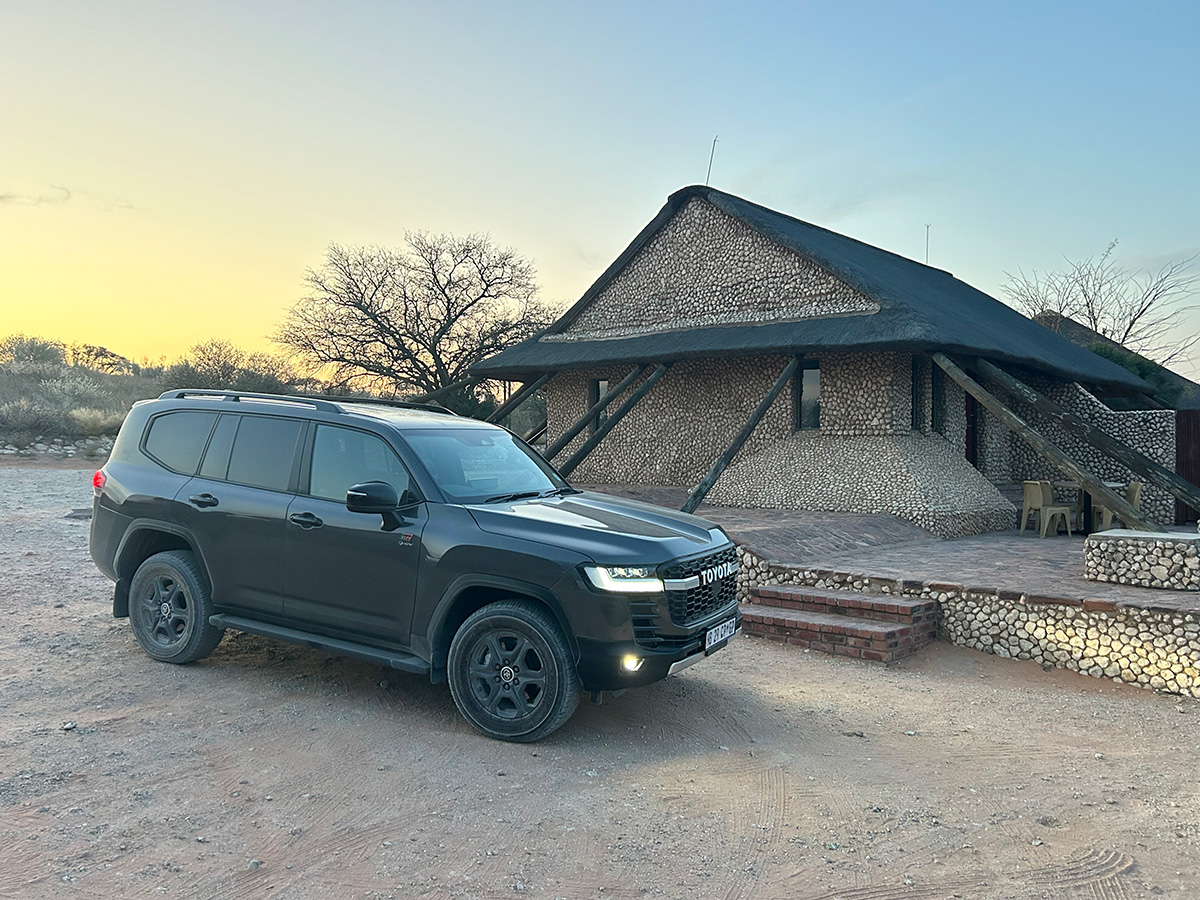
At the park entrance, we parked the Land Cruiser close to the bust of Paul Kruger overlooking the gate and the Sabie River; our mission accomplished. Even though we travelled nearly 1,300 km from Kgalagadi to get here, the trip was so comfortable and relaxed, we were fresh and ready for the return trip to Johannesburg.
Our experience again verified the 75-year-old Land Cruiser legacy, as the highly refined 300 3.5T GR-S HEV (now available at R2,343,800 including a three-year/100 000 km warranty and a nine-services/90,000 km service plan, with the HEV battery covered by an eight-year/160,000 km warranty) proved not only to be the ultimate long-distance cruiser but also a consummate all-rounder, combining legendary durability, uncompromising strength and go-anywhere capability with electrified performance. No wonder Land Cruiser 300 owners never want to get into another vehicle again.
Report by FERDI DE VOS | Images © GERHARD GROENEWALD

