



Driven had the distinct privilege of attending the 2025 Japan Mobility Show as a guest of Toyota and spent time in conversation with exterior designer Lu Yi about the highly anticipated new Toyota Land Cruiser FJ. The new model marks a fresh chapter in the Land Cruiser family for the South African market – one that carries the heritage of the “King of Africa” but channels it into a more compact and accessible expression of the Land Cruiser spirit.
In South Africa, the Land Cruiser 300 has long held the mantle of “King of Africa” thanks to its stature, capability, and reputation among those who demand the best from their off-road vehicles. The FJ does not seek to challenge or replace that icon, but rather to extend the Land Cruiser dynasty to a new audience. It is the smallest Land Cruiser in the modern lineup, conceived to embody the same sense of toughness and authenticity in a more agile, lifestyle-oriented form.
The global debut of the FJ Cruiser in Tokyo was met with a wave of excitement online, and judging by the attention it attracted at the show, South Africans are right to be equally intrigued. According to a Toyota South Africa representative, the FJ is set to reach local dealerships in the second quarter of 2026, possibly as early as May. That means the wait will be short before local fans can welcome this new addition to the Land Cruiser lineage.
CAPABILITY IS KING
One of the first questions raised when the covers came off was what lies beneath. The answer is reassuring for those who value traditional Toyota robustness. The new FJ uses a refined version of Toyota’s IMV ladder-frame platform, the same body-on-frame structure that underpins the Hilux and Fortuner. It is a proven foundation, built for durability and ease of repair, and perfectly suited to African conditions.
This decision signals that Toyota has not diluted the essence of what makes a Land Cruiser a Land Cruiser. It remains a vehicle built for resilience, with genuine off-road credentials. The shorter wheelbase and compact dimensions give it a more agile footprint, while the suspension geometry and articulation have been engineered to deliver the off-road capability South Africans expect from anything wearing the Land Cruiser badge.
When I asked Lu Yi about the development process, he revealed that the FJ’s evolution from concept to production-readiness took just three years – an exceptionally short timeframe for a project of this nature. “We worked with a clear vision from day one,” he explained. “We knew exactly what the FJ should represent. There are still a few minor details we’re refining inside and out, but the car is ready for introduction.” That sense of clarity and purpose comes through strongly in the design.

DNA THAT CONNECTS PAST AND PRESENT
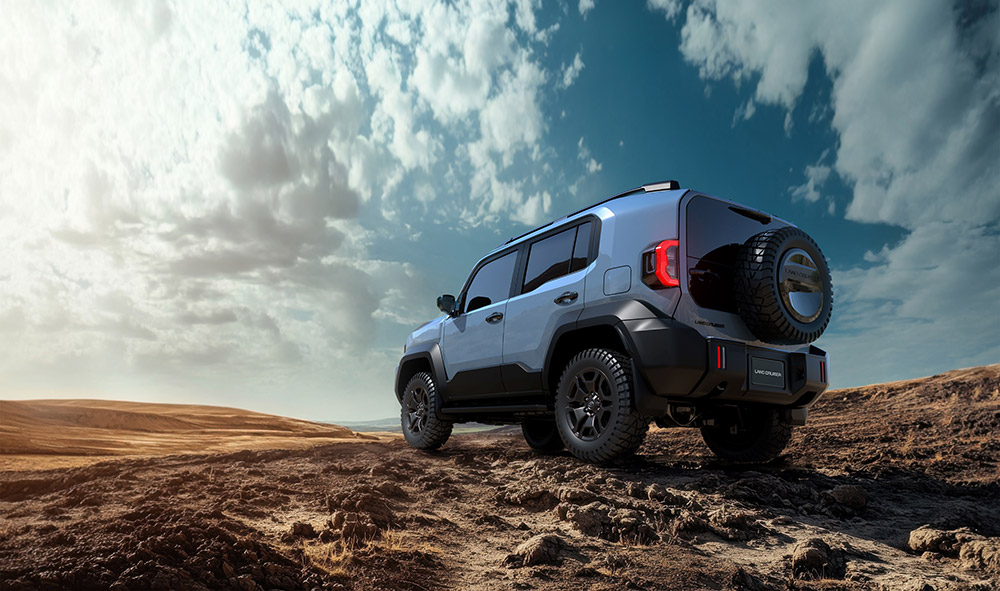
Visually, the new FJ immediately communicates its lineage. During our conversation, Lu Yi said his team’s mission was to “capture the essence of the Land Cruiser 40 Series and reinterpret it for a new generation.” This deliberate connection to the iconic Land Cruiser 40 Series is sure to evoke nostalgia and appreciation for the brand’s rich heritage among enthusiasts. His approach was to blend heritage cues with modern proportions, ensuring that the FJ feels at once familiar and forward-looking. “The FJ must speak to freedom and joy,” he added, “but it must also look unbreakable. That balance defines what we wanted to achieve.”
The resulting design is upright, bold, and unmistakably purposeful. The body sides are near-vertical, the overhangs are short, and the wheel arches are pronounced. The front end features rectangular headlights with integrated C-shaped daytime running lights, separated by a robust grille bearing the TOYOTA script rather than a badge. Chunky bumpers, visible skid plates, and an externally mounted spare wheel reinforce its go-anywhere credentials, while the roof rails and exposed hinges evoke the utilitarian confidence of earlier Land Cruiser models.
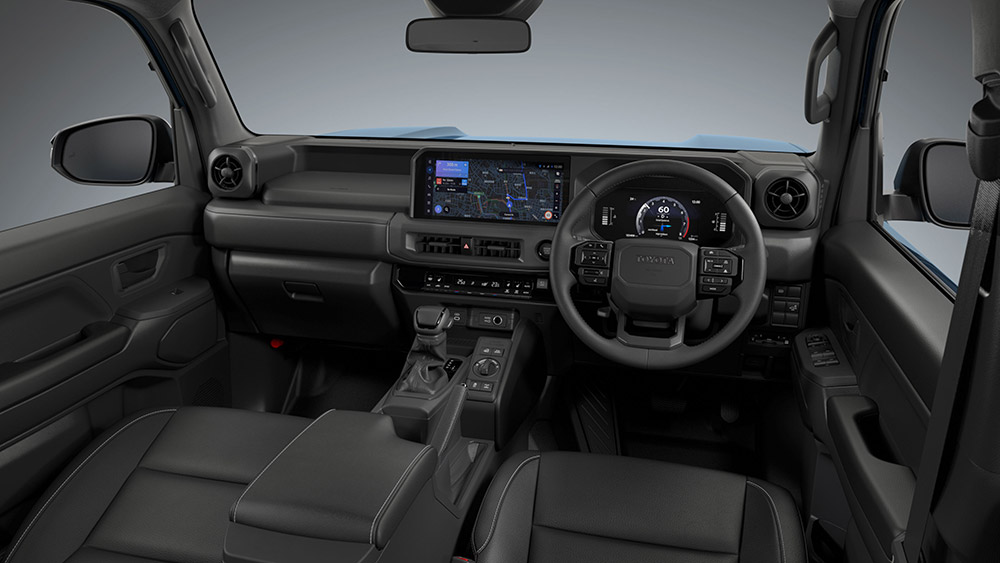
Inside, the cabin embraces functionality over frivolity. The dashboard is horizontal and straightforward, designed to give the driver a clear sense of the vehicle’s orientation when off-road. Large grab handles flank both the centre console and passenger side, while rotary controls and tactile buttons ensure usability with gloved hands. The FJ’s cabin does not pretend to be luxurious, but rather comfortable, resilient, and ready for adventure. The materials are solid, the layout practical, and the aesthetic consistent with its purpose.
This focus on usability will resonate with South Africans who expect their vehicles to feel as capable on gravel as on the asphalt. The FJ’s design achieves precisely that balance: rugged authenticity combined with an appealing, slightly retro modernity.
THE MECHANICAL HEART
Beneath the bonnet lies Toyota’s 2.7-litre naturally aspirated four-cylinder petrol engine, known internally as the 2TR-FE. It produces 120 kW and 246 Nm of torque, sent to all four wheels via a six-speed automatic transmission and a part-time four-wheel-drive system. While that represents a drop in output compared to the original FJ Cruiser’s 4.0-litre V6, the new powertrain promises significantly better efficiency and a lower cost of operation.
This may be one of the few areas where opinion will be divided. The original FJ’s V6 was beloved for its power and responsiveness, and some enthusiasts may lament its absence. Yet the new FJ’s focus on efficiency and global emissions compliance makes the four-cylinder choice understandable. It remains to be seen whether Toyota will introduce additional powertrains, but as I’ve learned over the years, Toyota has a knack for responding swiftly to market needs. A turbodiesel variant would be a logical move for South Africa, where torque and economy remain highly prized.
A LEGACY REBORN
To appreciate the new FJ’s importance, one must consider its lineage. The original FJ Cruiser, launched globally in 2006 and in South Africa in 2011, quickly gained a following for its distinctive styling and indestructible character. It was powered exclusively by a 4.0-litre V6 producing 200 kW and 380 Nm, paired with a five-speed automatic gearbox that sent power to all four wheels. Although production ended in most markets by 2014 and in Japan by 2017, it continued in the Middle East and parts of Africa until 2022.
The revival of the FJ nameplate carries emotional weight, signalling the return of a beloved character, rather than being just a new model, reinterpreted for a new era of drivers who value authenticity and design with purpose. Where the previous FJ was a bit of an outsider, the new one arrives with a far clearer brief – to offer a smaller, modern Land Cruiser that retains every ounce of credibility expected from the badge on its nose.
LOCAL IS LEKKER
The introduction of the FJ will be an important milestone for Toyota South Africa. Positioned as the smallest member of the Land Cruiser family, it broadens the brand’s reach without encroaching on other Toyota models. The Fortuner, for instance, remains aimed at the family SUV buyer, while the FJ will target individuals who lead an active lifestyle and want a Land Cruiser that reflects that identity.
South Africa’s appetite for rugged, capable vehicles remains strong, and the FJ’s combination of size, heritage, and genuine 4×4 underpinnings is a recipe for success. It promises to deliver the authenticity of the Land Cruiser brand in a more approachable form – the kind of vehicle you could take to the office during the week and into the bush over the weekend without hesitation.
Speculation about pricing is inevitable, and while Toyota South Africa has not yet disclosed any figures, indications suggest a range of R850 000 to R950 000. That would place the FJ among the upper tier of midsize SUVs but comfortably within reach of buyers who prioritise brand legacy and capability over luxury trimmings.
WHAT TO EXPECT AS WE HEAD FOR LOCAL LAUNCH
There are a few key factors that will determine the FJ’s local success. The first is the engine. South Africans have always associated Land Cruisers with abundant torque and long-haul dependability, so Toyota may face some scepticism around the smaller petrol unit. Introducing a diesel or hybrid option later could substantially broaden its appeal.
The second is specification and equipment. South African buyers are discerning, and while the FJ is intentionally simpler than the luxury-oriented SUVs in the range, Toyota must ensure that it feels well-equipped for its price point. Expect practical options such as an off-road package, roof accessories, and distinctive colour combinations that highlight its adventurous spirit.
Finally, timing will play a role. With interest already high and social media buzzing since its unveiling, Toyota South Africa will want to capitalise on the excitement and ensure early availability. If it lands as planned in the first half of 2026, it could become one of the most talked-about launches of the year.

LAST WORD
In the end, the new Toyota Land Cruiser FJ feels like precisely what the Land Cruiser family needed – a fresh, youthful addition that honours its past while appealing to a new generation of buyers. It stays true to the brand’s core values of strength, reliability, and adventure, while introducing a modern sensibility that will resonate with those who seek something authentic yet versatile.
Standing beside it in Tokyo, it was easy to sense the anticipation. The FJ’s proportions, stance, and detailing make it feel special in a way few vehicles manage today. Compact enough for daily use, tough enough for real exploration, and proudly bearing the Land Cruiser name, it looks set to find a welcoming home in South Africa.
When it arrives on our shores next year, the “King of Africa” will undoubtedly still reign supreme, but the heir apparent will have arrived – ready to inherit a kingdom built on trust, endurance, and an unbreakable bond with the land.
Report by BERNIE HELLBERG JR | Images © TOYOTA

