



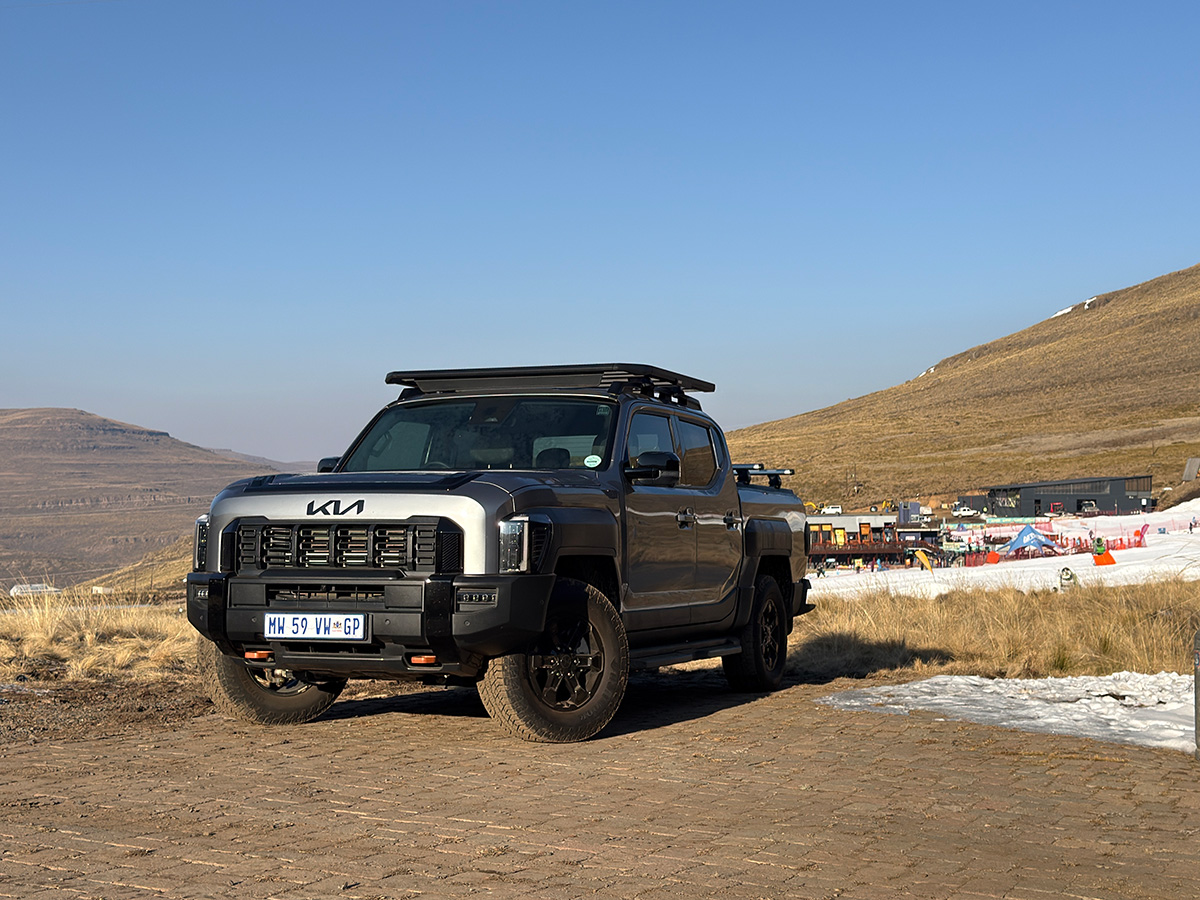
Our annual pilgrimage to Afriski in Lesotho proves that Kia’s bold new bakkie is far more than a styling statement.
Some trips become traditions before you even realise it. Last year we pointed the nose of a Lexus GX towards Lesotho’s Afriski Mountain Resort, discovering that there are few better ways to experience Southern Africa’s only ski destination than by tackling the dramatic highlands during winter. Naturally, we promised ourselves we’d be back.
This year’s pilgrimage, however, almost never happened. A series of delays and postponements threatened to derail what has quietly become something of an institution. When we finally found a suitable window in mid-August, another concern emerged. Unlike previous visits, we were travelling exceptionally late in the ski season. Had we left it too late? Would there still be enough snow to justify the journey?
Fortunately, Afriski has long anticipated exactly this predicament. While Mother Nature had delivered snowfall the week before our arrival, and would do so again shortly after we left, the resort’s sophisticated snow-making equipment ensured that the slopes remained perfectly skiable throughout our stay. It is one reason the resort, operating since 2002 atop the magnificent Mahlasela Pass, continues to attract visitors throughout the Southern Hemisphere winter, regardless of when they arrive.
This year also brought another first. Instead of staying in one of Afriski’s hotel-style rooms, we booked one of the resort’s private log cabins. Ours was an impressive five-bedroom lodge, complete with a roaring gas fireplace, generous living spaces and every modern convenience one could ask for. After spending the day on the slopes, retreating to a warm timber-clad lodge while temperatures outside plunged well below freezing added another layer of comfort to an already memorable weekend.
POINTING NORTH
It also seemed rather fitting, because our transport for the weekend was equally interesting. Finished in Steel Silver, Kia’s Tasman 2.2D X-Pro 4×4 Double Cab attracted attention long before we crossed the Lesotho border. By now, the conversation around the Tasman is well documented. Some admire its bold styling, others remain unconvinced. One thing is certain, though – people notice it. Every fuel stop, coffee break, and border crossing brought at least one curious onlooker wanting a closer look.
Unlike last year, we left significantly earlier in the morning, allowing us to reach Afriski well before sunset. Anyone who has driven the final ascent over the 3,222-metre Mahlasela Pass will appreciate why this matters. Narrow mountain roads, icy patches, roaming livestock and sheer drops make this a route best enjoyed in daylight, particularly during winter.
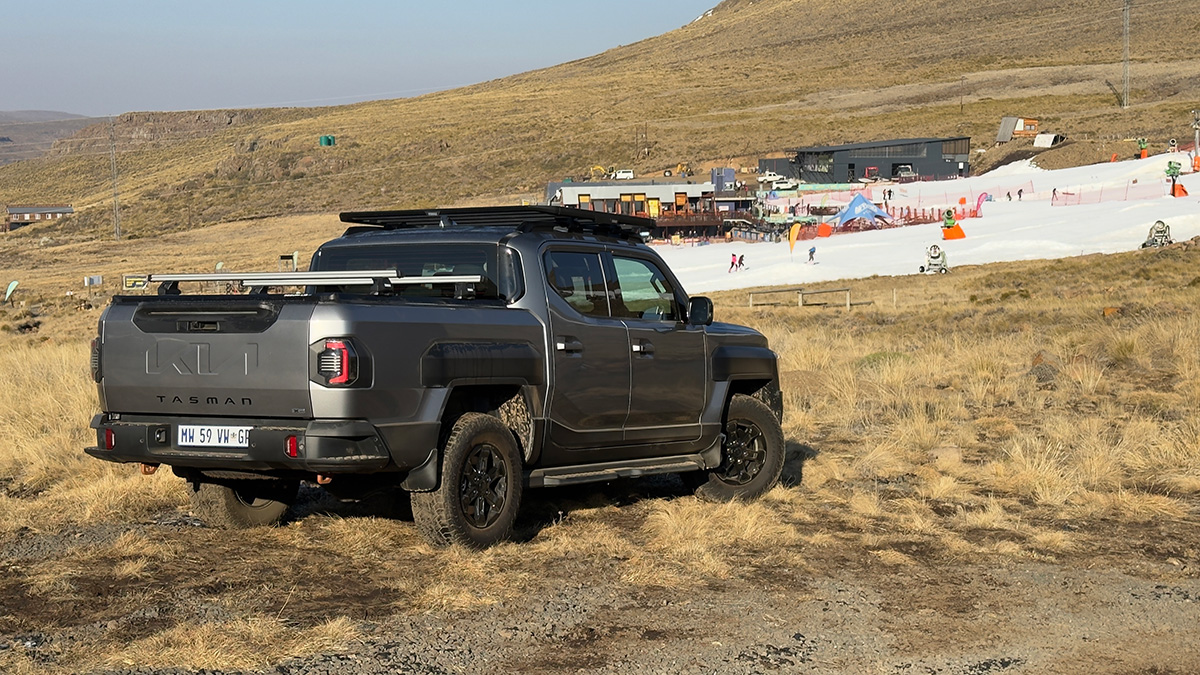
Our party consisted of four adults and enough luggage for a long weekend in the mountains. The Tasman’s load bin swallowed everything with ease, helped by the optional electric roller shutter that kept our gear secure and dry throughout the journey.
LIVING WITH THE TASMAN
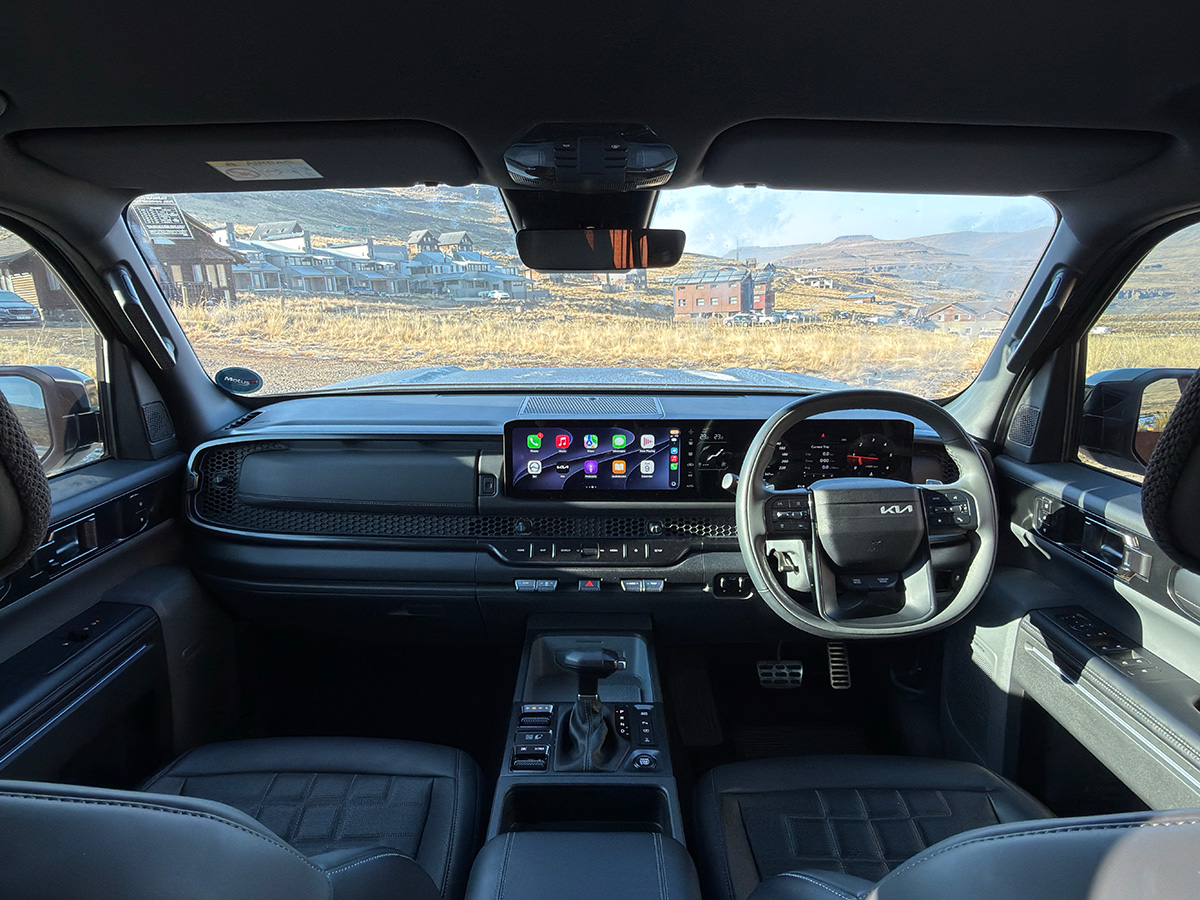
As the flagship derivative in the Tasman line-up, the X-Pro is also generously equipped. Alongside the dual 12.3″ displays, wireless Apple CarPlay and Android Auto, buyers get a Harman Kardon premium audio system, dual-zone climate control, leather upholstery, powered front seats, ambient lighting and a full suite of advanced driver assistance systems including adaptive cruise control, lane keeping assist, blind-spot monitoring and a 360-degree camera system. This specification comfortably nudges the Tasman into premium double cab territory, which is exactly where Kia intends it to compete.
Rear passengers are also reasonably well catered for. The adjustable rear seatback is a welcome feature on longer journeys, while USB-C charging ports and thoughtful storage spaces make life easier. That said, the cabin does feel a touch smaller inside than its substantial exterior dimensions suggest, particularly for those on the rear bench.
Our test vehicle also wore several accessories, including a Thule roof rack and elevated bicycle carrier mounted above the roller shutter. Useful? Absolutely. Aerodynamically efficient? Not quite. The added wind resistance introduced noticeable wind noise at highway speeds and certainly played its part in fuel consumption, which varied between 10.2 l/100 km and 11.8 l/100 km over the trip. Kia’s official claim of 7.8 l/100 km is undoubtedly possible, but probably without several sizeable accessories acting like sails.
Under the bonnet sits Kia’s familiar 2.2-litre turbodiesel engine producing 154 kW and 440 Nm, paired with an eight-speed automatic transmission. It doesn’t overwhelm with outright performance, but it suits the Tasman’s personality perfectly. It cruises effortlessly, overtakes confidently and never once felt short of breath, even as the road climbed steadily towards Lesotho’s highlands.
WHERE THE X PRO EARNS ITS BADGE
The real test, though, began once we reached Afriski. Although fresh snowfall had largely disappeared around the resort itself, winter had left plenty of muddy tracks, frozen puddles, and icy patches between our cabin, the restaurants, and the ski slopes. It was precisely the sort of mixed terrain the X-Pro was designed to handle.
Compared with the rest of the Tasman range, the X-Pro gets a dedicated off-road suspension setup, all-terrain tyres, 252 mm of ground clearance, a locking rear differential, low-range gearing, and dedicated terrain modes for snow, mud, and sand. On paper, it reads impressively. On the mountain, it simply got on with the job.
Grip was never in question, even when surfaces changed from frozen gravel to thick mud within a matter of metres. The electronics intervene subtly when required, while the four-wheel-drive system inspires confidence. There was never any unnecessary wheelspin, with the Tasman simply going where it is pointed, which is perhaps the greatest compliment one can pay a proper adventure vehicle.
NOT ONLY A WINTER PLAYGROUND
Of course, Afriski remains the star attraction. Skiing and snowboarding are what most South Africans associate with the resort, and rightly so. Equipment rental, ski lessons and well-maintained slopes make it accessible to complete beginners, while more experienced skiers have enough to keep them entertained. Snow tubing remains one of the more enjoyable diversions if you simply want to embrace your inner child.
As winter draws to a close, however, Afriski transforms into a completely different destination. The same mountains become home to hiking trails, mountain biking routes, trail running events and guided pony trekking, while fly fishing and scenic drives showcase a greener, equally spectacular side of Lesotho. It is easy to think of Afriski purely as a ski resort, but it offers plenty of reasons to return long after the snow has melted.
In many respects, that versatility mirrors the Tasman itself. Whether carrying mountain bikes, camping equipment or ski gear, it feels entirely at home as both a weekday workhorse and a weekend escape machine.
LAST WORD
The Tasman certainly played its part in making this year’s adventure to the Kingdom in the Sky memorable. Beyond the styling debate that continues to surround it lies a genuinely competent double cab with a comfortable cabin, a willing drivetrain and impressive off-road ability. It never once felt out of its depth devouring highway kilometres, climbing mountain passes or negotiating icy, muddy resort tracks.
Perhaps more importantly, it suited the spirit of the journey. Afriski has become something of an annual escape for us, and the Tasman proved itself exactly the sort of vehicle these adventures deserve. Comfortable enough for the long drive, capable enough for whatever Lesotho decided to throw at it, and distinctive enough that, even in a parking area full of serious off-road machinery, it never blended into the background.
We would like to thank Phillip Jacobs and the team from Kia Bethlehem for a warm welcome, and for ensuring the Tasman was spick and span for the remainder of our journey to Afriski.

