



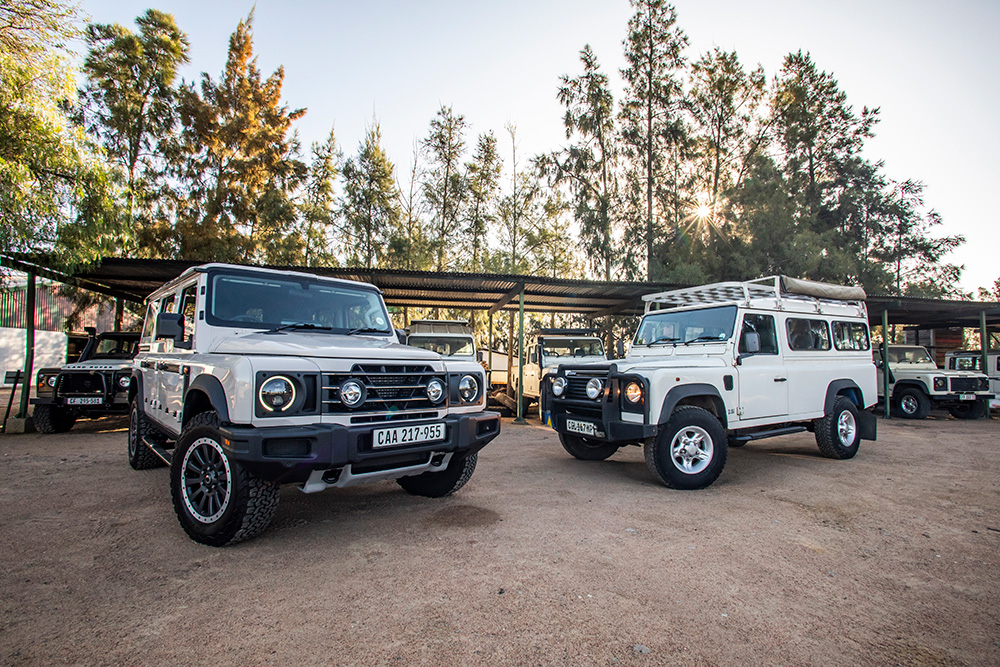
In their endeavour to build a modern Defender, the Ineos engineers chose a “Great Heart” – a choice of BMW inline-six engines – as powerplants for the Grenadier. As such, the honest and uncomplicated, yet lavishly equipped 4×4 SUV has revived the legacy of the only original BMW-powered Series Land Rover, the exclusively South African-built Defender 2.8i.
The enduring popularity of the homegrown song “Great Heart” is a tribute to the legacy of Johnny Clegg as a musician and a South African cultural icon. In much the same way, the exclusively South African-built Defender 2.8i has become a revered and highly collectable variant in the original Land Rover Series ranks.
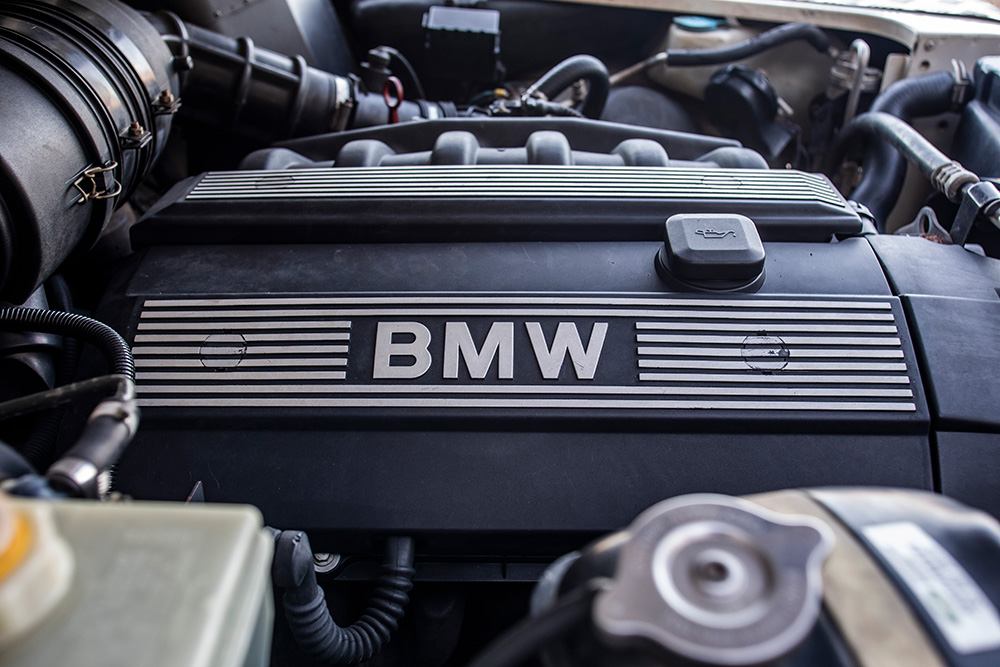
This is all due to its “great heart”, as this unicorn model was the only Defender ever powered by a BMW engine. The history of the 2.8i and its development, as a joint project between Land Rover and BMW, has been well-chronicled, so suffice to mention that the original “mule” for the Defender 90 2.8i was actually a bright green North American specification (NAS) 1995 Defender 90 soft-top model.
Development of the Defender 2.8i began in 1996, and it was phased out in 1999 after a total of 1,395 were produced at Rosslyn outside Pretoria – 656 Defender 90s and 739 Defender 110s. Interestingly, the prototypes were subjected to extensive testing, and according to contemporary reports, the 2.8i performed better than the V8 Defender in virtually every test.
In the Defender, the M52B28 inline-6, 24-valve engine delivered a meaty 142 kW at 5,300 rpm and 280 Nm of torque at 3,950 rpm. Adapted for the Land Rover with higher gear ratios, the 2.8i sprinted from zero to 100 km/h in 9.3 seconds, making it the fastest production Defender ever built.
The ‘great heart’ lineage
The normally aspirated M52 inline-six (also used in the BMW 328i, 528i, 728i, and the Z3) was on the Ward’s 10 Best Engines list from 1997 to 2000, and in the BMW engine lineage, it was followed by the M54 in 2000. The M54, in turn, was replaced by the N52 engine from 2004 (used in the E90 3 Series and E63 6-Series), and in 2007, the N53 began to replace the N52 in certain markets.
The N52 and N53 were the last naturally aspirated inline-six engines produced by BMW. It was superseded by the twin-turbocharged straight-six N54, produced until 2016, but from 2009 was replaced by the N55, BMW’s first straight-six engine to use a twin-scroll turbocharger.
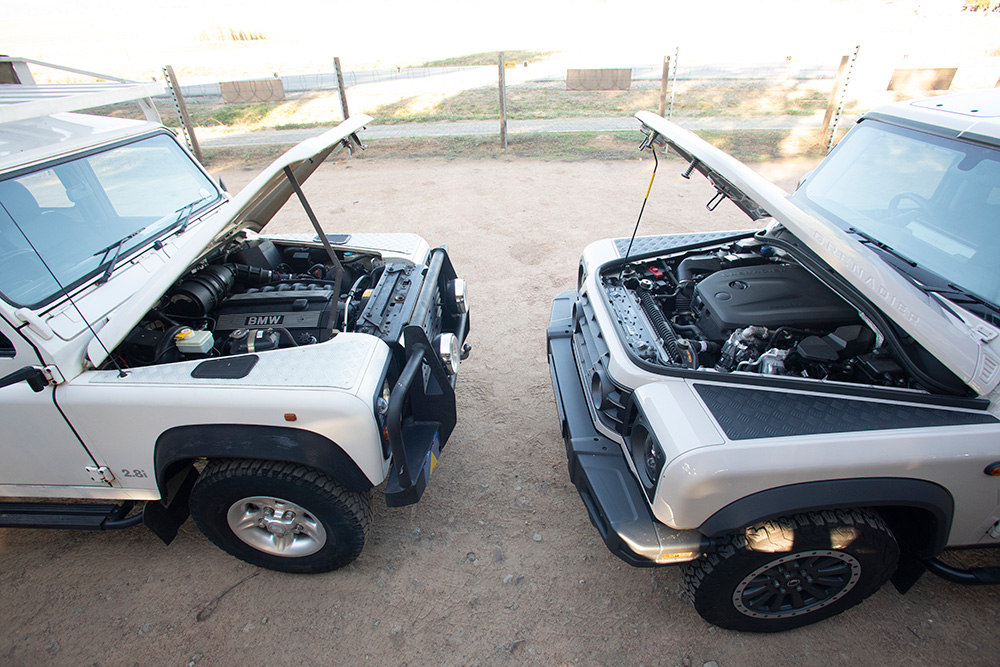
Following the introduction of the B58 engine in 2015, the N55 began to be phased out. This engine, with power delivery of up to 280 kW, was selected to Ward’s World’s 10 Best Engines four times, and is the powerplant used (in 210 kW guise) in the petrol version of the Ineos Grenadier.
Diesel Power too
Although no Defender with BMW diesel power was ever developed, there was a Range Rover model in the early 1990s, the P38 2.5 DSE, that utilised the BMW M51 inline-six turbodiesel engine introduced in the early 1990s. This engine was replaced by the M57 inline-six, which in turn was supplanted by the N57 common rail diesel with variable geometry turbochargers.
The diesel derivative of the Grenadier uses the B57 engine that replaced the N57 in 2015. This modular inline-six is available in configurations with up to four turbochargers. Still, in the Grenadier, it is used in single-turbo form with detuned specification, delivering 183 kW from 3,250 to 4,200 rpm and 550 Nm of torque from a low 1,250 rpm to 3,000 rpm.
In both petrol and diesel models, the engines are coupled to a ZF eight-speed automatic transmission with a “heavy duty” torque converter and permanent four-wheel drive (4WD), with low-range accessed through a 2.5:1 Tremec two-speed transfer case.
Interestingly, although Ineos Automotive negotiated with Daimler AG, owner of Mercedes-Benz, on the purchase of the Smart factory in Hambach, France, to build the Grenadier, the company never approached Stuttgart for an engine deal. Ineos instead chose a powertrain technology partnership with BMW, even though Munich supplies V8 engines to Jaguar Land Rover (JLR) for the Range Rover, and now also to Defender for the Octa.
Last word
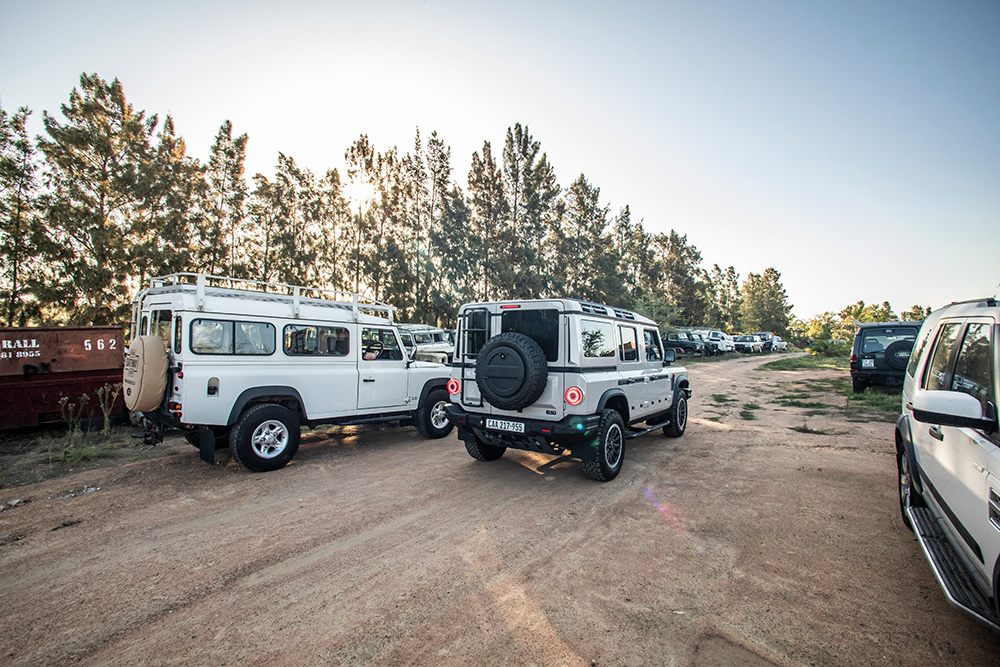
Getting to grips with the 2.8i Landy again after nearly 30 years was an interesting experience as it demonstrated how far technology has progressed over the last three decades, but also evoked some disbelief at how smooth the inline-six still performs after all these years.
The same goes for both the petrol and diesel derivatives of the Grenadier, with the added benefit of a slick automatic transmission with well-chosen gear ratios, a state-of-the-art, yet uncomplicated 4×4 drivetrain, as well as many modern in-car amenities. In this respect, the Grenadier with its BMW heart does the legacy proud. It is truly the spiritual successor to arguably the best Defender model ever.
To be continued next month with a look at the Defender 2.8i and its real successor, the new Defender Octa. Our thanks to Jacques “Nekkies” Smit from Gateway Offroad Centre near Wellington for his assistance with the Defender 110 2.8i and for permitting us to do our photoshoot on his premises.
Report by FERDI DE VOS | Images: RYAN ABBOTT

